
The Saints
About This Collection
The saints presented here are our own personal litany—holy men and women who have been especially meaningful to us in prayer and devotion.
It is not intended to be a complete directory of the saints of the Church.
Looking for someone not here? Explore more saints or for us to consider adding.
Saint of the Day
Traditional & Current
October 18, 2026
See today’s saint or observance in the 1962 Roman Calendar beside the current U.S. Roman Calendar.
Saint of the Day — Traditional & Current
October 18, 2026
The current U.S. Roman Calendar has no assigned saint today, so a saint remembered on this date in the Roman Martyrology is shown.
Sources: the 1962 calendar is identified from Missale Meum in the background; Traditional lives are from Novena Regina / Butler’s Lives of the Saints. The current U.S. calendar is identified from the Liturgical Calendar API; current saint and observance information is from Catholic Culture. When no current saint is assigned, the Roman Martyrology is used only to select a saint for the date.
No matching saints are currently in our personal litany.
Name searches only saint names. Date searches use feast dates; the year is ignored. Cause searches use the patronages and needs assigned to each saint.
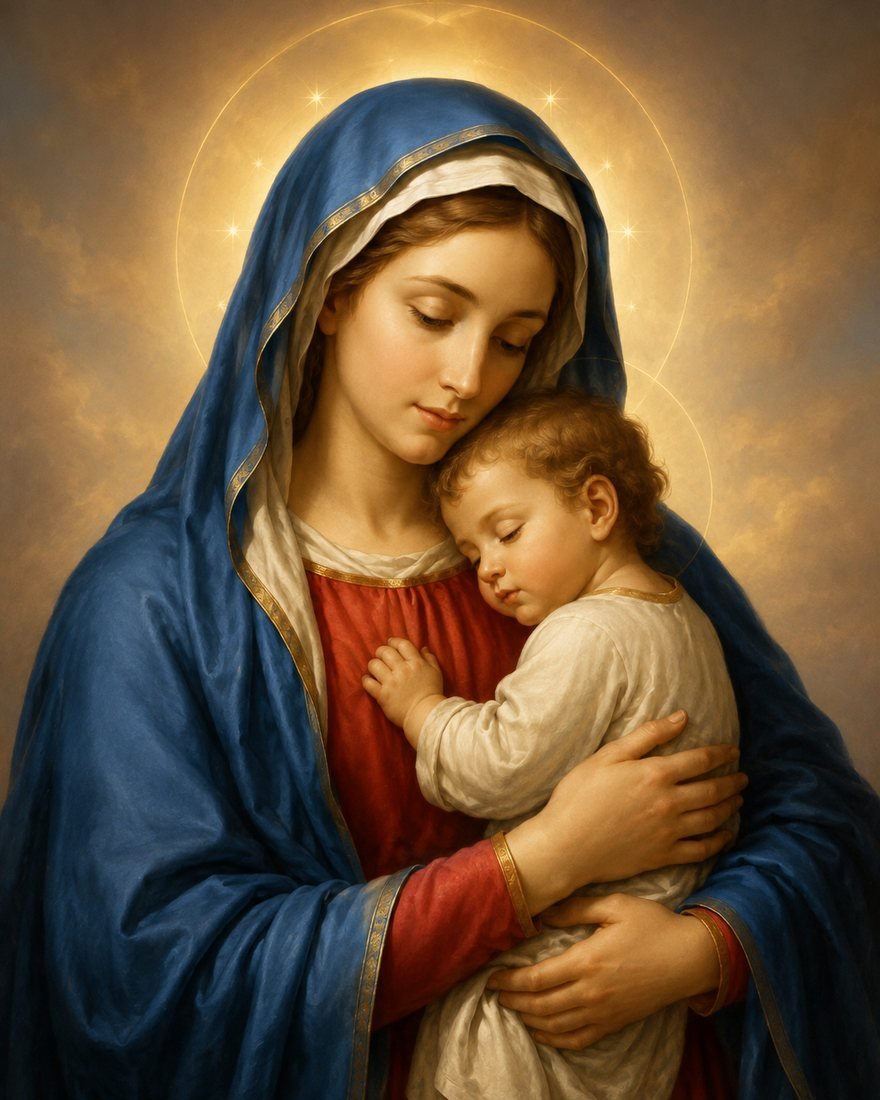
This is the approved devotional portrait already used for Mary, Mother of God on the To God Be Glory Saints page. It is devotional artwork, not a historical portrait. The popup reuses the exact existing image file without regenerating or altering it.
Mary, Mother of God
Life and Witness
Mary was a Jewish woman of first-century Galilee whose life is known principally through the New Testament. The Gospel of Luke first brings us into her life at Nazareth, where the angel Gabriel announces that she will conceive Jesus by the Holy Spirit. Her answer—“May it be done to me according to your word”—is not presented as passive resignation, but as a free and trusting gift of herself to God. Vatican II later described the qualities seen in Mary as faith, obedience, hope, and “burning charity.” Her faith is immediately joined to concern for another person: after the Annunciation, she goes “in haste” to the hill country to be with her kinswoman Elizabeth during her pregnancy. In the Magnificat, Mary rejoices in God’s mercy, his care for the lowly, and his faithfulness to his people.
Mary’s motherhood unfolds in circumstances that include both tenderness and hardship. She gives birth to Jesus at Bethlehem, receives the shepherds who come to adore him, and presents her child in the Temple. There Simeon foretells that a sword will pierce her own soul. The Gospel traditions show Mary and Joseph protecting the child entrusted to them, living the hidden years of family life at Nazareth, and later searching anxiously for the twelve-year-old Jesus when he remains in the Temple. Luke twice describes Mary as keeping these events and pondering them in her heart. These quiet details have made her, for Christians, not only a model of belief but also of prayerful attentiveness: she receives what she does not fully understand, remains faithful, and continues to entrust herself to God.
The Wedding at Cana gives one of the clearest Gospel glimpses of Mary’s care for other people. She notices the newly married couple’s need before they publicly ask for help and quietly brings it to Jesus: “They have no wine.” St. John Paul II, reflecting on this scene in Redemptoris Mater, describes it as an expression of Mary’s maternal concern for human need. Mary does not draw attention to herself or attempt to solve the problem independently. Instead, she turns the servants toward Christ: “Do whatever he tells you.” Her compassion and her intercession are therefore inseparable from her desire to lead people to her Son.
Mary’s love is also revealed through steadfast presence in suffering. John places her beside the Cross of Jesus when his Passion reaches its most painful hour. She cannot remove his suffering, yet she remains with him. From the Cross, Jesus entrusts the beloved disciple to Mary and Mary to the disciple: “Woman, behold, your son” and “Behold, your mother.” Catholic tradition sees in this scene not only a personal act of care but also a sign of Mary’s spiritual motherhood toward Christ’s disciples. Vatican II speaks of the “maternal charity” by which she cares for the brothers and sisters of her Son who still journey amid difficulties and dangers.
After the Resurrection and Ascension, Mary does not disappear from the life of the first Christians. Acts places her in Jerusalem praying with the Apostles and the other disciples as they await the Holy Spirit. Her presence there is characteristic of the pattern visible throughout the Gospel accounts: she is close to Christ, attentive to the needs of others, faithful in uncertainty, prayerful in waiting, and present to the community without making herself its center.
The Church honors Mary as Mother of God because the son she conceived and bore is Jesus Christ, one divine Person who is truly God and truly man. The title protects the Church’s faith about Christ: Mary is not the source of his divinity, but she is truly the mother of the Person who is the eternal Son of God made flesh. The Church also sees in her a model of discipleship whose greatness is expressed through humility, fidelity, contemplation, compassion, and charity. Her maternal role never competes with Christ; it is received from him and always points back to him. At the completion of her earthly life, the Church teaches that she was assumed body and soul into heavenly glory.
What Mary Is Known For
- Mother of God (Theotokos): mother of Jesus Christ, the eternal Son of God made man.
- Mother of the Church: a spiritual mother to Christ’s disciples in the order of grace; Vatican II describes her continuing care as a work of maternal charity.
- Faith, hope and “burning charity”: the Council uses these words to describe the virtues by which Mary cooperated in the work of her Son.
- Attentive care for others: seen in her journey to Elizabeth and especially at Cana, where she notices a family’s need and quietly brings it to Jesus.
- Model of faith and obedience: especially in her response at the Annunciation and her continuing fidelity when God’s plan was difficult or not fully understood.
- Maternal intercession: exemplified at Cana and understood by the Church as entirely dependent on Christ, the one Mediator, and always directed toward closer union with him.
- Prayer and contemplation: Scripture depicts her pondering God’s works in her heart and praying with the first Christian community.
- Compassion and steadfast love in suffering: she remained beside Jesus at the Cross and is especially contemplated in the devotion of Our Lady of Sorrows.
- Assumption: the Church teaches that she was taken body and soul into heavenly glory at the completion of her earthly life.
Intercession & Patronage
Mary is invoked throughout the Catholic world under hundreds of titles, so no single finite list can contain every local or devotional patronage. These are the broad intentions most directly connected with her life and the Church’s teaching about her maternal intercession:
Why Catholics Ask Mary to Intercede
The Church teaches that Mary’s intercession never competes with or replaces Jesus Christ. Vatican II states that her maternal role “in no wise obscures or diminishes” Christ’s unique mediation; rather, it depends entirely upon him and leads the faithful into closer union with him. The Catechism likewise teaches that, taken up into heaven, Mary continues her maternal intercession while all saving grace comes from Christ.
References
- Sacred Scripture — Solemnity of Mary, Mother of God (Galatians 4:4–7; Luke 2:16–21) — USCCB
- Sacred Scripture — Wedding at Cana (John 2:1–11) — USCCB
- Sacred Scripture — Mary at the Cross (John 19:25–27) — USCCB
- Sacred Scripture — Mary praying with the first Christian community (Acts 1:12–14) — USCCB
- Lumen Gentium, Chapter VIII: The Blessed Virgin Mary, Mother of God in the Mystery of Christ and the Church — Vatican II
- Catechism of the Catholic Church — Mary, Mother of Christ, Mother of the Church (nn. 963–975) — Vatican
- Munificentissimus Deus — Pope Pius XII, dogma of the Assumption
- Redemptoris Mater — St. John Paul II, On the Blessed Virgin Mary in the Life of the Pilgrim Church
- Butler’s Lives of the Saints, Volume I — “Solemnity of Mary Mother of God”
- Butler’s Lives of the Saints — Nativity of the Blessed Virgin Mary (public-domain edition)
- Magisterium AI — Lumen Gentium, Chapter VIII source document
- Magisterium AI — Catechism: Mary, Mother of Christ, Mother of the Church
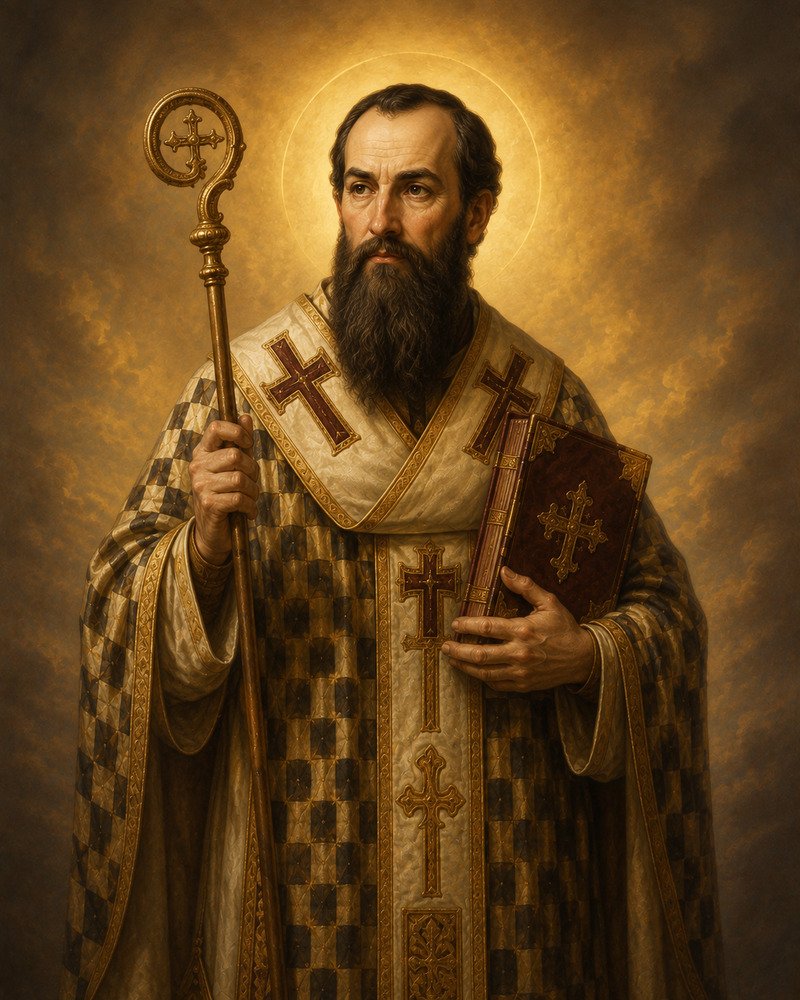
This is the existing devotional portrait already used for St. Basil the Great on the To God Be Glory Saints page. It is devotional artwork rather than a contemporary historical portrait, and this popup reuses the exact existing image file without changing it.
St. Basil the Great
Life and Witness
Basil grew up surrounded by learning, faith, and examples of costly Christian fidelity. His family had known persecution, and the faith he inherited was not merely a social identity. Even so, as a young man he pursued the finest education available, studying rhetoric and philosophy in Caesarea, Constantinople, and Athens. There he formed a deep friendship with St. Gregory Nazianzen. Basil was brilliant and ambitious enough for a successful public career, but later he looked back on those years with regret, describing his awakening to the Gospel as though he had been roused from sleep. The turning point of his life was not a rejection of learning itself, but a realization that knowledge and achievement were empty unless ordered toward Christ.
After this conversion of priorities, Basil was baptized and deliberately turned toward a life of prayer, Scripture, simplicity, and service. He traveled through Egypt, Palestine, Syria, and Mesopotamia to learn from ascetic communities, then returned to Pontus, where he helped shape a form of monastic life centered not only on prayer and self-denial but also on community, work, hospitality, obedience, and care for the needy. His sister Macrina had already embraced an ascetic life and exerted an important influence on him. Basil’s approach became foundational for Eastern Christian monasticism: solitude had value, but holiness was also tested in patience with other people, shared prayer, practical work, and love of neighbor.
Basil did not remain hidden in monastic retirement. The Church of his time was torn by conflict over the divinity of the Son and the Holy Spirit, while imperial power often favored forms of Arian theology. Basil was ordained a priest and, in 370, became Bishop of Caesarea. His episcopate was demanding and frequently painful. He preached, taught, wrote, disciplined clergy, negotiated with bishops and civil officials, worked for unity among divided Christians, and defended the Nicene faith with unusual intellectual precision. His treatise On the Holy Spirit became one of the great works helping the Church articulate the divinity of the Holy Spirit and the mystery of the Trinity.
Yet Basil’s greatness was not limited to theological argument. His writings and actions show an intense concern for people who were poor, hungry, sick, displaced, or socially unwanted. During severe hardship and famine in Cappadocia, he preached forcefully against hoarding and indifference, insisting that wealth carried responsibility toward those in need. As bishop he organized concrete relief rather than leaving charity at the level of words. Near Caesarea he established what came to be known as the Basiliad, a large complex serving the poor and sick, with lodging, medical care, and other forms of assistance. Pope Benedict XVI described it as a “city” of mercy and connected it with the development of hospital care; Pope Leo XIV has likewise highlighted it as an example of prayer and service becoming one expression of love for Christ.
This care reveals an important side of Basil’s personality. He could be stern in controversy and uncompromising when he believed the faith or the vulnerable were at stake, but his severity was not coldness. He wanted Christian belief to become visible as mercy. For him, the person praying in church and the person lying sick or hungry could not be separated. His monastic teaching joined contemplation to work for weaker brothers and sisters, and his preaching repeatedly pressed the prosperous to recognize the poor as neighbors whose dignity created a real claim upon Christian love.
Basil was also known for remarkable courage under political pressure. St. Gregory Nazianzen, his close friend and near-contemporary, recounts a confrontation between Basil and the imperial prefect Modestus during the reign of the Arian-sympathizing emperor Valens. Threats of confiscation, exile, torture, and death did not move him. Gregory’s account presents Basil as calm rather than theatrical: possessions meant little to him, the whole earth belonged to God, physical suffering was already familiar to his frail body, and death could not frighten a man whose hope was in God. Whether read as a remembered conversation or as Gregory’s carefully shaped portrait of his friend, the episode captures the quality for which Basil was widely respected—firmness without servility when conscience was at stake.
His friendship with Gregory Nazianzen also shows a gentler dimension of his life. Their relationship included affection, common study, shared ideals, disagreement, and periods of strain, but Gregory’s funeral oration leaves no doubt about the depth of his admiration and love. Basil’s life was filled with similar tensions: contemplation and administration, scholarship and practical mercy, firmness and pastoral care, solitude and responsibility for a vast Church. He did not resolve those tensions by choosing one side. His holiness was expressed in holding them together.
Basil’s liturgical influence likewise endured. A major Eucharistic prayer and the Divine Liturgy of St. Basil bear his name and preserve the theological and prayerful world associated with his ministry. Pope Benedict XVI also called him a wise liturgical reformer who helped his people learn and love the Psalms. Basil therefore became not merely a defender of doctrine but a teacher of how Christian truth should be prayed, sung, lived, and translated into charity.
Years of work, conflict, fasting, and chronic poor health wore him down. Basil died on January 1, 379, at about fifty years of age. The Catholic Encyclopedia records that his death was mourned far beyond his own congregation, with Christians and non-Christians alike honoring him. His influence continued through his theological writings, monastic teaching, liturgical tradition, and enduring vision that love of God must become concrete love of neighbor.
What St. Basil Is Known For
- Defending the Nicene faith: he was one of the great fourth-century bishops who resisted Arian teaching and helped clarify orthodox Trinitarian language.
- Teaching on the Holy Spirit: his On the Holy Spirit is a major patristic work defending the Spirit’s divine dignity and place in Trinitarian faith.
- Father of Eastern communal monasticism: his ascetical rules shaped monastic communities around prayer, obedience, common life, work, and charity.
- Care for the poor and sick: his preaching against selfish use of wealth was matched by organized relief and the Basiliad.
- The Basiliad: an extensive charitable complex near Caesarea that served the poor, travelers, and the sick and became a landmark in Christian institutional care.
- Liturgical prayer: the Divine Liturgy of St. Basil and a great Eucharistic prayer associated with him remain central in Byzantine Christian worship.
- Scripture and preaching: his homilies, including the Hexaemeron, show his commitment to explaining Scripture and forming Christian moral life.
- Courage before political power: Gregory Nazianzen’s account of Basil before the prefect Modestus became a classic portrait of episcopal courage and freedom of conscience.
- Christian unity: he labored intensely to heal divisions among bishops and churches while remaining firm about doctrine.
Intercession & Patronage
Patronage lists vary somewhat among Catholic and Eastern Christian sources. The following are the principal traditional or widely repeated associations connected with St. Basil, together with the historical reason for each when that reason can be documented:
Why Catholics Ask St. Basil to Intercede
Catholics ask St. Basil’s intercession not because he replaces Christ, but because his life gives a concrete example of Christian fidelity under pressure. Someone responsible for a hospital or charitable institution can look to the bishop who turned concern for the sick into organized care. A monk or religious community can look to the teacher who joined prayer with common life and service. A student, teacher, theologian, or pastor can ask the prayers of a saint who placed extraordinary learning at the service of the Gospel. Those facing intimidation can remember a bishop whose courage came from having already surrendered possessions, status, and even life itself to God.
References
- Pope Benedict XVI — General Audience: Saint Basil (1), 4 July 2007
- Pope Benedict XVI — General Audience: Saint Basil (2), 1 August 2007
- Pope Leo XIV — Dilexi te, nn. 53–54: St. Basil, monastic charity and the Basiliad
- Catholic Encyclopedia — St. Basil the Great (New Advent)
- St. Gregory Nazianzen — Funeral Oration on St. Basil, Oration 43 (New Advent)
- Butler’s Lives of the Saints — St. Basil the Great (public-domain edition)
- Greek Orthodox Archdiocese of America — Divine Liturgy of Saint Basil the Great
- Magisterium AI — St. Basil the Great, De Spiritu Sancto (On the Holy Spirit)
- Magisterium AI — Letter 188, St. Basil the Great
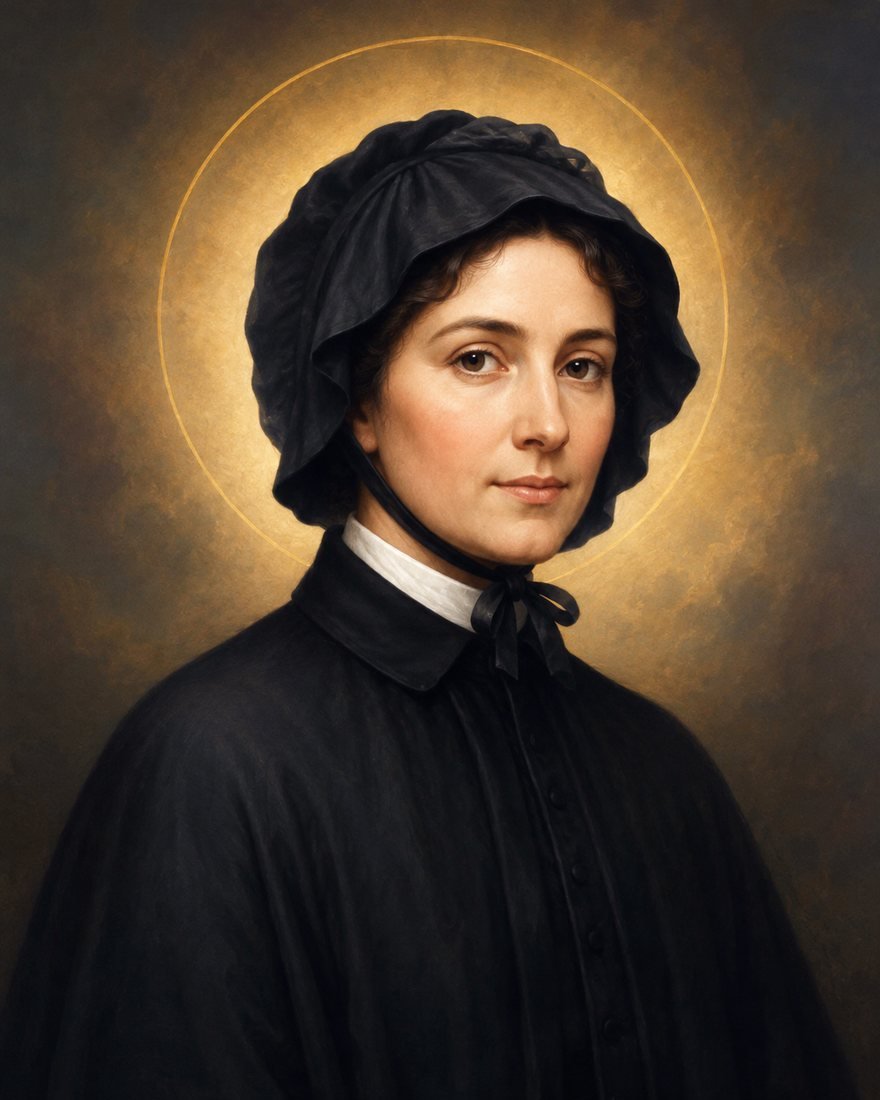
This is the approved devotional portrait already used for St. Elizabeth Ann Seton on the To God Be Glory Saints page. It is devotional artwork rather than a verified portrait from life. The popup reuses the exact existing image file without regenerating or altering it.
St. Elizabeth Ann Seton
Life and Witness
Elizabeth Ann Bayley was born into a prominent New York family, but loss entered her life very early. Her mother died when Elizabeth was only three, and her childhood included periods of loneliness and separation within a complicated stepfamily. Those experiences did not close her heart. As a young woman she developed a reflective interior life, loved Scripture, nature, music, and prayer, and showed an unusual attentiveness to people who were sick, poor, or alone. The National Shrine’s biography records that she and her beloved sister-in-law Rebecca nursed sick and dying relatives and neighbors. Elizabeth also helped found the Society for the Relief of Poor Widows with Small Children in 1797 and served as its treasurer. Long before she became Catholic or founded a religious community, charity was already becoming a habit of her life.
At nineteen Elizabeth married William Magee Seton, a New York merchant. Their marriage was affectionate, lively, and blessed with five children. Yet prosperity did not last. After William’s father died, the young couple assumed heavy family responsibilities; William’s business collapsed, the family lost its home and possessions, and his tuberculosis steadily worsened. Elizabeth tried to help with the company accounts while caring for children and extended family. In 1803 she sailed with William and their oldest daughter to Italy in the hope that a warmer climate might restore his health. Instead, the family was quarantined near Livorno because authorities feared yellow fever arriving from New York. William survived the quarantine but died in Pisa on December 27, 1803. At twenty-nine, Elizabeth was a widow responsible for five young children.
The months in Italy changed the direction of her spiritual life. The Catholic Filicchi family received Elizabeth and her daughter with extraordinary kindness after William’s death. Through their friendship she encountered Catholic worship at close range and became especially drawn to belief in the Real Presence of Christ in the Eucharist. Her conversion was not easy or impulsive. Returning to New York, she wrestled with fear, loyalty to the Episcopalian tradition that had nourished her childhood faith, concern for her children, and the opposition of relatives and friends. She nevertheless became convinced that entering the Catholic Church was the path God was asking her to follow. She made her profession of faith in March 1805 and received her First Holy Communion soon afterward. Pope Paul VI later praised both the courage of this decision and the fact that Elizabeth retained gratitude and affection for the Christians from whom her conversion had painfully separated her.
Conversion did not make life easier. Elizabeth was a financially strained widow in an environment where anti-Catholic prejudice could cost her friendships and employment. Attempts to support her family through teaching repeatedly failed. The National Shrine’s detailed biography emphasizes that during these uncertain years she continued to regard her five children as her first responsibility. When an opportunity eventually came from the Sulpician priests in Baltimore, the plan was shaped so that her children could remain part of her life rather than being set aside for a religious project.
Elizabeth moved to Maryland in 1808 and then to Emmitsburg in 1809. There a small group of women gathered around her, and the Sisters of Charity of St. Joseph’s took shape in the Vincentian spirit of St. Vincent de Paul and St. Louise de Marillac. Elizabeth opened St. Joseph’s Free School in 1810 for girls who could not afford tuition, followed by an academy whose paying students helped support the charitable work. These beginnings became a seed of the Catholic school system in the United States. The community also served orphans, poor families, the sick, and institutions in Philadelphia and New York.
Her years in Emmitsburg were not serene because suffering disappeared; they were serene because she learned to carry suffering in faith. Elizabeth buried two of her own daughters, Annina and Rebecca, as well as sisters in her religious community and other people she loved. The Shrine’s biography describes Scripture, especially Psalm 23, and the Eucharist as sources of consolation that helped her live through repeated grief without becoming hardened. Her charity remained intensely personal: she was remembered as a devoted mother to her children and as a spiritual mother who tried to meet weakness with compassion rather than harshness. Pope Paul VI summarized her spiritual inheritance as strong faith and pure love for God and for others, nourished by the Eucharist and the Word of God.
Elizabeth died at Emmitsburg on January 4, 1821. Her final years had been marked by tuberculosis, but the work she began continued to grow. Religious communities descending from the Emmitsburg foundation carried education, healthcare, orphan care, and service to the poor across North America. When Pope Paul VI canonized her on September 14, 1975, she became the first person born in what became the United States to be canonized by the Catholic Church. The Church did not hold her up simply because she founded institutions. Her holiness was lived through ordinary human roles—daughter, wife, mother, widow, friend, convert, teacher, religious sister—and through the decision, repeated in each role, to seek God and to love the person placed before her.
What St. Elizabeth Ann Seton Is Known For
- The first native-born U.S. citizen to be canonized: Pope Paul VI canonized her in 1975.
- Catholic education in the United States: St. Joseph’s Free School and Academy at Emmitsburg became foundational models for Catholic education and the later parochial-school movement.
- The Sisters of Charity: she founded the first native community of religious women in the United States, shaped by the spirituality of St. Vincent de Paul and St. Louise de Marillac.
- Love of the Eucharist and Scripture: her conversion and spiritual life were deeply marked by longing for Christ in the Eucharist and by daily nourishment from the Word of God.
- Charity toward widows, children, orphans, and the poor: her service began before her conversion and matured into schools, orphan care, social ministry, and the mission of her religious community.
- Faith through grief and change: she lived through childhood loss, financial ruin, widowhood, religious rejection, the deaths of children and friends, and serious illness without allowing suffering to extinguish her tenderness toward others.
Intercession & Patronage
Patronage lists can differ among Catholic sources. The associations below are the principal documented or widely repeated intentions connected with St. Elizabeth Ann Seton, with the reason for each association made explicit:
Why Catholics Ask St. Elizabeth Ann Seton to Intercede
People often turn to Elizabeth because so much of her holiness was formed inside situations that remain recognizable: marriage, parenting, widowhood, money trouble, loneliness, religious uncertainty, rejection, grief, work, education, and care for people who depend on us. Her life gives particular companionship to those who are trying to remain loving while circumstances are changing around them. She did not escape sorrow; she learned to bring sorrow into prayer and then allow prayer to become service. For Catholics seeking her intercession, that makes her not only a founder from American history but a spiritual mother who understood how faith can be lived in the middle of ordinary responsibilities and deep personal loss.
References
- Canonization of Elizabeth Ann Seton — Homily of Pope Paul VI, September 14, 1975 — Vatican
- Elizabeth Ann Bayley Seton (1774–1821) — Pope Paul VI canonization homily in Magisterium AI
- Proper of Saints — liturgical prayer for St. Elizabeth Ann Seton in Magisterium AI
- Full Biography of St. Elizabeth Ann Seton — National Shrine of Saint Elizabeth Ann Seton
- The Life of Saint Elizabeth Ann Seton — National Shrine of Saint Elizabeth Ann Seton
- St. Elizabeth Ann Seton — U.S. Saints and Blesseds — USCCB
- Elizabeth Ann Seton — USCCB biographical profile and patronages
- A Novena to Three American Saints for Life — St. Elizabeth Ann Seton — USCCB
- Saint Elizabeth Ann Seton — Prayer Requests and the roles of wife, mother, widow, sole parent, and convert — Seton Shrine
- Saint Elizabeth Ann Seton as Patroness of the Sea Services — Seton Shrine
- Butler’s Lives of the Saints: Concise, Modernized Edition — Bernard Bangley adaptation
View Pope Paul VI’s St. Elizabeth Ann Seton canonization homily in Magisterium AI →
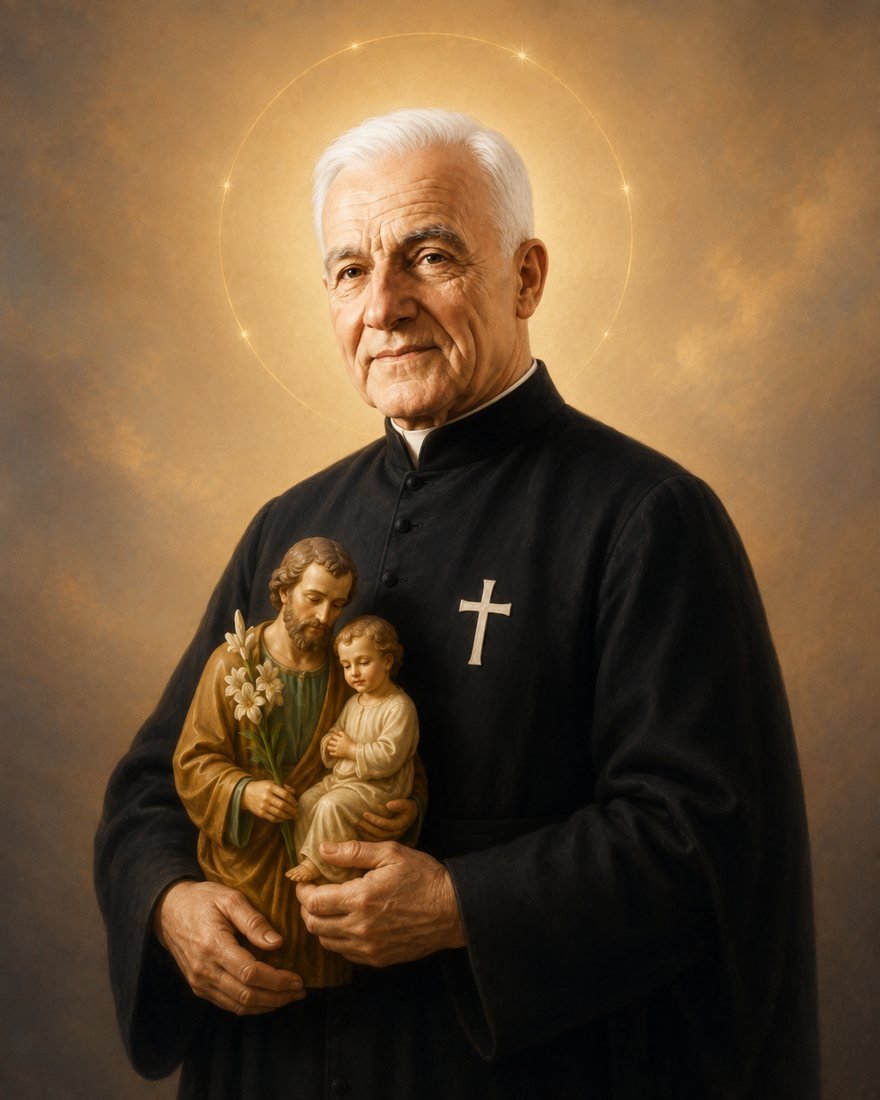
This is the approved devotional portrait already used for St. André Bessette on the To God Be Glory Saints page. The popup reuses the exact existing image file without regenerating or altering it.
St. André Bessette
Life and Witness
Alfred Bessette entered the world physically fragile. He was born on August 9, 1845 in rural Québec and was baptized the next day because his weakness caused concern for his survival. Hardship followed him through childhood. His father Isaac died in 1855 after being crushed by a falling tree, and his mother Clothilde died in 1857. Alfred was twelve years old and an orphan. With little schooling and a body that was not suited to heavy labor, he moved among relatives and tried a succession of jobs—farm work, trades, factories, and textile mills in New England. What looked like a life with very few advantages gradually formed in him a profound sympathy for people who were weak, poor, sick, or overlooked.
After returning to Québec, Alfred came under the guidance of Father André Provençal of Saint-Césaire. The priest recognized in the uneducated laborer a serious interior life and encouraged him toward the Congregation of Holy Cross. Alfred entered the novitiate in Montréal in December 1870 and took the name Brother André in honor of Father Provençal. His health and lack of education initially made his future uncertain, but he was eventually accepted and made final vows in 1874. The work given to him was ordinary: doorkeeper, infirmarian, lamp tender, messenger, gardener, barber, laundry helper, and general factotum at Collège Notre-Dame. He would spend nearly forty years connected to that doorway.
The doorway became his ministry. People arriving at the college found a small, quiet religious brother who listened closely to their troubles. The sick increasingly sought him out. Brother André prayed with them and urged confidence in St. Joseph, to whom he had been deeply devoted since youth. He sometimes recommended oil from a lamp burning before St. Joseph, but the Oratory today explicitly teaches that this oil was never meant as a magical remedy. André consistently directed attention away from himself. When people credited him with cures, he pointed them toward God and the intercession of St. Joseph.
Reports of healing multiplied, along with complaints and controversy. Crowds came in numbers that disrupted the school, so André sometimes received sick visitors at a nearby trolley station and eventually at the small chapel across the road. What is most securely documented is not that every reported cure can be historically verified, but that André gave enormous amounts of his life to people who were frightened, ill, grieving, or desperate. Pope Benedict XVI, at his canonization, described him as showing “boundless charity” and striving to relieve the distress of those who confided in him. Holy Cross accounts remember that he listened to people during the day and prayed for them deep into the night. Even those who were not physically cured often left feeling heard, consoled, and encouraged to return to prayer and the sacraments.
André’s devotion to St. Joseph also gave physical form to a dream. He wanted a place of prayer on Mount Royal. The Congregation acquired land across from the college, and in 1904 a very modest chapel dedicated to St. Joseph was blessed. Brother André helped raise money in humble ways, including small sums from cutting hair, and became the chapel’s caretaker. As pilgrims increased, the little shrine expanded. In 1909 he left his porter’s assignment and devoted himself full-time to receiving the people who came to what would become Saint Joseph’s Oratory of Mount Royal.
His gentleness did not mean that he promised an easy life. André himself had known poverty, orphanhood, physical weakness, exhausting work, misunderstanding, and decades of contact with human suffering. He taught people not merely to demand that suffering disappear but to ask for grace, courage, conversion, and trust in God within it. That balance is important to understanding him. Healing was never presented as a personal power he possessed; his ministry was one of prayer, hospitality, confidence in Providence, and persistent insistence that St. Joseph lead people to Jesus Christ.
Brother André died on January 6, 1937 at the age of ninety-one. For days enormous crowds filed past his coffin; contemporary estimates placed the number near one million. The Oratory he had begun as a small chapel continued toward completion and became one of the world’s great shrines dedicated to St. Joseph. St. John Paul II beatified André in 1982, and Pope Benedict XVI canonized him on October 17, 2010. His life remains striking precisely because the Church found extraordinary holiness in a man whose official jobs seemed so small. He opened doors, listened, prayed, welcomed suffering people, and repeatedly pointed beyond himself.
What St. André Bessette Is Known For
- Devotion to St. Joseph: André made confidence in St. Joseph the center of his apostolate and founded the shrine that became Saint Joseph’s Oratory of Mount Royal.
- Care for the sick and suffering: thousands came to him for prayer, consolation, and hope; numerous healings and conversions were attributed to his ministry and intercession.
- Hospitality and listening: his work as a porter became a spiritual ministry in which people who felt ignored or desperate found someone willing to receive them.
- Humility: he repeatedly denied that healing power belonged to him and redirected praise toward God and St. Joseph.
- Prayer: witnesses and Holy Cross tradition emphasize the intense inner life behind his public ministry, including prayer for people long after their brief encounters with him had ended.
- Perseverance in weakness: poor health, little formal education, poverty, and humble assignments did not prevent him from becoming one of Canada’s most beloved saints.
Intercession & Patronage
St. André has one particularly clear formal patronage and several strong devotional associations rooted directly in his life and ministry:
Why Catholics Ask St. André Bessette to Intercede
André is especially approachable to people who feel small beside a problem they cannot solve. His own life contained little of what the world normally associates with influence: he was poor, orphaned, frequently ill, barely educated, and assigned to answer a door. Yet he made himself available to God and to other people with remarkable consistency. Someone caring for a sick spouse or parent can ask the prayers of a saint who spent his life receiving suffering people. Someone discouraged by chronic illness can turn to a man who never needed perfect health before he could love and serve. Someone who feels unnoticed can remember that a porter became a saint not by escaping humble work but by filling it with prayer and charity.
References
- Canonization Homily — Pope Benedict XVI on St. André Bessette, October 17, 2010 — Vatican
- Saint Brother André — spirituality, ministry, healings, and Patron Saint of Family Caregivers — Saint Joseph’s Oratory
- Encountering Saint Brother André — detailed life timeline — Saint Joseph’s Oratory
- Canonization of Saint Brother André — Saint Joseph’s Oratory
- Saint André Bessette, C.S.C. — Congregation of Holy Cross
- Saint André Bessette: A Life of Prayer and Hospitality — Congregation of Holy Cross
- The St. Joseph Oratory and St. André Bessette — Congregation of Holy Cross
- Present in the World Today — Saint Brother André’s continuing mission of hope — Saint Joseph’s Oratory
- Walking beside Brother André — prayer and spirituality leaflet — Saint Joseph’s Oratory
- Biographies on Brother André — archival and documentary background — Saint Joseph’s Oratory
- Proper of Saints — Roman Missal prayer for St. André Bessette in Magisterium AI
- Magisterium AI corpus changelog — includes St. John Paul II’s Prayer before the tomb of Brother André Bessette
View the Roman Missal prayer for St. André Bessette in Magisterium AI →
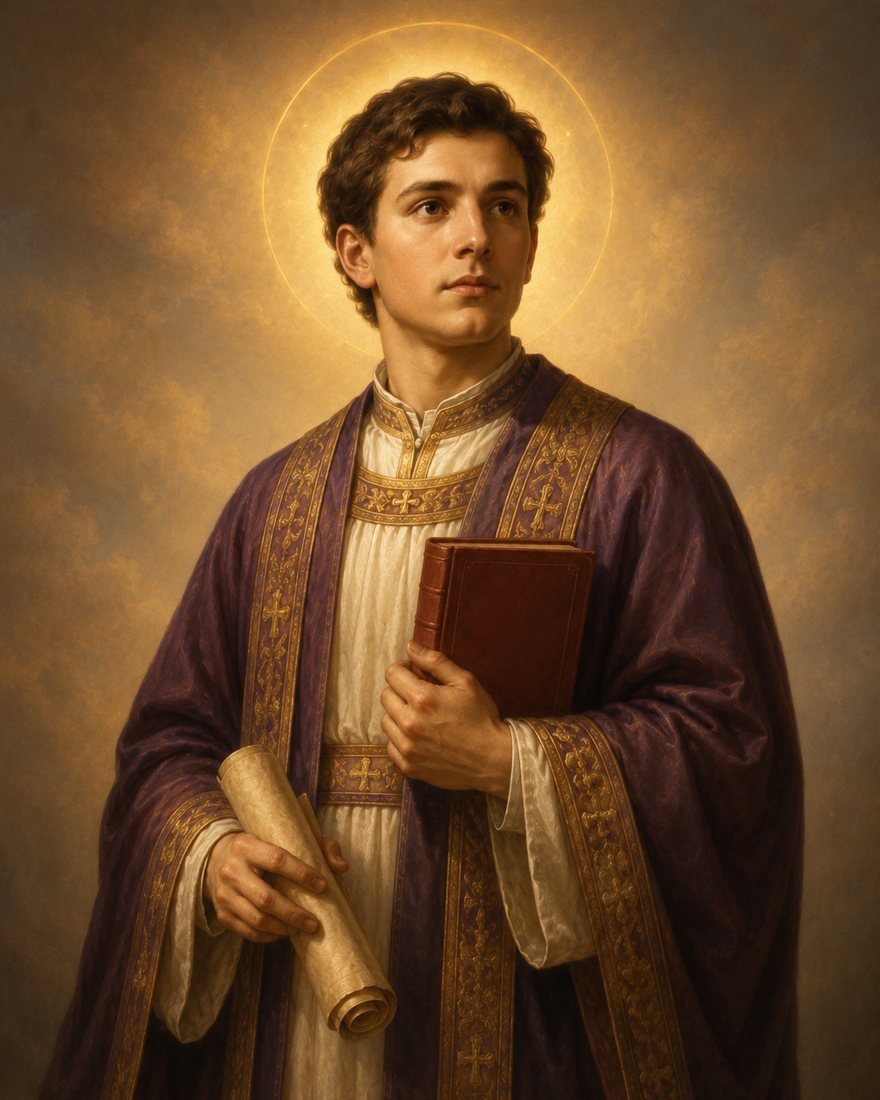
This is the approved devotional portrait already used for St. Timothy on the To God Be Glory Saints page. It is devotional artwork rather than a historical portrait from life. The popup reuses the exact existing image file without regenerating or altering it.
St. Timothy
Life and Witness
Timothy enters the New Testament quietly, as a young believer from Lystra whose character was already known before he joined St. Paul. Acts tells us that his mother was Jewish and a believer while his father was Greek, and that the Christians of Lystra and Iconium spoke well of him. The Second Letter to Timothy remembers the sincere faith that had lived first in his grandmother Lois and his mother Eunice. His story therefore begins not with public importance but with faith received, learned, and lived within a family.
When Paul returned to Lystra during his second missionary journey, he chose Timothy as a companion. From then on Timothy became one of the people Paul trusted most. He crossed Asia Minor with Paul and Silas, entered Macedonia, shared in the building up of newly founded churches, and was repeatedly sent into difficult situations where tact, courage, and loyalty were needed. Paul sent him back to Thessalonica to strengthen believers under pressure, later entrusted him with work connected with Corinth and Macedonia, and associated his name with several New Testament letters.
The relationship between Paul and Timothy was deeply personal. Paul could call him a beloved and faithful child in the Lord, but he also treated him as a responsible coworker. In Philippians Paul gives perhaps the clearest glimpse of Timothy’s heart: he says that he has no one like Timothy who will be genuinely concerned for the welfare of the Christians there. Pope Benedict XVI highlighted this passage when describing Timothy, noting that Paul regarded him almost as an alter ego and entrusted him with important missions. Timothy’s strength was not showmanship. It was dependable concern for other people and willingness to serve wherever the Gospel required.
The pastoral letters preserve another human side of Timothy. Paul reminds him not to let others despise his youth, to set an example in speech, conduct, love, faith, and purity, to attend to reading and teaching, and to stir into flame the gift received through the laying on of hands. The letters also show that Timothy knew physical weakness. Paul advises him to take a little wine for his stomach and his frequent ailments. The detail is small, but it has helped generations of Christians see a saint who carried real bodily limitations while continuing demanding pastoral work.
Early Church tradition connects Timothy especially with Ephesus. Eusebius, writing in the fourth century, calls him the first bishop of that city. Later accounts also describe a martyrdom there, but those details belong to later tradition rather than the New Testament record and should be presented with that distinction. What is certain from the earliest sources is that Timothy spent years accepting assignments that required travel, patience, courage, and pastoral judgment.
His life is therefore a story of faithful friendship and quiet responsibility. Timothy learned the Scriptures from childhood, accepted formation from Paul without becoming merely Paul’s shadow, and gradually carried responsibility for communities of his own. The Roman liturgy remembers Timothy and Titus together for their apostolic virtues and for preserving the faith handed on through apostolic preaching. His witness is particularly consoling for people who do not feel naturally forceful: Christian leadership can be tender, teachable, physically vulnerable, and still remarkably courageous.
What St. Timothy Is Known For
- Closest coworker of St. Paul: Timothy appears throughout Acts and Paul’s letters as a trusted missionary companion and delegate.
- Genuine pastoral concern: Paul praised him as someone sincerely concerned for the welfare of other Christians.
- Faith handed on through family: Lois and Eunice are remembered as part of the spiritual foundation of Timothy’s life.
- Pastoral leadership at Ephesus: early Church tradition identifies him as the first bishop of Ephesus.
- Perseverance despite physical weakness: Paul’s advice concerning Timothy’s stomach and frequent ailments gives an unusually personal glimpse of an early Christian pastor carrying on through illness.
- Scripture, teaching, and courage: the letters addressed to him repeatedly urge faithful teaching, disciplined life, love, self-control, and courage in witness to Christ.
Intercession & Patronage
The strongest traditional patronage is connected to Timothy’s own health; several additional associations arise directly from his biblical ministry:
Why Catholics Ask St. Timothy to Intercede
Timothy is a saint for people who have been given responsibility and wonder whether they are strong enough for it. His life shows a man formed by family faith, friendship, Scripture, and repeated acts of obedience. He knew illness, youth, demanding travel, difficult churches, and the burden of representing another apostle’s teaching, yet Paul trusted him because his concern for people was sincere. Catholics may therefore ask Timothy’s prayers not only for stomach ailments but also for faithful leadership, courage in ministry, the passing on of faith within families, and the grace to care genuinely for those entrusted to them.
References
- Timothy and Titus — General Audience of Pope Benedict XVI, December 13, 2006 — Vatican
- Memorial of Saints Timothy and Titus, Bishops — USCCB
- Acts 16 — Timothy joins Paul — USCCB
- Philippians 2 — Paul on Timothy’s genuine concern — USCCB
- 1 Timothy 5 — Timothy’s stomach and frequent illnesses — USCCB
- 2 Timothy 1 — Lois, Eunice, sincere faith, and courage — USCCB
- The Roman Missal, Proper of Saints — Saints Timothy and Titus — Magisterium AI
- St. John Chrysostom, Homily 16 on First Timothy — bodily illness and 1 Timothy 5:23
- Butler’s Lives of the Saints — St. Timothy, Bishop and Martyr
- Saints Timothy and Titus — patronage of relief from stomach disorders — Franciscan Media
View the Roman Missal memorial of Saints Timothy and Titus in Magisterium AI →
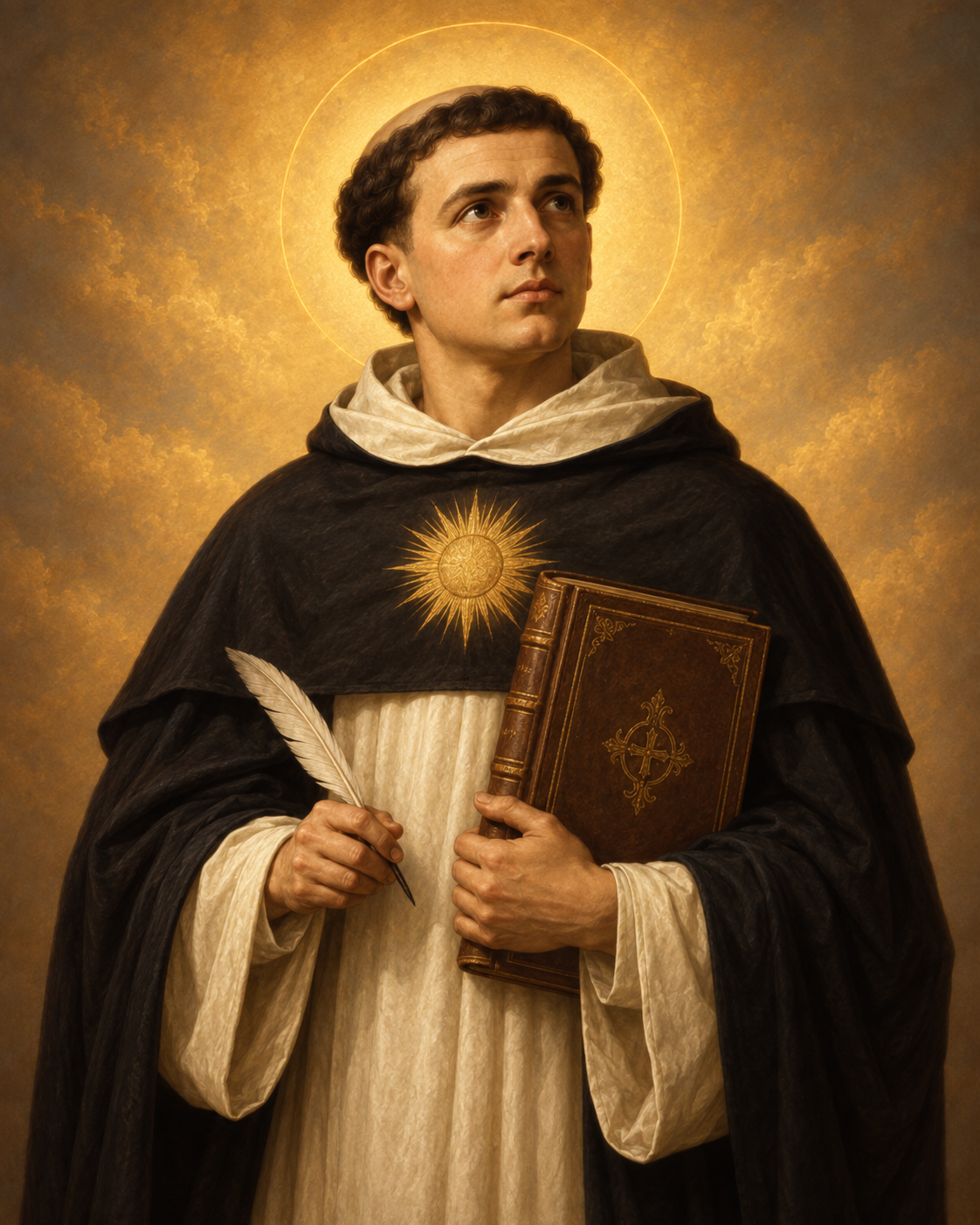
The card and popup use an AI-generated devotional portrait created for this site from representative sacred-art references to St. Thomas Aquinas. It is not presented as a verified portrait from life.
St. Thomas Aquinas
Life and Witness
Thomas was born into a noble family near Aquino and received his early education near the Benedictine Abbey of Monte Cassino. As a young student in Naples he encountered the newly available works of Aristotle and, even more decisively, discovered a vocation to the recently founded Dominican Order. His family strongly opposed that choice, but Thomas persisted in it.
He studied under St. Albert the Great in Paris and Cologne and eventually became one of the leading teachers of theology in medieval Europe. His work did not set faith against reason. Instead, he argued that truth is one: authentic human reason and revealed faith cannot finally contradict each other because both come from God. This synthesis became one of his most lasting contributions to Catholic thought.
Thomas wrote biblical commentaries, philosophical works, the Summa contra Gentiles, and above all the Summa Theologiae. Pope Benedict XVI emphasized that Thomas was first of all a theologian formed by Scripture and prayer, not merely an abstract philosopher. His intellectual discipline was joined to humility and a deeply contemplative life.
His Eucharistic devotion was especially strong. Pope Urban IV commissioned him to prepare liturgical texts for the feast of Corpus Christi, and hymns traditionally attributed to Thomas continue to express Catholic faith in Christ’s Real Presence. Near the end of his life, after a profound spiritual experience during Mass, Thomas stopped writing. He died at Fossanova while traveling toward the Council of Lyon, having received Viaticum with deep devotion.
What St. Thomas Aquinas Is Known For
- Summa Theologiae: His unfinished theological synthesis remains one of the most influential works in Catholic theology.
- Faith and reason: Thomas showed how philosophical reasoning and revealed faith can work together without confusing their distinct methods.
- Eucharistic theology and worship: His theology of the Eucharist and the liturgical texts associated with Corpus Christi have profoundly shaped Catholic prayer and teaching on the Real Presence.
- Doctor Angelicus and Doctor Communis: The Church has repeatedly presented him as an outstanding master of theology and a model for Catholic intellectual life.
Intercession & Patronage
Why Catholics Ask St. Thomas Aquinas to Intercede
Catholics ask St. Thomas Aquinas to intercede for intellectual clarity without pride: the grace to study carefully, reason honestly, remain faithful to revelation, and let knowledge lead toward love of God rather than self-importance. His life is especially helpful when faith and serious intellectual inquiry seem to be placed in opposition.
References
- Pope Benedict XVI — General Audience on St. Thomas Aquinas (2 June 2010)
- Pope Benedict XVI — St. Thomas Aquinas (2): faith, reason and Catholic education (16 June 2010)
- Pope Benedict XVI — St. Thomas Aquinas (3) (23 June 2010)
- Wikimedia Commons — Thomas Aquinas by Bartolomé Esteban Murillo, 1650; image licensed CC BY-SA 3.0
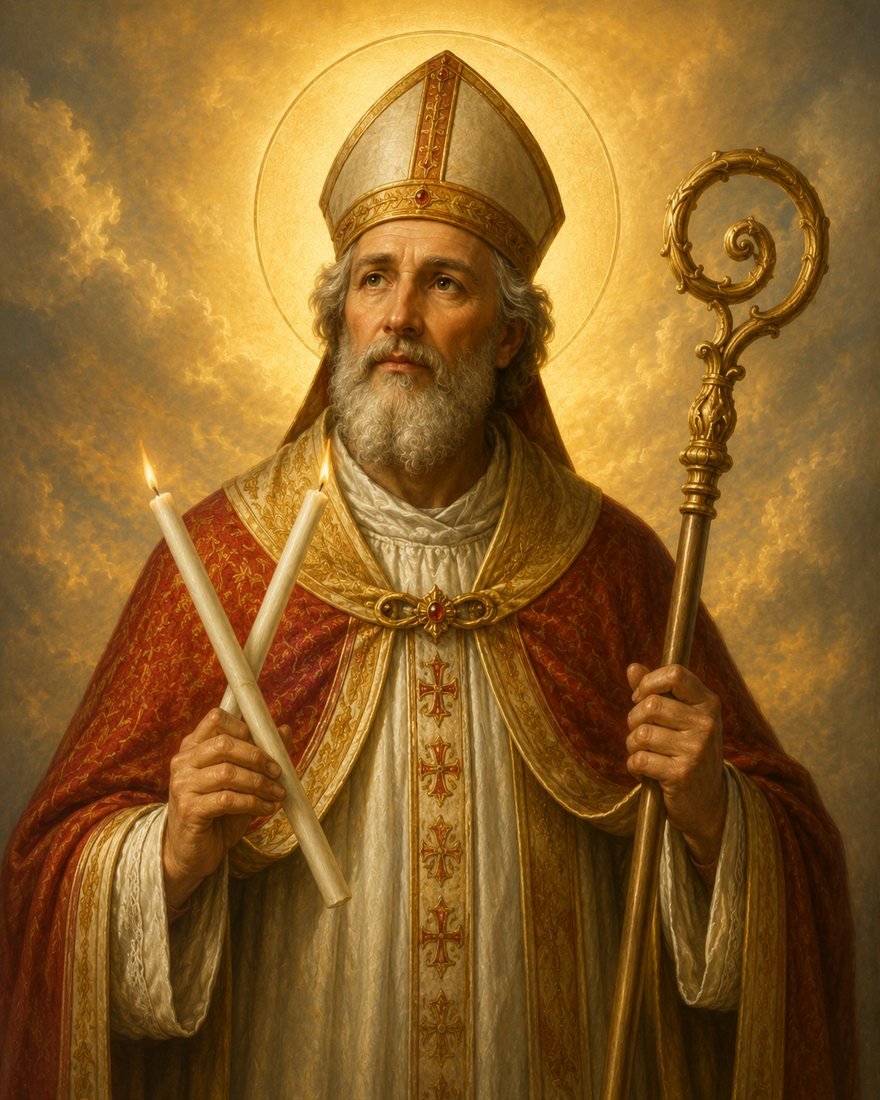
This is the approved devotional portrait already used for St. Blaise on the To God Be Glory Saints page. Because no historical portrait from life exists, the image should be understood as devotional artwork. The popup reuses the exact existing image file without regenerating or altering it.
St. Blaise
Life and Witness
St. Blaise is one of those early martyrs whose devotion became far more detailed than the surviving historical record. Ancient Christian tradition remembers him as Bishop of Sebaste in Armenia and as a martyr of the early fourth century. The Catholic Encyclopedia notes that the later Acts contain legendary material and that very little can be established about the details of his life with modern historical certainty. The Church’s own Book of Blessings likewise says simply that he was bishop of Sebaste in the fourth century and that little is known about his life.
Yet the traditions that gathered around Blaise consistently portray the same kind of man: a healer who became a shepherd of souls and a bishop who cared for people in danger. Later accounts say that he had practiced medicine before becoming bishop. During persecution he is said to have withdrawn to a cave, where he prayed and where even sick or injured animals were brought to him. Whether every detail can be verified or not, the tradition remembers holiness in him as compassionate attention to suffering rather than distance from it.
The story that shaped his devotion most powerfully concerns a child in danger of choking on a fish bone. According to the traditional account, a distressed mother brought the child to Blaise while the bishop was being taken to prison or while he was imprisoned, and Blaise prayed for the child, who recovered. This story became so closely associated with him that by the Middle Ages devotion to him had spread widely and Christians invoked him especially for diseases of the throat.
The Church did not leave this association merely in popular folklore. The Book of Blessings explicitly explains the traditional story and provides the annual Blessing of Throats on February 3. Two candles, often crossed near the throat, accompany a prayer asking God through the intercession of St. Blaise for deliverance from ailments of the throat and from every other evil. The rite makes clear that the blessing is an act of faith in God’s protection and love for the sick, not a magical remedy.
Later accounts of Blaise’s martyrdom describe him refusing to sacrifice to pagan gods, suffering torture, and finally being beheaded. Some versions say his flesh was torn with iron combs used for wool, which later helped produce an association with wool workers and combers. Other stories emphasize animals gathering peacefully around his place of prayer. These details belong to later tradition, but they helped generations of ordinary Christians imagine Blaise as a bishop whose courage before persecutors did not harden his tenderness toward creatures or the sick.
Blaise therefore survives in Catholic memory not because we possess a long biography written by people who knew him, but because a very old tradition of veneration became attached to a concrete work of mercy: concern for a person struggling to breathe or swallow. His feast brings together bodily vulnerability, pastoral care, prayer, and martyrdom. Even when the historical limits of the legends are stated clearly, the spiritual point remains strong: Christian courage and Christian compassion belong together.
What St. Blaise Is Known For
- Bishop and martyr of Sebaste: this is the historical core of his identity in the Church’s tradition.
- The Blessing of Throats: his February 3 feast is associated with the Church’s special blessing for protection from diseases of the throat and other illness.
- The child and the fish bone: the traditional healing story explains why his intercession became especially connected with choking and throat ailments.
- A healer of body and soul: later tradition describes him as a physician before becoming bishop, an image that helped unite physical compassion with pastoral care.
- Courage under persecution: the later Acts remember him refusing idolatry and accepting martyrdom rather than abandoning Christ.
- One of the Fourteen Holy Helpers: in medieval Western devotion Blaise became one of the saints especially invoked in times of sickness and danger.
Intercession & Patronage
Blaise has one especially strong liturgical patronage and several additional traditional associations. The popup distinguishes the official throat devotion from later legendary patronages:
Why Catholics Ask St. Blaise to Intercede
Catholics ask St. Blaise to intercede especially when illness makes something as ordinary as breathing, speaking, or swallowing frightening. The old story of the choking child made him a saint associated with urgent, concrete compassion, while his martyrdom made him a witness to courage under pressure. The Church’s continuing Blessing of Throats keeps the devotion centered on God: Blaise is asked to pray, and the blessing asks God for protection, healing, and confidence in divine care.
References
- The Roman Missal, Proper of Saints — prayer under the patronage of St. Blaise — Magisterium AI
- Book of Blessings: Blessing of Throats on the Feast of Saint Blaise
- Roman Ritual: Blessing of Throats on the Feast of St. Blaise
- Catholic Encyclopedia — St. Blaise
- Butler’s Lives of the Saints — St. Blase, Bishop and Martyr
- Catholic Encyclopedia collection in Magisterium AI — historical note on the February 3 blessing of throats
View the Roman Missal prayer for St. Blaise in Magisterium AI →
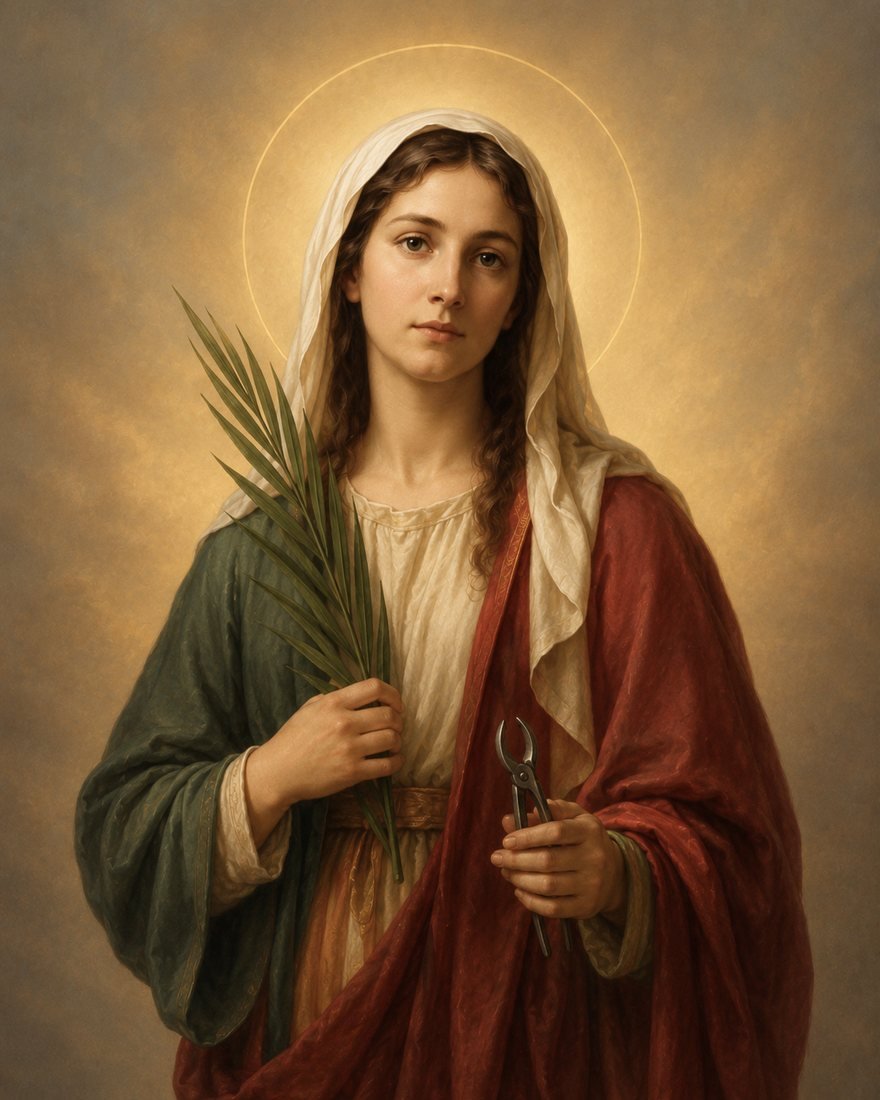
This is the approved devotional portrait already used for St. Apollonia on the To God Be Glory Saints page. No portrait from life exists. The popup reuses the exact existing image file without regenerating or altering it.
St. Apollonia
Life and Witness
St. Apollonia lived in Alexandria during a frightening outbreak of mob violence against Christians near the end of the reign of the emperor Philip the Arab, shortly before the empire-wide persecution under Decius. Our principal source is unusually early. Dionysius, Bishop of Alexandria, wrote to Fabius of Antioch about what his own Christian community had suffered, and Eusebius later preserved large portions of that letter in his Church History.
Dionysius describes a city in which a hostile agitator stirred crowds against Christians. An elderly man named Metras was beaten and stoned. A woman named Quinta was dragged through the streets and killed. Christian homes were plundered. The violence was not a distant government policy carried out quietly by officials; it was communal terror, with neighbors exposed to humiliation, loss, and death.
In the midst of this Dionysius names Apollonia, describing her as an admirable woman advanced in years. The mob struck her face and jaws and broke out her teeth. They then led her outside the city, built a fire, and threatened to burn her alive unless she repeated impious words and denied her Christian faith. The violence that later made her the patron saint of dental suffering was therefore not an isolated injury. It was an attempt to use pain, fear, and public humiliation to force a believer to renounce Christ.
The ancient account says that Apollonia asked to be released for a moment and then entered the fire rather than speak the demanded blasphemy. Because this detail can be troubling when read through modern questions about self-inflicted death, the Church’s tradition has treated it carefully. St. Augustine, while firmly condemning suicide as a general rule, referred to exceptional cases of martyrs honored by the Church and cautioned against rash judgment, allowing that an extraordinary divine prompting might have been involved. Apollonia’s action has never been a Christian permission for self-harm; the Church venerates her as a martyr who refused apostasy under violent coercion.
What survives of her personality is brief but powerful. Dionysius does not give us childhood memories, family details, or long speeches. He gives us an older woman whose faith had endured long enough to be tested in one terrible public moment and who would not make a false confession to save herself. Her courage belongs within the larger courage of the Alexandrian Christians, many of whom lost homes, possessions, safety, and life without abandoning the faith.
Over time the physical cruelty inflicted on her mouth and teeth gave rise to a very specific popular devotion. Christians suffering toothache and diseases of the mouth invoked her, and dentists and other dental professionals came to regard her as a patron. Images often show her with pincers or a tooth, not to glorify torture, but because the instrument of suffering became the visual sign by which generations remembered a woman who remained faithful when pain was used as a weapon against conscience.
What St. Apollonia Is Known For
- Martyr of Alexandria: her death occurred during the anti-Christian violence of AD 248–249, shortly before the persecution of Decius.
- An unusually early historical witness: Bishop Dionysius of Alexandria described her suffering in a letter preserved by Eusebius.
- Courage under brutal coercion: she refused to speak blasphemy even after severe injury to her face and teeth and the threat of death by fire.
- Patron saint of dental suffering: the damage to her teeth during martyrdom produced a centuries-old association with toothache and dentistry.
- Witness of older age: the earliest account describes her as already advanced in life, making her courage especially striking as the culmination of a long Christian fidelity rather than the impulse of youth.
Intercession & Patronage
Her historic patronage is unusually focused because it grows directly from the injuries described in the earliest account of her martyrdom:
Why Catholics Ask St. Apollonia to Intercede
Catholics ask St. Apollonia to intercede because her suffering became inseparably connected with pain of the teeth and mouth, but her story reaches beyond physical pain. The earliest account remembers a woman who would not allow fear and violence to dictate what she professed to believe. A person sitting anxiously in a dentist’s chair may therefore ask her prayers for relief and good care, while also remembering the deeper courage for which the Church honors her.
References
- Eusebius, Church History, Book VI, Chapter 41 — the Martyrs in Alexandria and Apollonia
- Eusebius of Caesarea, Church History — Magisterium AI source collection
- Catholic Encyclopedia — St. Apollonia
- Catholic Encyclopedia collection in Magisterium AI — entry index containing St. Apollonia
- Butler’s Lives of the Saints — St. Apollonia and the Martyrs of Alexandria
- St. Augustine, City of God, Book I, Chapter 26 — exceptional martyr traditions and the prohibition of suicide
- Magisterium AI patronage reference collection — dentists includes Apollonia
This is the approved devotional portrait already used for St. Polycarp on the To God Be Glory Saints page. No verified portrait from life exists. The popup reuses the exact existing image file without regenerating or altering it.
St. Polycarp
Life and Witness
St. Polycarp stands unusually close to the first generation of Christianity. He was Bishop of Smyrna in Asia Minor and lived long enough for Christians of the later second century to remember having heard him speak about people who had known Christ. St. Irenaeus of Lyons, who listened to Polycarp as a young man, remembered his manner of life and teaching and said that Polycarp had been instructed by apostles and by others who had seen the Lord. For Irenaeus, Polycarp was not simply an important bishop; he was a human bridge carrying the memory of apostolic Christianity into another generation.
Polycarp’s surviving Letter to the Philippians helps us hear the tone of his pastoral life. He urges Christians to be firm in faith, attached to one another in truth, meek in their dealings, and unwilling to despise anyone. He tells them not to postpone doing good and speaks of care for widows, the poor, and those who wander. These are not the words of a bishop interested only in winning arguments. His defense of truth was joined to practical mercy and to concern for the shape of ordinary Christian relationships.
St. Ignatius of Antioch, on his way to martyrdom in Rome, wrote directly to Polycarp. Ignatius urged him to stand firm like an anvil under blows, but also told him to know people individually, to care for widows, and not to despise slaves. The letter suggests the sort of pastoral responsibility Polycarp carried: he was expected to protect doctrine while also remembering particular vulnerable people by name.
Polycarp also traveled to Rome and met Pope Anicetus concerning differences in the date of celebrating Pascha, the Christian Passover. The two bishops did not reach agreement on the custom, yet the ancient record emphasizes that they remained in communion with one another. This episode became a valuable example of holding serious differences without breaking Christian charity or unity.
His death is recorded in one of the earliest surviving Christian martyr narratives, The Martyrdom of Polycarp. When authorities came for him, the account says that he received his captors peacefully, ordered food and drink for them, and asked for time to pray. At the stadium the proconsul urged the aged bishop to save himself by cursing Christ. Polycarp answered that he had served Christ for eighty-six years and had received no wrong from him, so he could not blaspheme his King and Savior. The precise meaning of the eighty-six years—his age or the length of his Christian life—is debated, but the statement communicates the central fact: decades of fidelity had become a settled relationship of love.
The martyrdom account portrays him as calm rather than theatrical. He would not seek death rashly, yet once arrested he would not purchase survival by denying Christ. He prayed for the whole Church and accepted the sentence of burning. The text reports that the flames did not consume him as expected and that he was finally killed by a blade. Afterwards the Christians gathered his bones with reverence and kept the anniversary of his martyrdom. This passage is among the earliest clear witnesses to Christian honor for martyrs and their relics.
Polycarp’s lasting beauty is the union of firmness and charity. He opposed teachings he believed would destroy Christian faith, but his own letter urges mercy, almsgiving, patience, meekness, and care for the weak. He could disagree with the Bishop of Rome over a significant custom and still preserve communion. And when death came, he met his captors with hospitality and prayer. The Roman liturgy asks that Christians who honor him may share his constancy and rise to eternal life through the Holy Spirit.
What St. Polycarp Is Known For
- A living link to the apostolic age: Irenaeus remembered hearing Polycarp and testified to his connection with those who had known the apostles and the Lord.
- Bishop of Smyrna: he shepherded one of the important early Christian communities of Asia Minor.
- Author of the Letter to the Philippians: his surviving letter combines defense of the faith with practical teaching on charity, humility, family life, clergy, widows, the poor, and perseverance.
- Friend of St. Ignatius of Antioch: Ignatius addressed a personal letter to Polycarp on pastoral leadership while traveling toward martyrdom.
- Christian unity without false uniformity: Polycarp and Pope Anicetus disagreed over the dating of Pascha but remained in communion.
- One of the earliest documented martyrs after the New Testament period: the account of his arrest and death is among the oldest surviving martyr narratives.
- Steadfast love for Christ: his famous refusal to curse Christ summarizes a lifetime in which fidelity had become personal loyalty and gratitude.
Intercession & Patronage
Polycarp’s strongest associations come from his episcopal ministry and martyrdom. Two additional illness patronages belong to later devotional tradition and are clearly labeled as such:
Why Catholics Ask St. Polycarp to Intercede
Catholics ask St. Polycarp to intercede because his life shows what long fidelity can look like when it has become peaceful, charitable, and deeply rooted. He is an especially fitting intercessor for bishops and teachers, for Christians under pressure, for people trying to preserve unity during disagreement, and for anyone who wants courage without bitterness. Later Catholic devotion also invokes him for earache and dysentery, but his strongest historical witness remains the steadfast love that allowed an elderly bishop to face death without surrendering either truth or charity.
References
- The Martyrdom of Polycarp — Magisterium AI
- Epistle of Polycarp to the Philippians — Magisterium AI
- The Roman Missal, Proper of Saints — St. Polycarp — Magisterium AI
- St. Irenaeus, Against Heresies III.3 — testimony concerning Polycarp
- St. Ignatius of Antioch, Epistle to Polycarp — pastoral counsel
- Polycarp, Epistle to the Philippians — New Advent
- The Martyrdom of Polycarp — New Advent
- Catholic Encyclopedia — St. Polycarp
- Butler’s Lives of the Saints — St. Polycarp, Bishop and Martyr
- St. Polycarp devotional patronages — Catholic Culture
The popup uses the same Wikipedia/Wikimedia lead image loaded for St. Patrick in the Saints directory. No portrait from Patrick’s lifetime exists; the image is later devotional or historical artwork and is not presented as a likeness from life.
St. Patrick
Life and Witness
Much of what makes St. Patrick unusually vivid among saints of the early Middle Ages comes from his own surviving words. In the Confessio he does not present himself as a polished hero. He calls himself a sinner, a simple and poorly educated man, and repeatedly gives God the credit for whatever good came through his life. That humility is important, because Patrick’s story is one of a frightened captive gradually becoming a man willing to return to the very land of his enslavement out of love for the people who lived there.
Patrick says that when he was about sixteen he was seized from his family home in Britain and carried away to Ireland with thousands of other captives. He spent roughly six years in slavery, tending animals in an unfamiliar country. He admits that before his captivity he had not taken his Christian faith seriously. Isolation, hardship, and fear changed him. While working outdoors he began to pray constantly, sometimes many times by day and night, and he later remembered this period not only as suffering but as the time in which his heart awakened to God.
Eventually Patrick believed that God was showing him a way of escape. He fled, traveled a long and dangerous distance, found passage away from Ireland, and after further hardship was reunited with his family. Yet the deepest turning point came after he had regained what most people would have wanted most: safety and home. Patrick describes a dream or vision in which he heard the voice of the Irish asking him to come and walk among them again. The former captive gradually came to understand that his own suffering had prepared him to love the people among whom he had once been powerless.
After formation and ordination, Patrick returned to Ireland as a bishop and missionary. His own writings speak of baptizing great numbers, ordaining clergy, traveling among communities far from Roman centers, facing opposition, imprisonment, threats, and repeated danger. He did not describe evangelization as conquest or personal success. Again and again he speaks as someone astonished that God could use him. His joy came from seeing people receive the Christian faith, including people whom the social world around him considered unimportant.
Patrick’s love for his converts appears especially powerfully in his Letter to the Soldiers of Coroticus. After armed raiders killed some newly baptized Christians and carried others away as captives, Patrick protested publicly and demanded the release of the prisoners. The letter is fierce because it is pastoral: he speaks of the victims as his children in God and says he had left homeland, relatives, and even personal safety for their sake. The same man who had once been enslaved could not remain silent when Christians under his care were murdered or sold into bondage.
Later legends added many colorful stories to Patrick’s memory, especially the shamrock and the driving of snakes from Ireland. Those traditions became part of popular devotion, but they do not appear in Patrick’s own fifth-century writings and should not overshadow the better-attested picture. The historical Patrick is already compelling: a former slave who returned voluntarily, a missionary who endured hostility without abandoning the people he served, and a pastor whose own writings reveal gratitude, humility, courage, and deep affection for his converts.
His influence on Ireland was immense, even though the Christianization of the island was a longer process involving other missionaries as well. The Church remembers Patrick as the great apostle of Ireland because his mission became a foundational part of Irish Christian identity, and Irish missionaries in later centuries carried that faith far beyond Ireland. Pope Paul VI praised this missionary inheritance, linking the zeal of later Irish evangelizers with the work begun by Patrick.
What St. Patrick Is Known For
- Apostle and patron of Ireland: Patrick became the most important missionary saint associated with the conversion and organization of the early Irish Church.
- Former captive who returned as a missionary: his willingness to return to Ireland after escaping slavery gives his ministry an extraordinary quality of forgiveness and self-giving.
- Author of two surviving writings: the Confessio and the Letter to Coroticus provide rare first-person evidence of his faith, personality, struggles, and pastoral love.
- Defender of captives: his letter against Coroticus condemns the killing and enslavement of newly baptized Christians and pleads for the release of prisoners.
- Missionary courage: Patrick speaks of danger, chains, criticism, and hostility, yet remained committed to preaching the Gospel.
- Humility and gratitude: his writings repeatedly describe his own weakness while giving God credit for conversions and missionary fruit.
Intercession & Patronage
Why Catholics Ask St. Patrick to Intercede
Catholics ask St. Patrick to intercede because his life shows how grace can transform suffering without erasing the memory of it. The enslaved teenager became a bishop who returned to serve the people of Ireland; the man who once lacked freedom became a defender of other captives; the person who considered himself poorly educated became one of the most recognizable evangelizers in Christian history. His intercession is especially fitting for missionaries, the Irish people, captives and migrants, and anyone asking for courage to follow God into difficult circumstances.
References
- St. Patrick’s Confessio — Royal Irish Academy / Trinity College Dublin HyperStack
- St. Patrick’s Letter to the Soldiers of Coroticus — Royal Irish Academy / Trinity College Dublin HyperStack
- St Patrick: Through me many peoples were born again in God — Vatican
- Letter of Pope Paul VI for the Feast of St. Patrick, Apostle of Ireland
- Butler’s Lives of the Saints — March 17, St. Patrick
- Magisterium AI — Patron Saints in the Catholic Church (includes Patrick among engineers and other occupational patronages)
- Magisterium AI — Catholic source discussion of St. Patrick’s missionary trials
The popup uses the same Wikipedia/Wikimedia lead image loaded for St. Joseph in the Saints directory. No portrait from Joseph’s lifetime exists; the image is later devotional or historical artwork and is not presented as a likeness from life.
St. Joseph
Life and Witness
The Gospels record no spoken words of St. Joseph, yet they reveal a man whose love was expressed through action. Matthew calls him a “just man.” When Joseph discovered that Mary was expecting a child before they lived together, he faced a crisis he could not understand. His first instinct was not public humiliation or revenge. He intended to separate from her quietly. Before he acted, an angel told him not to fear taking Mary into his home because the child had been conceived through the Holy Spirit. Joseph obeyed. His justice was therefore not cold rule-keeping; it was a readiness to protect another person while remaining open to God’s will even when that will overturned his expectations.
Joseph then accepted a fatherhood that demanded everything while giving him none of the ordinary securities of biological parenthood. He named the child Jesus, thereby legally receiving him into the house of David. He took Mary to Bethlehem, found himself caring for her as she gave birth in poverty, and then responded immediately when danger threatened the child. Matthew portrays him rising in the night, taking Jesus and Mary into Egypt, and living as a displaced family until it was safe to return. Pope Francis has drawn attention to the practical courage hidden in those few Gospel sentences: Joseph had to find shelter, food, employment, and safety for his family in a foreign land.
When the family returned, Joseph settled in Nazareth and supported them through ordinary work. Scripture calls him a tekton, a craftsman traditionally rendered “carpenter.” The hidden years of Nazareth are largely silent, but that silence is not emptiness. Jesus grew up in a home where Joseph worked, worshiped, traveled with the family to Jerusalem, observed the Law, and exercised real paternal responsibility. St. John Paul II emphasized that Joseph’s fatherhood was expressed concretely by making his life a service to the mystery entrusted to him.
Luke’s account of the twelve-year-old Jesus in the Temple gives one of the clearest glimpses of Joseph’s tenderness. Mary speaks to Jesus of the anguish that “your father and I” experienced while searching for him. Joseph’s fatherhood involved worry, searching, misunderstanding, and perseverance—ordinary experiences of loving parents. The Gospel then says Jesus returned with Mary and Joseph to Nazareth and was obedient to them. Joseph helped create the human home in which the Son of God grew “in wisdom and age and favor.”
Because Scripture says nothing about Joseph during Jesus’ public ministry and because Jesus entrusted Mary to the beloved disciple at the Cross, Christian tradition has long concluded that Joseph probably died before the Passion. The date and circumstances are unknown. From this arose the beautiful devotion to Joseph as patron of a happy death: tradition imagines him dying with Jesus and Mary near him. Pope Francis has been careful to distinguish this from historical data while affirming the spiritual meaning of the devotion.
The Church’s devotion to Joseph developed especially around what his hidden life reveals: fidelity without recognition, strength without domination, work offered in love, courage in uncertainty, and fatherhood understood as self-gift. Pope Francis described him as a beloved, tender, obedient, accepting, creatively courageous, working father and a father “in the shadows”—someone who made room for another person to grow rather than seeking to possess that person.
This is why Joseph’s apparent quietness has inspired enormous confidence. He cared for Mary, protected Jesus, earned a living, obeyed God promptly, faced migration and danger, and accepted a vocation much larger than his own plans. The Church sees in that guardianship an image of his continuing concern for Christ’s Mystical Body and therefore honors him as Patron of the Universal Church.
What St. Joseph Is Known For
- Husband of Mary and guardian of Jesus: his unique vocation was to receive, protect, and provide for the Mother of God and the Incarnate Son.
- A just and obedient man: the Gospel repeatedly shows Joseph responding promptly to God’s direction even when circumstances are confusing or dangerous.
- Tender fatherhood: Church teaching emphasizes that Joseph truly exercised paternal care toward Jesus through protection, work, education, and daily presence.
- Work and hidden holiness: his life in Nazareth sanctifies ordinary labor and family responsibility.
- Creative courage: he solved concrete problems for the Holy Family during poverty, travel, exile, and return.
- Patron of the Universal Church: because he guarded Christ and Mary, the Church entrusts herself to his continuing protection.
Intercession & Patronage
Why Catholics Ask St. Joseph to Intercede
Catholics turn to St. Joseph because the Gospel presents holiness in a form that is extraordinarily close to ordinary life. He did not preach publicly or leave writings. He listened, worked, protected, worried, traveled, provided, and obeyed. His love made other people safer and freer to fulfill God’s plan. For fathers and spouses, workers and migrants, the dying, the poor, and anyone carrying responsibility quietly, Joseph offers a model of strength joined to tenderness and action joined to trust.
References
- Sacred Scripture — Matthew 1–2, Joseph in the infancy narrative — USCCB
- Sacred Scripture — Luke 1–2, the Holy Family and finding of Jesus in the Temple — USCCB
- Patris Corde — Pope Francis, Apostolic Letter on St. Joseph
- Redemptoris Custos — St. John Paul II, On the Person and Mission of Saint Joseph
- Pope Francis General Audience — Saint Joseph, Patron of a Happy Death
- Pope Francis General Audience — Saint Joseph, Patron of the Church
- Congregation for Divine Worship — New invocations in the Litany of Saint Joseph
- Magisterium AI — Patris Corde, section 5, “A creatively courageous father”
- Butler’s Lives of the Saints — St. Joseph
This is the approved devotional portrait already used for St. Isidore of Seville on the To God Be Glory Saints page. No portrait from life exists. The popup reuses the exact existing image file without regenerating or altering it.
St. Isidore of Seville
Life and Witness
St. Isidore lived at a moment when the old Roman world in Spain had fractured and the Visigothic kingdom was still being drawn toward a more stable Catholic culture. He belonged to an extraordinary Christian family. His older brother Leander, Archbishop of Seville and friend of Pope St. Gregory the Great, had enormous influence on his formation. Benedict XVI described Leander as demanding, studious, and austere—a brother who formed Isidore in both disciplined study and an ascetical way of life.
Later stories portray Isidore as a discouraged schoolboy who learned perseverance by watching drops of water wear away stone. Whether every detail of that tale is historical cannot be proved, but it captures something true about the man he became. Isidore’s life was marked by enormous intellectual labor. He did not study merely to display learning. He wanted to gather, organize, preserve, and hand on useful knowledge in a society where books and schools were fragile.
When Leander died, Isidore succeeded him as Bishop of Seville, probably around the beginning of the seventh century. The office required him to move continually between contemplation and public responsibility. Benedict XVI highlights this tension in Isidore’s personality: he loved study and interior recollection, yet accepted the exhausting duties of a bishop. Rather than treating learning and pastoral service as rivals, Isidore tried to unite them.
He promoted the education of clergy, encouraged schools, participated in major councils, and helped strengthen Catholic unity in Visigothic Spain after the abandonment of Arianism by the ruling dynasty. At the Fourth Council of Toledo in 633 he exercised major influence on reforms involving worship, discipline, clerical formation, and the common life of the Church. His work helped give a divided society a shared religious and intellectual framework.
Isidore’s most famous work is the Etymologiae or Origins, a vast encyclopedia in twenty books covering grammar, rhetoric, mathematics, medicine, law, Scripture, theology, animals, agriculture, geography, tools, war, ships, buildings, and much more. Modern readers can easily notice its errors and limitations, but its historical importance is immense. At a time when many classical texts were becoming difficult to obtain, the Etymologiae preserved and organized fragments of ancient learning that would otherwise have been far less accessible to medieval students.
Yet Isidore was not simply a collector of facts. He wrote biblical commentaries, histories, works on nature and time, monastic rules, and theological texts. He believed knowledge should lead to wisdom and moral responsibility. Benedict XVI emphasized Isidore’s concern that study be integrated with charity and the spiritual life rather than becoming empty curiosity.
His final days reinforce that pastoral side. Traditional accounts describe him giving generously to the poor, and the Vatican City State biography notes that during the last six months of his life his house was constantly filled with needy people because of his almsgiving. The scholar who spent decades gathering the world into books ended life by giving his possessions away. That combination—love of truth and concrete charity—is one of the best ways to understand his sanctity.
What St. Isidore Is Known For
- Doctor of the Church: he is honored for the breadth and enduring influence of his theological and educational work.
- Author of the Etymologiae: his twenty-book encyclopedia became one of the most widely used reference works of medieval Europe.
- Preserver and organizer of knowledge: he gathered material from earlier Christian and classical authors at a time of political and cultural instability.
- Educator of clergy: he promoted systematic intellectual and spiritual formation for priests and bishops.
- Leader in Visigothic Spain: his episcopal and conciliar work helped strengthen Catholic unity and ecclesial order.
- Scholar joined to charity: his intellectual life did not prevent deep concern for the poor and the practical needs of his flock.
Intercession & Patronage
Why Catholics Ask St. Isidore to Intercede
Catholics ask St. Isidore to intercede because he shows that intellectual life can itself become a form of service. He gathered knowledge not to escape the world but to equip the Church and society to live more wisely. Students, teachers, researchers, programmers, and anyone overwhelmed by information can look to him for patience, clarity, disciplined study, and the humility to remember that knowledge is meant to serve truth and love.
References
- Pope Benedict XVI General Audience — Saint Isidore of Seville
- Vatican City State — April 4: Saint Isidore of Seville, Doctor of the Church
- Butler’s Lives of the Saints — St. Isidore of Seville, April 4
- Magisterium AI — Patron Saints in the Catholic Church (computer programmers, computer scientists, technicians, users)
- Magisterium AI — Patron Saints in the Catholic Church (schoolchildren and software engineers)
- Magisterium AI — Catholic Encyclopedia, Mozarabic Rite and Isidore’s role
- Magisterium AI changelog documenting inclusion of Benedict XVI’s 18 June 2008 Isidore audience and Isidore’s De temporibus
This is the approved devotional portrait already used for St. Gemma Galgani on the To God Be Glory Saints page. Gemma lived in the age of photography, but this card uses the existing approved devotional image so the Saints directory remains visually consistent. No image asset was changed in this plugin.
St. Gemma Galgani
Life and Witness
St. Gemma Galgani’s life was short, intensely prayerful, and marked by repeated loss. She was born near Lucca in 1878 into a Catholic family. Her father was a pharmacist, and for a time the family lived comfortably. But sorrow entered early. Her mother became gravely ill and died while Gemma was still a child. The loss wounded her deeply and also intensified the way she turned toward Jesus, Mary, and prayer for consolation.
Gemma was an intelligent and serious student, but her health was fragile. More deaths followed, including that of a beloved brother who had been preparing for the priesthood. When her father later died, the family’s financial situation collapsed. Gemma experienced not only grief but real poverty and insecurity. Her spirituality therefore developed in circumstances very different from a protected devotional life: she knew bereavement, sickness, disappointment, embarrassment, and dependence on the charity of others.
In her late teens and early twenties she became seriously ill with disease affecting her spine and other complications that left her bedridden and in great pain. The Vatican City State biography describes osteitis of the lumbar vertebrae and mastoid disease, with partial paralysis. During this time she grew especially close to St. Gabriel of Our Lady of Sorrows and to the spirituality of the Passionists. After a novena she experienced a striking recovery in 1899, which she and those around her understood as a grace received through intercession.
Gemma longed to give her whole life to God and hoped to enter religious life, especially the Passionist nuns. Poor health and the unusual attention surrounding her mystical experiences complicated those hopes, and she was never able to enter the convent she desired. This disappointment became one of the hidden sacrifices of her life. She eventually found a home with the Giannini family in Lucca, who received her with great generosity and treated her as one of their own.
Beginning in 1899 Gemma reported extraordinary mystical experiences connected with the Passion of Christ, including recurring wounds resembling the stigmata. Her spiritual director, Passionist Father Germano Ruoppolo, investigated her experiences and preserved much of the documentary record in her letters, autobiography, diary, and later biography. Not everyone around Gemma believed the phenomena were supernatural, and responsible Catholic presentation should not reduce her holiness to extraordinary signs. The Church canonized her for heroic Christian virtue, not simply because she reported mystical experiences.
What gives warmth to Gemma’s story is the direction of her love. She was drawn again and again to Christ crucified, not because she loved pain for its own sake but because she wanted to unite her suffering to his love and offer herself for others, especially for the conversion of sinners. The Vatican biography summarizes this spirituality by noting that she found in the Lord’s Passion a path to holiness and offered herself for the salvation of souls. Her writings reveal an intensely personal affection for Jesus and a longing that people know his mercy.
Gemma could also be simple, affectionate, and practical. Accounts from those who knew her remember care for the poor and a desire to give away what she had. Her own poverty made that generosity costly. She did not become a nun, found no public ministry, and died at twenty-five. Yet the hiddenness of her life became part of its message: holiness can grow in illness, family loss, frustrated plans, dependence on others, and a life that appears outwardly small.
In 1902 Gemma developed tuberculosis. Her condition deteriorated, and for reasons of infection control she was moved to separate quarters belonging to the Giannini family. She died on Holy Saturday, April 11, 1903. Pope Pius XI beatified her in 1933, and Pope Pius XII canonized her in 1940. The Passionists honor her as a daughter of their spirituality even though she never formally entered their convent.
What St. Gemma Galgani Is Known For
- Deep devotion to the Passion of Christ: the Cross stood at the center of her prayer and understanding of suffering.
- Mystical experiences and reported stigmata: these were carefully documented by people around her, especially her spiritual director, though not everyone accepted them during her lifetime.
- Perseverance through illness and bereavement: she endured the deaths of close family members, chronic disease, financial collapse, and tuberculosis.
- Desire for religious life: she longed to become a Passionist nun but accepted that poor health prevented the vocation from unfolding as she had hoped.
- Prayer for sinners: Gemma consciously offered suffering and prayer for conversion and the salvation of others.
- Hidden charity: despite her own poverty and dependence, accounts of her life remember concern for people in need and a readiness to give.
Intercession & Patronage
Why Catholics Ask St. Gemma to Intercede
Catholics ask St. Gemma to intercede because she knew what it meant to love God while life repeatedly failed to follow the path she wanted. She lost parents, health, financial security, and the religious vocation she hoped to enter, yet her faith did not harden into bitterness. Her spirituality became intensely personal and compassionate: she wanted to remain close to Christ in suffering and to offer prayer for other people. Those dealing with chronic pain, bereavement, vocational disappointment, temptation, or hidden suffering often find in her a saint who understands both weakness and ardent love.
References
- Vatican City State — April 11: Saint Gemma Galgani
- Vatican — Pastoral Visit of St. John Paul II to Lucca, including the Shrine of St. Gemma Galgani (September 1989)
- Magisterium AI — Patron Saints in the Catholic Church, Pharmacists (includes Gemma Galgani)
- Magisterium AI — Patron Saints in the Catholic Church, Students (includes Gemma Galgani)
- Magisterium AI changelog documenting the addition of St. John Paul II’s 1989 address at the Shrine of St. Gemma Galgani
- St. Gemma Galgani — EWTN Mission daily saint biography
- St. Gemma Galgani — devotional patronage explanations based on her documented illnesses and family history
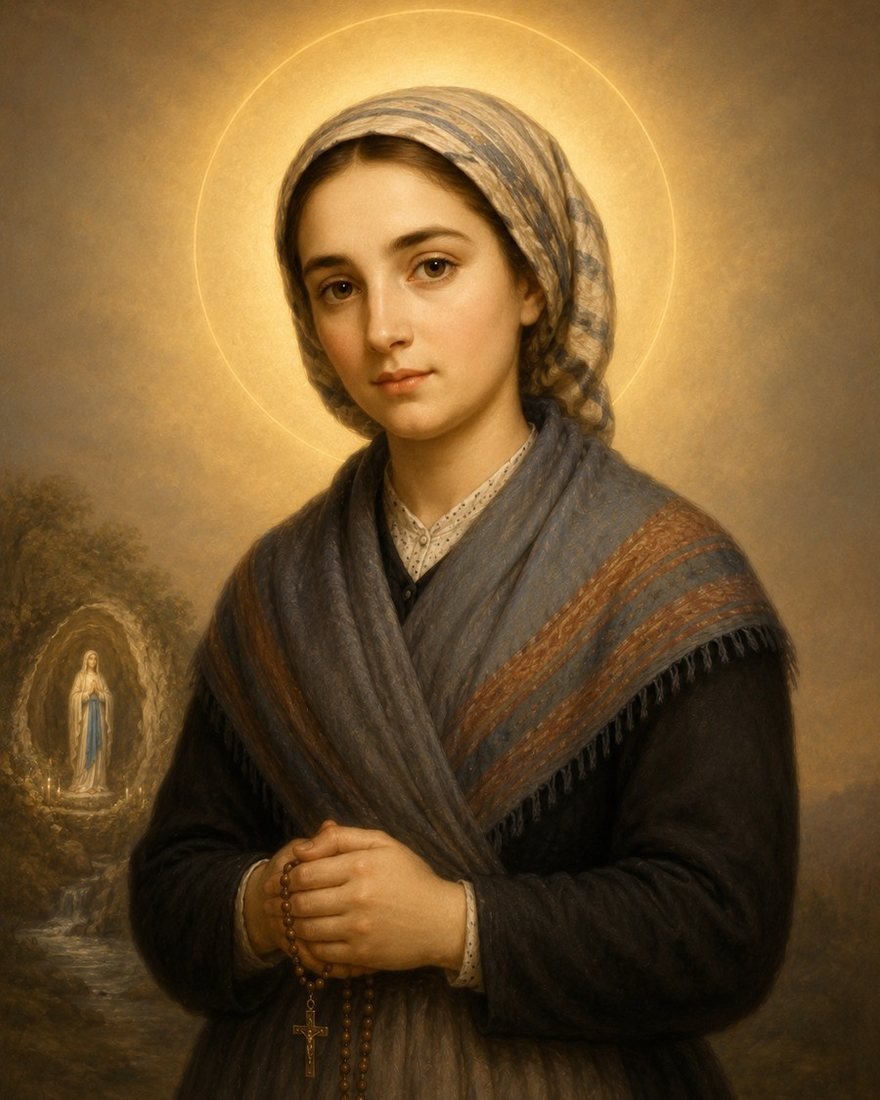
The popup uses the same portrait image shown on Bernadette’s Saints-directory card. It is presented as devotional artwork rather than as documentary evidence about the apparitions.
St. Bernadette Soubirous
Life and Witness
Bernadette Soubirous was born in Lourdes in 1844 into a close and loving family that later fell into severe poverty. The official Lourdes account is careful not to reduce her childhood to misery alone: her early home life gave her affection, humor, and a strong sense of family. By adolescence the family was living in the former town jail known as the Cachot, and Bernadette’s health was fragile. She suffered recurring asthma and had missed so much schooling that at fourteen she still struggled to read and write and had not yet made her First Communion.
On February 11, 1858, while gathering firewood near the Grotto of Massabielle, Bernadette reported seeing a young woman whom she called “the Lady.” Over the next months she reported eighteen apparitions. The message she repeated was simple rather than sensational: prayer, penance, conversion, and concern for sinners. On March 25 the Lady identified herself in the local dialect as the Immaculate Conception. Bernadette did not use the experiences to make herself important. She repeatedly submitted to questioning by civil and Church authorities and insisted that her task was to report what she had seen and heard, not to force anyone to believe her.
Her character during the public storm around Lourdes is one of the strongest parts of her story. Crowds followed her, officials interrogated her, admirers offered gifts, and curiosity threatened to turn her into a spectacle. Yet she resisted being commercialized. The Lourdes sanctuary preserves her refusal to accept money and her insistence that she wanted to remain poor. Her quick wit and directness survived the pressure, but so did a remarkable simplicity: she did not pretend to understand more than she did.
After the apparitions, Bernadette gradually withdrew from public attention. She entered the Sisters of Charity and Christian Instruction at Nevers in 1866. There she did not become a professional visionary or a public speaker. She lived the ordinary discipline of religious life, serving for a time in the infirmary and later as sacristan. Her own health continued to decline, and the woman associated throughout the world with a shrine of healing spent much of her own life sick.
That contrast reveals much of Bernadette’s spiritual beauty. She did not treat illness as proof that God had abandoned her, nor did she claim that faith guaranteed a cure. She offered her suffering in prayer, continued to care about others, and tried to live the Lourdes message herself. The official Lourdes biography says that she understood her “mission in Lourdes” to be finished and sought a hidden life in which Mary, rather than Bernadette, remained at the center.
Her humility was not weakness. She could be strong-willed, sensitive, and spirited, and she worked consciously against her faults. What emerged was a very human holiness: truthfulness under pressure, refusal to exploit religious fame, affection for family, service to the sick, patience in physical suffering, and a desire to disappear rather than become the focus of the devotion that had grown around Lourdes.
Bernadette died at Nevers on April 16, 1879, at the age of thirty-five after years of serious illness. She was beatified in 1925 and canonized by Pope Pius XI on December 8, 1933. The Church did not canonize her simply because she reported apparitions. Her sanctity was recognized in the way she responded to grace—with humility, courage, honesty, charity, and faithful perseverance.
What St. Bernadette Soubirous Is Known For
- The Lourdes apparitions: she was the sole visionary of the eighteen 1858 apparitions recognized by the local bishop in 1862.
- Truthfulness under pressure: repeated questioning did not substantially alter her testimony.
- Humility and self-effacement: she resisted money, celebrity, and attempts to make her the center of Lourdes.
- Prayer and conversion: the message she transmitted emphasized prayer, penance, and concern for sinners.
- Service to the sick: in religious life she assisted in the infirmary even while living with serious illness herself.
- Patient endurance: asthma and later severe disease accompanied much of her life without extinguishing her faith or humor.
Intercession & Patronage
Why Catholics Ask St. Bernadette Soubirous to Intercede
Catholics ask St. Bernadette to intercede because she knew both public scrutiny and hidden suffering. She is especially close to people who are ill, poor, doubted, or overwhelmed by attention they never asked for. Her life points away from herself: the enduring lesson of Bernadette is to tell the truth, pray faithfully, care for others, and allow God to work without needing to control how others respond.
References
- Sanctuary of Our Lady of Lourdes — Life of Bernadette Soubirous
- Sanctuary of Lourdes — 1862 decree recognizing the apparitions
- Pope Benedict XVI — Lourdes torchlight procession, September 13, 2008
- Magisterium — Dicastery for the Causes of Saints biography of Bernadette
- Magisterium — Butler’s Lives of the Saints, Volume II, Bernadette
- Magisterium AI — source-backed research on Bernadette and apparition discernment
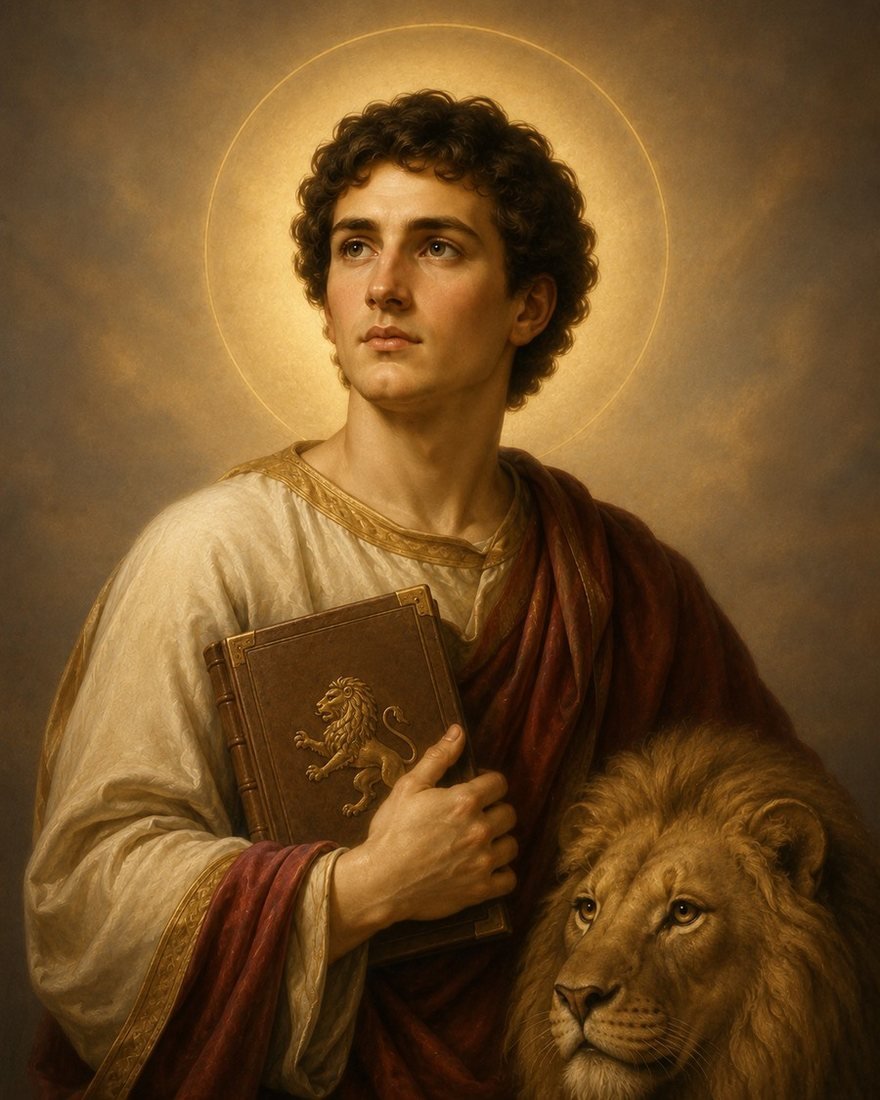
The popup uses the same devotional portrait shown on the Saints-directory card. No reliable portrait of Mark from life exists; the image is later sacred art.
St. Mark the Evangelist
Life and Witness
St. Mark stands close to the beginnings of the written Gospel. The New Testament contains several references to a “John whose other name was Mark,” a relative of Barnabas who moved within the missionary circle of Barnabas and Paul. Colossians identifies Mark as Barnabas’s cousin, and later Pauline texts speak of a Mark who became useful in ministry. First Peter ends with greetings from “Mark, my son,” a phrase that helped shape the ancient Christian memory of a close bond between Mark and Peter.
It is important to distinguish what Scripture says from later identification. The New Testament never explicitly declares that every reference to “Mark” points to the author of the Second Gospel. Very early Church tradition, however, consistently links the Gospel with Mark and Peter. Papias of Hierapolis, whose testimony is preserved by Eusebius, says that Mark became Peter’s interpreter and carefully wrote down what he remembered of Peter’s preaching. Irenaeus, Clement of Alexandria, Origen, and Jerome repeat the same basic connection.
This tradition gives Mark’s vocation a deeply personal quality. His task was not to make himself the hero of the story but to preserve and hand on the memory of Jesus Christ. The Gospel that bears his name is vigorous and immediate. Jesus acts, heals, teaches, suffers, and gives his life. Mark does not romanticize the disciples; their fear and misunderstanding remain visible. Yet that honesty serves hope, because the Gospel shows imperfect people slowly learning who Jesus is.
Mark’s own story, if the New Testament references belong to the same man, also contains failure and restoration. Acts says John Mark left Paul and Barnabas during an early mission. The disagreement later became serious enough that Paul and Barnabas separated over whether Mark should accompany them again. Yet later Pauline letters speak warmly of Mark as a fellow worker and someone “useful” for ministry. Christian tradition has therefore often seen in him a quiet example of a person whose early failure did not end his vocation.
Ancient tradition also associates Mark with the evangelization of Alexandria in Egypt. Later accounts describe him as the first bishop of that Church and as a martyr. Those details belong to ecclesial tradition rather than to the New Testament, and the exact chronology is uncertain. What is historically secure is the extraordinary antiquity of the Alexandrian Church’s claim to Mark as its apostolic founder and patron.
Mark’s relics became associated with Venice in the ninth century, and the winged lion became the city’s great religious and civic symbol. The lion is also Mark’s traditional evangelist symbol, commonly connected with the strong “voice crying in the wilderness” at the opening of his Gospel and with the four living creatures of Ezekiel and Revelation.
The spiritual warmth of Mark’s life lies in faithful transmission. He is remembered as someone who listened, learned, carried another apostle’s preaching, recovered from difficulty, and gave the Church a Gospel whose first words announce “the gospel of Jesus Christ, the Son of God.” His sanctity is the sanctity of a witness who made Christ’s story more important than his own.
What St. Mark the Evangelist Is Known For
- The Gospel according to Mark: the Church has from earliest centuries attributed the Second Gospel to him.
- Companion of St. Peter: Papias and other early witnesses call Mark Peter’s interpreter and connect the Gospel with Peter’s preaching.
- Missionary companionship: the New Testament places John Mark in the circles of Barnabas, Paul, and Peter.
- Failure followed by restored usefulness: Acts records conflict over Mark’s earlier departure, while later Pauline texts speak of him as a valued coworker.
- Alexandria: ancient Christian tradition honors him as founder of the Church there.
- The winged lion: his enduring iconographic symbol and the emblem associated with Venice.
Intercession & Patronage
Why Catholics Ask St. Mark the Evangelist to Intercede
Catholics ask St. Mark to intercede for the grace to receive the Gospel faithfully and pass it on without making themselves the center. Writers, preachers, teachers, missionaries, and anyone starting again after a setback can find in Mark a saint whose remembered vocation was to listen carefully, preserve apostolic testimony, and keep serving.
References
- USCCB — Acts 12–15, John Mark in the early missionary Church
- USCCB — 1 Peter 5:13, “Mark, my son”
- Eusebius, Church History III.39 — Papias on Mark as Peter’s interpreter
- St. Jerome, De Viris Illustribus 8 — Mark
- Catholic Encyclopedia — Gospel of Mark and early authorship tradition
- Magisterium — Roman Missal, Proper of Saints: St. Mark
- Butler’s Lives of the Saints: April — St. Mark entry
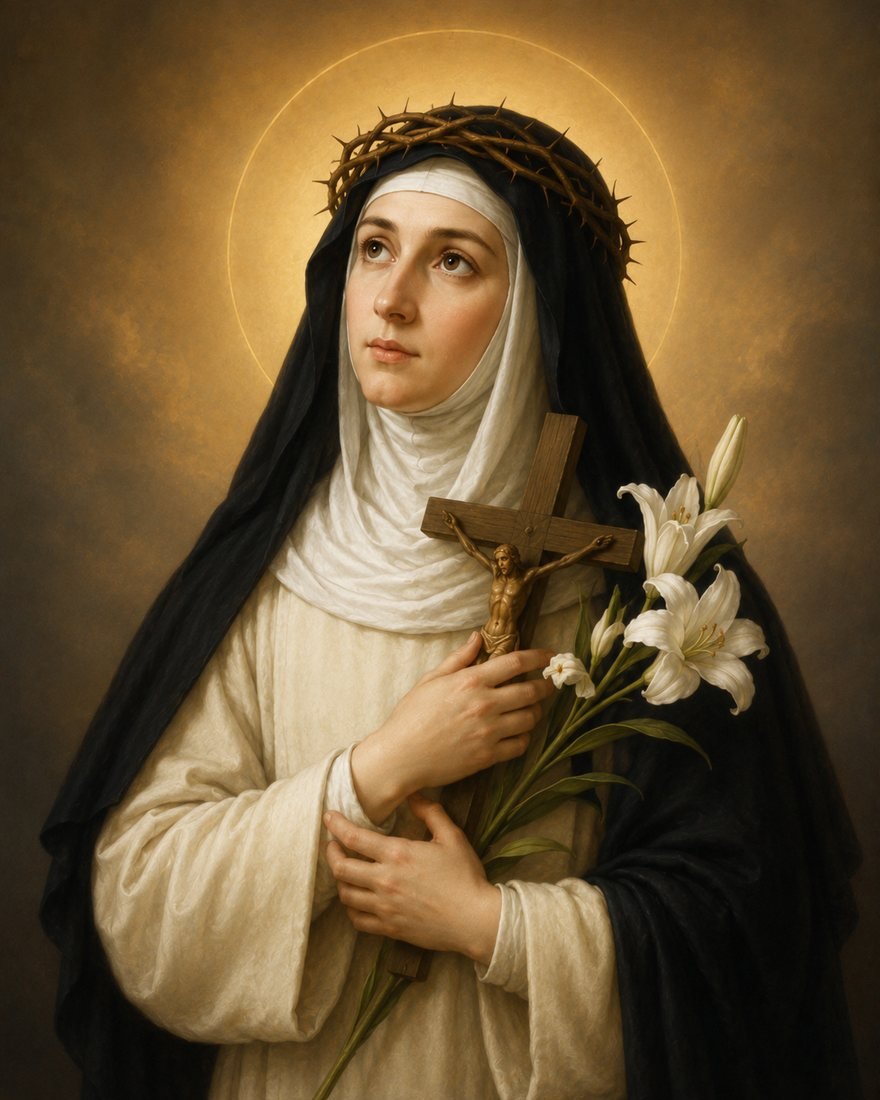
The popup uses the same devotional portrait shown on Catherine’s Saints-directory card. It is later sacred art, not a portrait certified from life.
St. Catherine of Siena
Life and Witness
Catherine Benincasa was born in Siena in 1347 into a very large family. From childhood she showed an intense attraction to prayer, but her holiness did not remain in an interior world. After resisting family pressure to marry, she entered the Dominican Third Order known in Siena as the Mantellate while continuing to live at home. For a period she embraced deep solitude and prayer, then came to understand that love of God had to expand into active love of neighbor.
That movement from contemplation to charity became the pattern of her life. Catherine served the sick, including people others were reluctant to approach. She cared for the poor and entered situations of disease and social rejection with an intensity that startled her contemporaries. Benedict XVI emphasized that her prayer and mystical life were inseparable from concrete works of charity, especially service to the sick.
People from very different social classes began seeking her counsel. Catherine dictated letters to clergy, laypeople, political leaders, and popes. She could write with tenderness, but she could also be startlingly direct. Her courage came from love of Christ and the Church rather than from a desire to win arguments. She repeatedly urged conversion, reform of clergy, peace among warring Italian cities, and fidelity to the Church during a period of deep political and ecclesial crisis.
One of the most famous episodes of her public life was her contact with Pope Gregory XI, then residing at Avignon. Catherine strongly urged him to return to Rome. She was not the only influence on that historic decision, and it would be an oversimplification to say that she single-handedly ended the Avignon Papacy. Yet her letters and personal appeals were part of the moral and spiritual pressure calling the papacy back to its Roman center.
Catherine’s concern for the Church did not make her blind to its wounds. She loved the Church enough to call for reform while refusing to abandon communion. During the Western Schism that began in 1378, she supported Pope Urban VI and spent her final years in Rome praying and working for unity. Her love could therefore be both filial and demanding: she wanted the Church purified because she believed Christ loved it.
Her major spiritual work, The Dialogue of Divine Providence, presents the Christian life as a journey into the mercy of God through Christ. Benedict XVI highlighted Catherine’s language of being “set on fire” by divine love and her conviction that true knowledge of God produces humility, compassion, and service. She did not treat mystical experience as escape from the world. The more intensely she loved Christ, the more urgently she cared about sick bodies, frightened souls, divided cities, and a wounded Church.
Catherine died in Rome in 1380 at only thirty-three. She was canonized in 1461, declared a Doctor of the Church by St. Paul VI in 1970, named a patron of Italy with St. Francis of Assisi, and proclaimed a co-patron of Europe by St. John Paul II. Her life remains a remarkable union of contemplation, fearless truth-telling, and practical charity.
What St. Catherine of Siena Is Known For
- Doctor of the Church: her letters, prayers, and Dialogue are major works of Catholic spirituality.
- Love of Christ and the Church: she combined intense mystical prayer with passionate concern for reform and unity.
- Care of the sick and poor: active charity became a decisive expression of her spiritual life.
- Peacemaking: she traveled and wrote in efforts to reconcile political enemies and restore peace.
- Courageous counsel: popes, clergy, rulers, prisoners, and ordinary people received direct spiritual advice from her.
- The return of Gregory XI to Rome: she was an important spiritual advocate for the pope’s return from Avignon, though not the sole cause.
Intercession & Patronage
Why Catholics Ask St. Catherine of Siena to Intercede
Catholics ask St. Catherine of Siena to intercede when love needs courage. She is especially compelling for people who must care for someone suffering, speak an uncomfortable truth, work for peace, or remain faithful during confusion in the Church. Her life teaches that contemplation is not withdrawal from charity: the more deeply she believed she belonged to Christ, the more urgently she served his people.
References
- Pope Benedict XVI — General Audience on St. Catherine of Siena, November 24, 2010
- Magisterium — The Dialogue of Divine Providence by Catherine of Siena
- Magisterium — Roman Missal Proper of Saints: St. Catherine of Siena
- Dominican Order — Catherine of Siena profile and spirituality
- Dominican Friars — St. Catherine and care for the sick
- Butler’s Lives of the Saints: April — St. Catherine of Siena
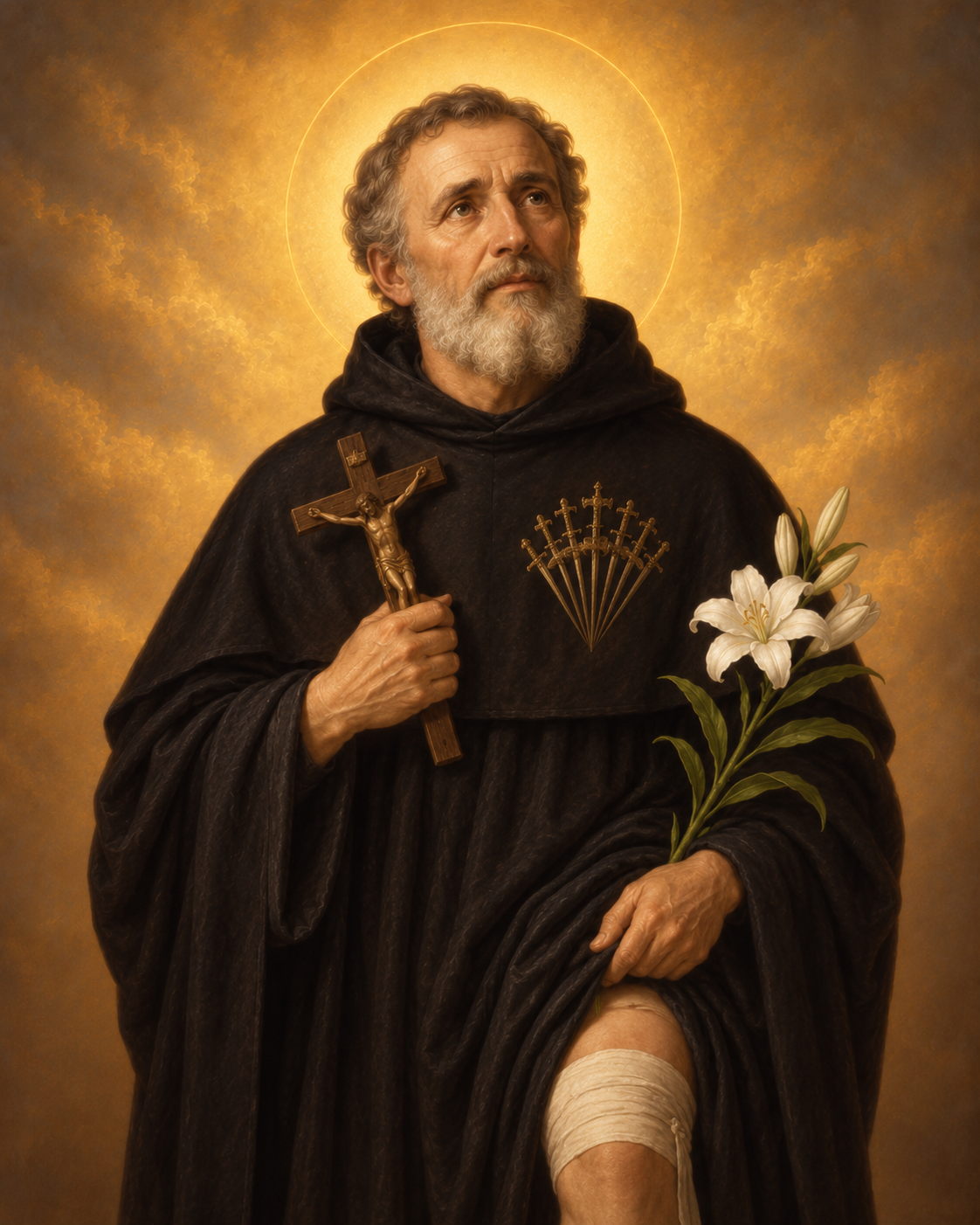
The Saints-directory card and popup use an AI-generated devotional portrait created for this site from representative sacred-art references to St. Peregrine Laziosi. It is not presented as a verified portrait from life.
St. Peregrine Laziosi
Life and Witness
Peregrine Laziosi was born around 1260 in Forlì, a city torn by fierce political conflict between papal and anti-papal factions. His family supported the anti-papal side, and traditional Servite accounts remember the young Peregrine as hot-tempered and politically militant. His path to holiness therefore did not begin in quiet piety. It began with anger.
The turning point came when St. Philip Benizi, Prior General of the Servites, came to Forlì to preach reconciliation. The young Peregrine joined those heckling him and, according to the Servite tradition, struck Philip. Rather than retaliate, Philip forgave him. That mercy unsettled Peregrine. He later sought Philip out, asked forgiveness, and began a conversion that redirected the intensity of his personality toward prayer and service.
Peregrine eventually entered the Order of the Servants of Mary. His later life was remembered for austerity, perseverance, and concern for sinners and the suffering. Hagiographic tradition describes him as a priest and preacher who practiced severe penance; some modern Servite summaries are more cautious about details of ordination. What is constant across the tradition is that his conversion became lasting rather than momentary.
The event that most shaped his later patronage concerns a serious disease of his leg. Traditional accounts describe a painful ulcerous or cancer-like growth that became so severe a physician planned amputation. On the night before the operation, Peregrine prayed before an image of Christ crucified and entrusted himself to God. The tradition says that he experienced a remarkable healing and that the operation was no longer necessary.
The historical record does not permit modern medicine to diagnose the lesion with certainty, and the cure belongs to the saint’s hagiographic tradition. Yet the spiritual meaning of the story explains why generations of people facing cancer, surgery, and frightening diagnoses have turned to him. Peregrine is not remembered as someone who denied illness. He faced the possibility of losing a limb and prayed in the presence of the Cross.
His earlier violence also gives his life unusual depth. The saint invoked for healing first needed healing in his own character. Forgiveness received from Philip Benizi became the doorway through which an angry young man learned repentance. His patronage therefore speaks not only to diseased bodies but also to people who need hope that their past does not have to determine their future.
Peregrine died at Forlì in 1345. Devotion to him grew, and he was beatified in 1609 and canonized by Pope Benedict XIII in 1726. The Servite tradition continues to present him as a companion for the seriously ill, especially those with cancer, and as a witness to conversion, trust, and compassion.
What St. Peregrine Laziosi Is Known For
- Patron of cancer patients: the association arises from the traditional account of his severe leg disease and unexpected healing.
- A dramatic conversion: he moved from political hostility and violence to repentance after receiving forgiveness from St. Philip Benizi.
- Servite spirituality: his life developed within the Order of the Servants of Mary and devotion to Christ’s Passion and Mary’s sorrows.
- Prayer in serious illness: the most famous episode of his life places him before the Crucifix on the eve of a planned amputation.
- Hope after a damaging past: his story shows that real conversion can redirect a strong and even destructive personality toward holiness.
Intercession & Patronage
Why Catholics Ask St. Peregrine Laziosi to Intercede
Catholics ask St. Peregrine to intercede because his life joins two kinds of healing: bodily suffering and moral conversion. He knew the fear of serious disease, but he also knew what it meant to look back on violent behavior and change. For people facing cancer, surgery, chronic wounds, or the consequences of a painful past, Peregrine represents hope without denial of suffering.
References
- St. Peregrine Laziosi Parish and Diocesan Shrine — biography and patronage
- Magisterium — Saints of the Day, May 1: St. Peregrine Laziosi
- EWTN — The Cancer Saint, St. Peregrine, O.S.M.
- Butler’s Lives of the Saints — St. Peregrine Laziosi entry index
- Order of Servants of Mary — Servite spiritual tradition
- Wikimedia Commons — Statue of St. Peregrine Laziosi by Mihály Singer; photograph by Globetrotter19, CC BY-SA 3.0
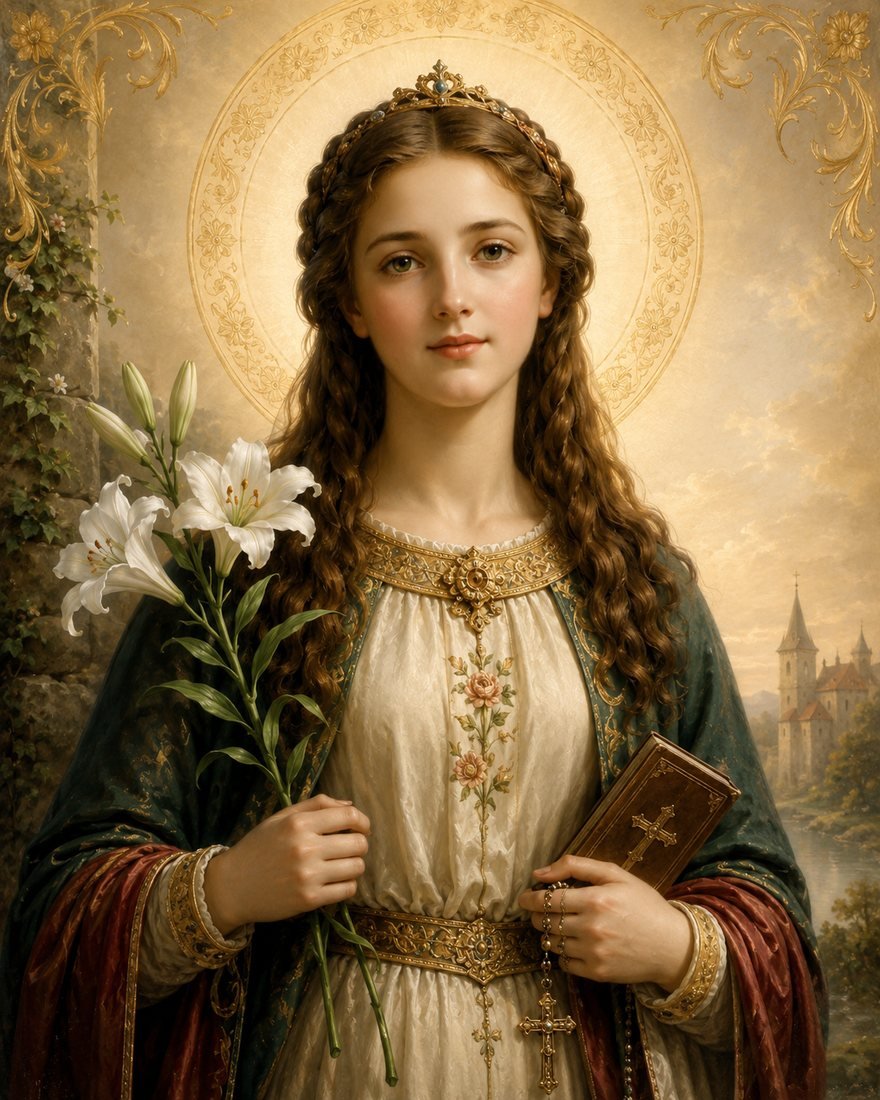
The popup uses the same devotional artwork shown on the Saints-directory card. Because Dymphna’s historical appearance is unknown, it is not presented as a likeness from life.
St. Dymphna
Life and Witness
St. Dymphna is one of the clearest examples of why a careful saints biography must distinguish historical evidence from hagiographic tradition. Devotion to her at Geel in Belgium is genuinely medieval and well documented. The earliest surviving written life, however, was composed only in the middle of the thirteenth century by Pierre, a canon of Saint-Aubert at Cambrai, who explicitly said that he was recording oral tradition. That means the familiar details of Dymphna’s seventh-century life cannot be verified in the way the life of a modern saint can.
The traditional story says that Dymphna was the Christian daughter of a pagan Irish ruler. After her mother’s death, her father became disordered and eventually wanted to marry his own daughter. Dymphna refused and fled with the priest Gerebernus and companions to the region of Geel. Her father found them, killed Gerebernus, and, when Dymphna continued to resist, killed her as well. In this tradition she is both a virgin martyr and a victim of incestuous violence.
The Catholic Encyclopedia, while recording the ancient veneration, is unusually frank that the narrative as written cannot be treated as secure history. That caution does not erase what can be documented: by the thirteenth century Dymphna had long been venerated at Geel, a church was dedicated to her, and people suffering from mental disturbance were coming to the shrine seeking help.
What developed at Geel became one of the most remarkable parts of her legacy. Rather than isolating every mentally ill pilgrim in an institution, local families gradually began receiving people into their homes. Over centuries this foster-family model became internationally famous. The details and medical understanding changed with time, but the underlying practice—offering people with mental illness a place in ordinary community life—made Geel an enduring symbol of humane care.
This history explains why Dymphna’s patronage is larger than the legendary violence of her own story. She became associated with troubled minds because generations of afflicted people came to her shrine and were cared for there. Her name became attached not only to prayer for healing but also to a culture that insisted people with mental illness should be treated with patience, dignity, work, relationship, and human affection.
For modern Catholics, Dymphna can therefore be approached without romanticizing either mental illness or medieval legend. Her devotion creates space to pray for people experiencing anxiety, depression, psychosis, trauma, neurological disorders, family abuse, or fear. It also challenges caregivers and communities to replace stigma with compassionate presence.
The historical person behind the longstanding devotion remains obscure, but the centuries-old Christian memory of Dymphna has become a powerful language of protection for people whose minds, emotions, or family relationships are places of suffering. The Church honors her on May 15.
What St. Dymphna Is Known For
- Patron of mental and emotional illness: this is one of the strongest and most enduring associations in Catholic devotion.
- The Geel tradition of care: her shrine helped give rise to a centuries-long practice of welcoming people with mental illness into local family homes.
- Protection from family violence: the traditional story presents her fleeing an incestuous threat from her father.
- Virgin and martyr: this is her longstanding liturgical identity, even though the detailed medieval narrative cannot be historically verified.
- Compassion without stigma: the social legacy of Geel has made her devotion especially meaningful to mental-health patients, families, and caregivers.
Intercession & Patronage
Why Catholics Ask St. Dymphna to Intercede
Catholics ask St. Dymphna to intercede because her name has been linked for centuries with people whose suffering is often hidden or stigmatized. Her devotion says that mental illness does not erase a person’s dignity, that people in unsafe families deserve protection, and that communities are called to compassionate care rather than rejection.
References
- Catholic Encyclopedia — St. Dymphna: earliest sources and historical caution
- National Shrine of St. Dymphna — history of the devotion and Geel care tradition
- Magisterium — Patron Saints in the Catholic Church: mental-health professionals / Dymphna
- Magisterium — Patron Saints index including therapists and Dymphna
- Catholic Encyclopedia, Volume 5 PDF — St. Dymphna article
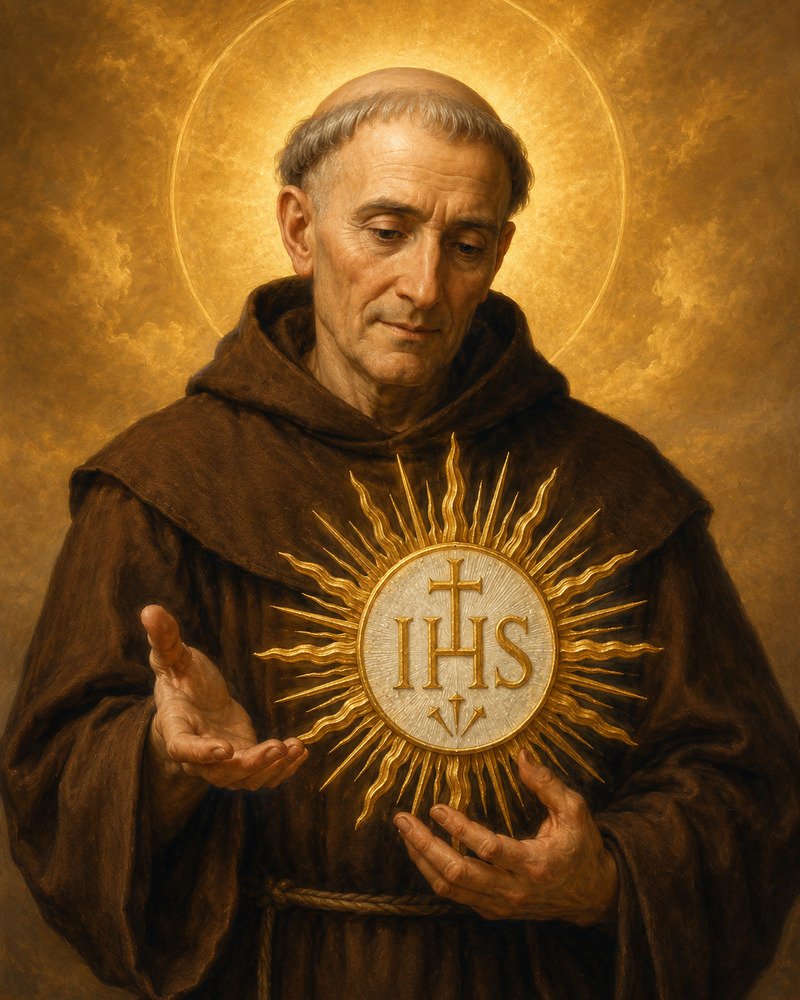
The popup uses the same devotional portrait shown on Bernardino’s Saints-directory card. Late-medieval and Renaissance images preserve a recognizable iconographic type, but this website image is not claimed as a documentary portrait from life.
St. Bernardino of Siena
Life and Witness
Bernardino was born in 1380 in Massa Marittima and was orphaned while still young. Raised by relatives in Siena, he received a good education and developed a strong devotional life. His charity became visible before his fame as a preacher. During the plague of 1400, when fear and death overwhelmed Siena, the young Bernardino helped organize volunteers to care for patients at the great hospital of Santa Maria della Scala. He placed himself where infection, exhaustion, and human need were most intense.
He entered the Franciscan Observance and was ordained a priest. Early accounts say his weak or harsh voice initially seemed unsuited to public preaching. Whether every miraculous detail of the later stories can be verified or not, the historical result is clear: Bernardino became one of the most influential popular preachers of fifteenth-century Italy.
He traveled constantly, speaking in city squares to crowds that could not fit inside churches. His preaching was vivid, practical, and often aimed at social sins that damaged ordinary people: factional hatred, revenge, usury, dishonesty, sexual exploitation, and gambling. He did not treat conversion as a private feeling. He wanted people to change how they handled money, enemies, family life, and public responsibility.
The devotion most closely associated with Bernardino is the Holy Name of Jesus. He displayed the monogram IHS—often painted within a radiant sun—and urged people to honor the name of Christ. The practice became so visible that it attracted criticism and ecclesiastical examination. Bernardino defended the devotion successfully, and the radiant IHS became one of the most recognizable symbols of late-medieval Catholic piety.
His popularity did not make him eager for ecclesiastical rank. He repeatedly refused offers of bishoprics and instead continued preaching and reforming Franciscan life. He served as a major leader of the Observant reform, which emphasized poverty, discipline, prayer, and renewed fidelity to the Franciscan rule.
There is warmth beneath Bernardino’s reputation as a forceful preacher. His ministry began with plague victims; his sermons repeatedly attacked practices that exploited poor families; and his reforming zeal was aimed at helping communities become more peaceful and Christian. His use of the Holy Name was not a marketing trick. He wanted people to place Jesus, rather than faction, money, status, or vice, at the center of public and private life.
Bernardino died at L’Aquila in 1444 while still engaged in missionary preaching. His reputation for holiness spread rapidly, and Pope Nicholas V canonized him in 1450, only six years after his death.
What St. Bernardino of Siena Is Known For
- The Holy Name of Jesus: he popularized public devotion to the radiant IHS monogram.
- Powerful preaching: his missions drew huge crowds across Italy and addressed both personal conversion and public morality.
- Care during plague: before becoming famous, he organized and personally joined service to the sick in Siena.
- Franciscan Observant reform: he became a leading figure in renewing disciplined Franciscan life.
- Opposition to gambling and social exploitation: his sermons attacked practices he believed destroyed families and communities.
- Refusal of ecclesiastical honors: he declined several bishoprics in order to continue preaching and reform work.
Intercession & Patronage
Why Catholics Ask St. Bernardino of Siena to Intercede
Catholics ask St. Bernardino to intercede for the grace to communicate truth clearly and to put faith into practical action. His life joins eloquent preaching with plague service, moral courage, and reform. He is especially meaningful for people whose work involves public communication, for those struggling with gambling or destructive habits, and for anyone trying to make peace in a divided community.
References
- Magisterium AI — source-backed history of the IHS monogram and St. Bernardino
- Magisterium — Patron Saints index: advertisers / Bernardino of Siena
- Magisterium — Catholic Encyclopedia material on the Franciscan Observants and Bernardino
- Butler’s Lives of the Saints — St. Bernardino of Siena excerpt
- Catholic Encyclopedia background on Siena and Bernardino
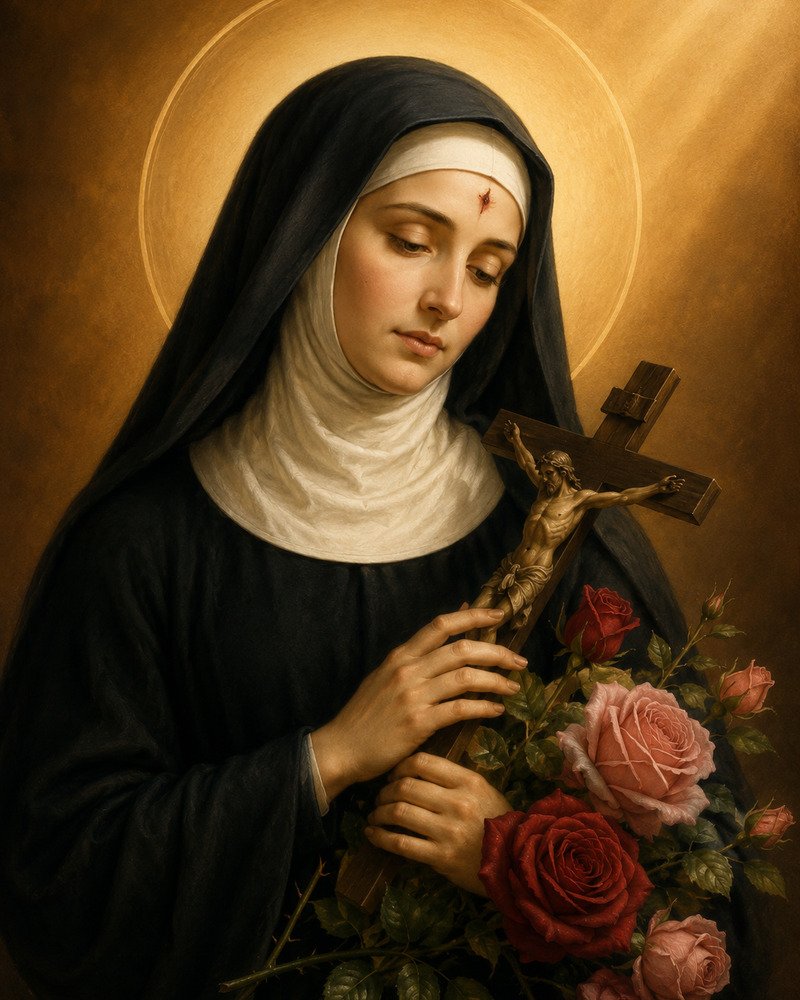
The popup uses the same devotional portrait shown on Rita’s Saints-directory card. Her familiar habit, crucifix, thorn, and rose imagery comes from later sacred iconography.
St. Rita of Cascia
Life and Witness
Rita was born near Cascia in Umbria around the end of the fourteenth century. The documentary record for her early life is limited, and some familiar details come from later hagiographic tradition. What the Church consistently remembers is the unusual breadth of her vocation: Rita knew married life, motherhood, widowhood, bereavement, and finally Augustinian religious life.
Traditional biographies describe a marriage lived within the violent culture of local family feuds. Her husband was eventually killed. Rita’s response became one of the central reasons she is remembered as a woman of peace. Rather than feeding a cycle of revenge, she sought forgiveness and reconciliation. Later stories say she feared her sons would avenge their father and prayed that they would not commit grave violence. Both sons died while still young.
After losing her husband and sons, Rita sought admission to the Augustinian monastery in Cascia. Tradition says her entrance was complicated by the unresolved hostility surrounding her family and that reconciliation between feuding parties helped open the way. Whether every later narrative detail can be established or not, peacemaking is deeply embedded in the oldest devotional memory of her.
In the monastery Rita lived a hidden life of prayer, obedience, penance, and service. Her spirituality centered strongly on the Passion of Christ. She wanted not merely to observe the Crucifix from a distance but to be transformed by Christ’s forgiving love. Later tradition says she received a wound on her forehead resembling a thorn from Christ’s crown, a sign that became one of her best-known iconographic attributes.
St. John Paul II emphasized that Rita’s greatness was expressed through love in every state of life. He called her a woman who found in faith an unshakable strength to be a peacemaker and described her as wife, mother, widow, and nun. He also highlighted forgiveness—not passive resignation—as one of the defining features of her spirituality.
The famous rose associated with Rita expresses the same pattern. A late tradition says that near the end of her life she asked for a rose from the garden at Roccaporena in winter and that one was found. Whatever the historical status of the episode, the rose became a symbol of hope flowering amid suffering and of charity stronger than bitterness.
Rita died in Cascia on May 22, 1457. Devotion to her grew steadily, and Pope Leo XIII canonized her in 1900. The worldwide devotion that calls her the saint of impossible causes is rooted not in a life where problems magically disappeared, but in a life that moved through family conflict, violent loss, grief, frustrated plans, and suffering without surrendering forgiveness or hope.
What St. Rita of Cascia Is Known For
- Peacemaking and forgiveness: her life is remembered above all for refusing to perpetuate family vengeance.
- Many states of life: she became holy as wife, mother, widow, and religious sister.
- Devotion to the Passion: the Crucified Christ shaped her understanding of suffering, forgiveness, and love.
- The wound of the thorn: later tradition associates her forehead wound with mystical participation in Christ’s crown of thorns.
- The rose: a devotional symbol of hope and grace appearing amid winter and suffering.
- “Impossible” causes: generations of Catholics have turned to her when circumstances seem closed, conflicted, or hopeless.
Intercession & Patronage
Why Catholics Ask St. Rita of Cascia to Intercede
Catholics ask St. Rita to intercede because she lived through circumstances that could easily have produced bitterness: family conflict, violent death, grief, and blocked hopes. The Church remembers her not as someone who escaped suffering but as someone who answered it with forgiveness, prayer, and practical peacemaking. That is why people bring her situations that feel impossible.
References
- St. John Paul II — Address to pilgrims devoted to St. Rita, May 20, 2000
- Magisterium — St. John Paul II address on St. Rita
- Basilica of St. Rita of Cascia — historical and spiritual material on Rita
- Basilica of St. Rita — Fifteen Thursdays devotional history and peacemaking tradition
- Vatican Jubilee history — canonization of St. Rita in 1900
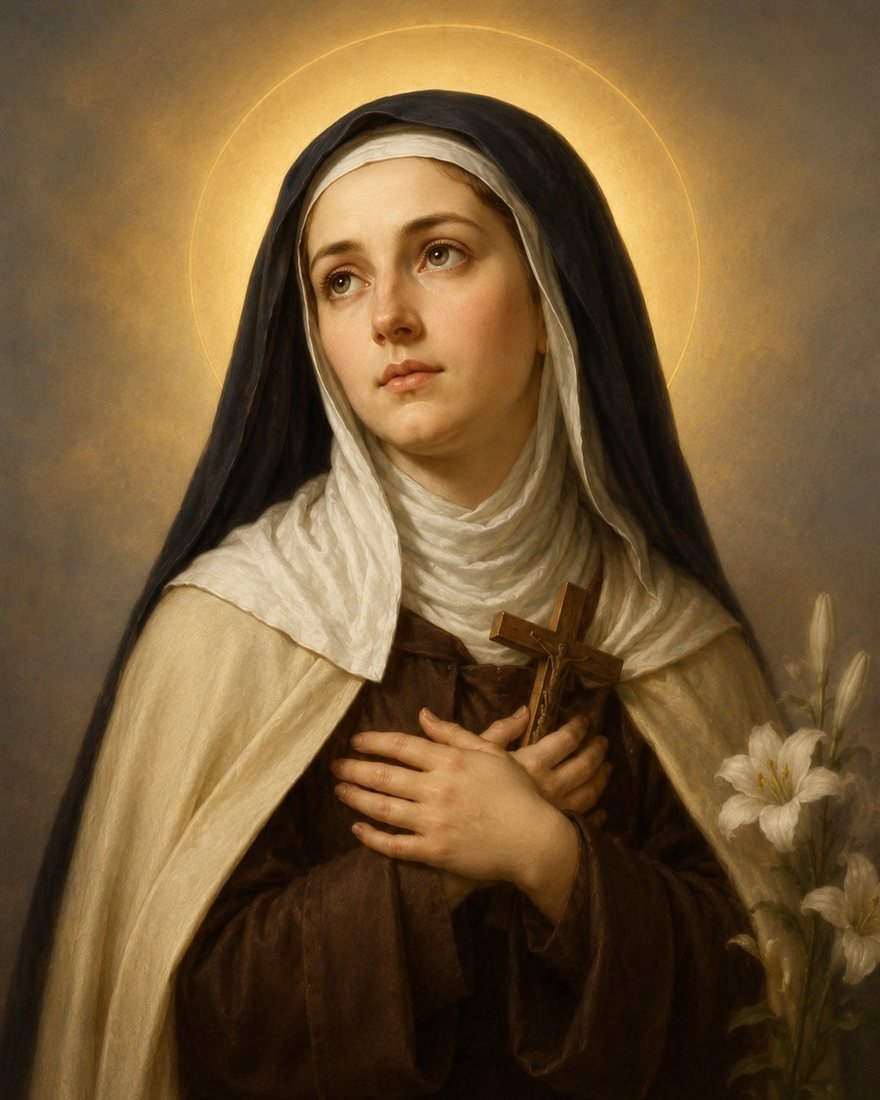
The popup uses the same devotional portrait shown on the Saints-directory card. It is later sacred art and is not presented as a verified likeness from life.
St. Mary Magdalene de’ Pazzi
Life and Witness
Mary Magdalene de’ Pazzi was born Caterina de’ Pazzi in Florence on April 2, 1566, into a prominent family. From childhood she showed an unusually intense interior life and a strong attraction to prayer. Benedict XVI noted that she was especially drawn to intimate conversation with God and that her spiritual development centered early on the Eucharist.
She made her First Communion at about ten and soon afterward privately vowed virginity. After a period of discernment and resistance from family expectations, she entered the Carmelite monastery of Santa Maria degli Angeli in Florence, taking the name Mary Magdalene. The monastery’s frequent reception of Holy Communion was one of the reasons it attracted her.
Her religious life became associated with extraordinary mystical experiences. During periods of ecstasy she spoke at length about the Trinity, Christ’s Passion, the Holy Spirit, Scripture, and the renewal of the Church. Her sisters wrote down what she said, producing collections that preserve her spiritual language. These writings can sound dramatic, but their central theme is remarkably simple: she wanted the love of God received in prayer to become purifying love for the Church and for other people.
One of the most important parts of her biography is less spectacular. After early consolations, Mary Magdalene passed through several years of severe spiritual trial. She experienced dryness, temptation, darkness, and a sense of distance from God. She remained within community life, continued prayer, and learned fidelity without emotional consolation. This long testing gives her spirituality a depth that would be lost if she were remembered only for ecstasies.
Her love for the Church was ardent and sometimes anguished. She prayed for clergy, religious life, and reform and dictated letters calling people to deeper fidelity. Benedict XVI described her as a symbolic figure of a “living love” who reminds Christians that the mystical dimension belongs to every Christian life—not as extraordinary visions, but as real communion with God that transforms conduct.
Within the convent she also carried ordinary responsibilities, including formation of younger sisters. Accounts of her life remember a demanding but affectionate concern for the community. Her spirituality was not self-absorbed: love of God was meant to make a person more truthful, more charitable, more available to the Church, and more willing to endure purification.
Mary Magdalene de’ Pazzi died in Florence on May 25, 1607. Pope Urban VIII beatified her in 1626 and Pope Clement IX canonized her in 1669. Her legacy is particularly strong in the Carmelite tradition and in Christian teaching on the relationship between contemplative prayer, spiritual desolation, ecclesial love, and reform.
What St. Mary Magdalene de’ Pazzi Is Known For
- Carmelite mysticism: her dictated spiritual texts explore the Trinity, the Passion, the Holy Spirit, and divine love.
- Eucharistic devotion: frequent Communion was central to her spiritual life from youth.
- Love for the Church: she prayed intensely for renewal and dictated letters encouraging reform and fidelity.
- Perseverance in spiritual darkness: years of dryness and temptation tested a spirituality first marked by extraordinary consolation.
- Purity and single-hearted love: the Roman Missal’s prayer for her feast explicitly asks that the faithful imitate her purity and love.
- Formation of others: she served within her Carmelite community in responsibilities connected with younger religious.
Intercession & Patronage
Why Catholics Ask St. Mary Magdalene de’ Pazzi to Intercede
Catholics ask St. Mary Magdalene de’ Pazzi to intercede when prayer feels either overwhelmingly intense or painfully empty. Her life contains both mystical consolation and years of darkness. She teaches that genuine love of God is tested by perseverance and becomes visible in love of the Church, concern for other people, and fidelity to one’s vocation.
References
- Pope Benedict XVI — Letter for the fourth centenary of St. Mary Magdalene de’ Pazzi’s death
- Magisterium — Roman Missal Proper of Saints: St. Mary Magdalene de’ Pazzi
- Magisterium — document corpus includes Benedict XVI’s 2007 letter on St. Mary Magdalene de’ Pazzi
- Carmelite Order — official Carmelite resources
- Butler’s Lives of the Saints — May volume/index
The popup uses the same devotional portrait shown on the Saints-directory card. It is later sacred art and is not presented as a verified likeness from life.
St. Philip Neri
Life and Witness
St. Philip Neri was born in Florence in 1515 and grew up with a naturally warm, cheerful temperament. As a young man he was sent to work with a relative near Monte Cassino, where a prosperous future seemed possible. Instead, a deep conversion redirected his life. He left the business opportunity behind and went to Rome, arriving with little money and no carefully mapped career. What followed was nearly sixty years of service to a city that would come to know him as its “Apostle.”
Philip spent his early Roman years in prayer, study, tutoring, and quiet works of mercy. He visited hospitals, helped pilgrims, sought out the poor, and formed friendships with people who might never have entered a formal religious setting. His holiness was never cold or severe. Pope St. John Paul II described the “saint of joy” as someone whose cheerful and relaxed way of educating others was joined to fraternal generosity and patience. Philip understood that people often opened their hearts more readily when they felt loved rather than judged.
He gathered men for informal meetings of prayer, Scripture, spiritual conversation, music, and discussion of the lives of the saints. These gatherings eventually became the Oratory. They were not built around Philip making himself important; their purpose was to lead people toward Jesus Christ, the sacraments, and concrete charity. Pope Francis emphasized that from Philip’s friendship with Christ came prayer, listening to the Word of God, preparation for the sacraments, study of the saints and Church history, and works of charity for the poor.
Philip was ordained a priest in 1551. The confessional became one of the great centers of his ministry. He had a gift for reading people without humiliating them. He could be gentle, funny, direct, or deliberately playful when pride needed to be punctured. Stories about his humor are famous, but the humor had a spiritual purpose: he wanted people to become simple, humble, free, and joyful in God. His well-known sayings warning against melancholy and scrupulosity reflect a pastoral instinct that holiness should make a person more trusting, charitable, and alive.
He also organized pilgrimages to the Seven Churches of Rome and encouraged practical service to the sick and poor. During times when Rome was crowded with pilgrims, Philip and his companions helped provide food and care. His love for people was personal. He formed young men, counseled laypeople, advised clergy and future saints, and remained accessible to ordinary Romans whose lives were complicated, imperfect, and in need of patient guidance.
The Congregation of the Oratory developed from this circle of priests and brothers living a common spiritual life without taking religious vows in the manner of a monastic order. Philip resisted unnecessary rigidity and wanted the Oratory to preserve freedom, fraternity, prayer, learning, music, and pastoral closeness to people. His influence spread well beyond the community he founded.
Philip’s joy was not superficial cheerfulness. It rested on long prayer, Eucharistic devotion, confession, humility, and a deep experience of the Holy Spirit. The Roman Missal asks that the Spirit kindle in Christians the same fire with which Philip’s heart was filled. His life shows a charity that could laugh with people, sit with them in sorrow, correct them without crushing them, and patiently lead them toward Christ.
He died in Rome on May 26, 1595, after celebrating Mass and receiving visitors. He was canonized in 1622. Centuries later, the Church still remembers him not simply as an organizer or reformer but as a priest whose holiness made people feel that the Christian life could be serious without becoming gloomy, disciplined without becoming harsh, and deeply prayerful while remaining full of human warmth.
What St. Philip Neri Is Known For
- The “Apostle of Rome”: he spent almost six decades evangelizing the city through friendship, confession, preaching, prayer, and charity.
- Christian joy: his cheerful temperament and humor became tools for humility and spiritual freedom rather than entertainment for its own sake.
- Spiritual direction and confession: generations of Romans sought his counsel because he combined insight with patience and affection.
- The Oratory: the community that grew around his prayer meetings became the Congregation of the Oratory.
- Care for the poor, sick, and pilgrims: practical works of mercy accompanied his preaching and spiritual formation.
- Prayer and the Holy Spirit: Church texts remember the extraordinary interior fire that animated his ministry.
Intercession & Patronage
Why Catholics Ask St. Philip Neri to Intercede
Catholics ask St. Philip Neri to intercede when faith has become heavy, anxious, isolated, or joyless. His life shows that charity can be both serious and cheerful: he listened closely, served people in practical need, used humor to loosen pride and fear, and continually directed people toward Christ, prayer, and the sacraments.
References
- Pope Francis — Message for the 500th anniversary of the birth of St. Philip Neri (2015)
- St. John Paul II — Letter for the fourth centenary of the death of St. Philip Neri (1994)
- Magisterium AI — St. John Paul II, address to the General Chapter of the Oratory of St. Philip Neri
- Magisterium AI — Roman Missal, Proper of Saints: St. Philip Neri
- Butler’s Lives of the Saints — St. Philip Neri (Alban Butler text)
- Butler’s Lives of the Saints — searchable calendar edition

The popup uses the same devotional portrait shown on the Saints-directory card. It is later sacred art rather than a verified likeness from life.
St. Joan of Arc
Life and Witness
St. Joan of Arc was born around 1412 in Domrémy, a small village in a France fractured by the Hundred Years’ War. She grew up in a peasant household and received no formal scholarly education, but witnesses later remembered a serious, prayerful girl who knew ordinary domestic work, loved the Church, and cared deeply about people who were poor or suffering. Benedict XVI specifically noted her compassion for the poorest, the sick, and those wounded by the violence of war.
At about thirteen, Joan said she began receiving a mystical call associated with St. Michael the Archangel, St. Catherine of Alexandria, and St. Margaret. She understood that call not merely as a private consolation but as a demand for greater prayer, sacramental life, and eventually a public mission. She made a commitment to virginity and intensified her participation in Mass, confession, Communion, and silent prayer.
Joan became convinced that she was to help the Dauphin Charles, whose claim to the French throne was endangered, and that he should be crowned at Reims. The idea that an unknown teenage village girl could influence kings, clergy, and soldiers seemed impossible. Yet after repeated refusals she gained access to military and political leaders, underwent examination by theologians at Poitiers, and was allowed to accompany the French effort to relieve Orléans in 1429.
Her courage helped revive a demoralized cause. Joan carried a banner and appeared with the army, but Benedict XVI stressed that her mission among soldiers also had an evangelizing character. She urged confession, prayer, moral discipline, and respect for civilians. Before fighting at Orléans she sent the English a proposal urging peace and withdrawal. When peaceful appeals failed, she participated in the campaign, was wounded, and returned to the field.
The lifting of the siege of Orléans was followed by further French success and the coronation of Charles VII at Reims on July 17, 1429. Joan considered the coronation a central part of what she had been called to accomplish. Yet political support soon weakened. In May 1430 she was captured by Burgundian forces and eventually transferred to English custody.
Her trial at Rouen was deeply entangled with politics. The nineteen-year-old prisoner faced trained clerics and legal experts without an advocate. The surviving trial record shows extraordinary clarity, courage, and sometimes humor in her answers. She was questioned about her voices, clothing, obedience to the Church, and mission. After pressure, threats, imprisonment, and a brief abjuration obtained under extreme circumstances, she was condemned as a relapsed heretic.
Joan was burned at the stake on May 30, 1431. Witnesses reported that she repeatedly invoked the name of Jesus and asked that a cross be held before her. About twenty-five years later, a formal rehabilitation trial examined the earlier proceedings and declared the condemnation unjust and invalid. She was beatified in 1909 and canonized by Pope Benedict XV in 1920.
Her holiness cannot be reduced to military success. What stands out in the Church’s presentation of Joan is the union of contemplation and action: a young woman of prayer who believed God had asked something difficult of her, who showed tenderness toward the suffering, who remained sacramentally rooted, and who continued to call on Jesus even when abandoned by political allies and condemned by a corrupted process.
What St. Joan of Arc Is Known For
- The Maid of Orléans: her presence helped inspire the relief of Orléans and the French campaign leading to Charles VII’s coronation.
- Courage rooted in prayer: her public mission grew from an intense sacramental and contemplative life.
- Compassion: Vatican sources emphasize her love for the poor, sick, and suffering amid war.
- Fidelity under interrogation: the surviving trial records preserve a remarkably direct and courageous voice.
- Martyr-like witness: she died invoking Jesus after an unjust process later formally overturned.
- Contemplation joined to action: the Church often presents Joan as an example of mystical prayer translated into courageous service.
Intercession & Patronage
Why Catholics Ask St. Joan of Arc to Intercede
Catholics ask St. Joan of Arc to intercede when courage must be joined to prayer: when a person feels young, unqualified, misunderstood, or surrounded by forces larger than themselves. Her story is powerful because tenderness and strength coexist in it. She cared for the suffering, sought peace when possible, acted decisively when she believed duty required it, and called on Jesus when every earthly support had failed.
References
- Pope Benedict XVI — General Audience on St. Joan of Arc (2011)
- Vatican News — St. Joan of Arc, Virgin
- Magisterium AI — Patron Saints in the Catholic Church (includes Joan among patrons of soldiers)
- EWTN — Benedict XVI catechesis on St. Joan of Arc
- Catholic Encyclopedia — St. Joan of Arc, hosted by EWTN
- Butler’s Lives of the Saints — searchable calendar edition
The popup uses the same devotional portrait shown on the Saints-directory card. The Child Jesus and lily commonly shown with Anthony are traditional sacred iconography.
St. Anthony of Padua
Life and Witness
St. Anthony of Padua was born Fernando in Lisbon around 1195. He entered religious life with the Canons Regular of St. Augustine and later moved to the monastery of the Holy Cross at Coimbra, one of Portugal’s important centers of learning. There he immersed himself in Scripture and the Fathers of the Church. His extraordinary command of the Bible would later make him one of the great preachers of the thirteenth century.
A decisive change came in 1220 when the bodies of five Franciscan friars martyred in Morocco were brought through Coimbra. Their willingness to give everything for Christ stirred Fernando deeply. He asked to join the Friars Minor, took the name Anthony, and hoped to preach in Morocco. Illness forced him to abandon that plan, and a storm diverted his return journey to Sicily. What seemed like failure became the route to his true mission.
Anthony initially lived quietly among the friars in Italy. His learning was not widely known until an unexpected occasion when he was asked to preach. His knowledge of Scripture, clarity of thought, and spiritual intensity astonished those present. He was then sent throughout Italy and France to preach, teach, reconcile people to the Church, and combat serious doctrinal confusion.
Benedict XVI emphasized that Anthony united intelligence with mystical fervor. St. Francis of Assisi himself authorized him to teach theology to the friars, with the warning that study must never extinguish prayer and devotion. Anthony therefore became an early architect of Franciscan theology, but his scholarship remained pastoral. He wanted Scripture to change lives rather than simply win arguments.
His preaching repeatedly defended the poor against greed and exploitation. Benedict XVI highlighted Anthony’s appeals to the wealthy to welcome the poor and become merciful. His concern was practical enough that tradition connects him with efforts on behalf of debtors and people trapped by unjust economic pressures. He preached repentance, confession, humility, chastity, generosity, and confidence in Christ.
Anthony’s popularity grew enormously, yet he also needed solitude. Near the end of his life he withdrew for prayer at Camposampiero. Exhausted and ill, he asked to be taken back toward Padua and died at Arcella on June 13, 1231. He had been a Franciscan for only about a decade.
He was canonized in 1232, less than a year after his death, and declared a Doctor of the Church in 1946. Over the centuries countless popular devotions gathered around him. The most famous is asking his intercession for lost things. The tradition is commonly traced to a story that a novice took Anthony’s valuable psalter containing teaching notes; Anthony prayed for its return, and the book was restored.
Yet the saint behind the popular “finder of lost things” devotion was much larger than the custom. He was a man who loved Scripture, preached mercy, challenged social injustice, cared about ordinary people, and insisted that true faith must be animated by charity. Benedict XVI summarized Anthony’s teaching with the conviction that love gives faith its life.
What St. Anthony of Padua Is Known For
- Extraordinary preaching: crowds came to hear his Scripture-centered preaching and calls to conversion.
- Doctor of the Church: his theological and biblical teaching earned him the title Evangelical Doctor.
- Franciscan theology: St. Francis personally approved Anthony’s teaching of theology to the friars.
- Defense of the poor: he condemned greed and urged concrete mercy toward people suffering poverty and debt.
- Confession and conversion: reconciliation with God was a recurring theme of his preaching.
- Finding what is lost: centuries of popular devotion invoke his intercession for lost objects and, more deeply, for lost faith, peace, or direction.
Intercession & Patronage
Why Catholics Ask St. Anthony of Padua to Intercede
Catholics ask St. Anthony to intercede because his ministry joined learned theology to very ordinary human need. He preached to crowds, defended the poor, heard confessions, taught Scripture, and became remembered as someone who helped people recover what had been lost. The best form of the devotion follows the Basilica’s own prayer: not merely finding an object, but finding again grace, virtue, peace, and the will of God.
References
- Pope Benedict XVI — General Audience on St. Anthony of Padua (2010)
- Magisterium AI — Roman Missal, Proper of Saints: St. Anthony of Padua
- Magisterium — St. John Paul II on Franciscan theology and St. Anthony’s teaching
- Basilica of St. Anthony of Padua — “Help me find” devotion
- Franciscan Media — St. Anthony of Padua: Finder, Teacher, Matchmaker, Guide
- Franciscan Media — St. Anthony of Padua, Saint of the Day
- Butler’s Lives of the Saints — searchable calendar edition
The popup uses the same devotional portrait shown on the Saints-directory card. It is later sacred art and not a verified portrait from life.
St. Germaine Cousin
Life and Witness
St. Germaine Cousin was born in 1579 in Pibrac, a village near Toulouse in southern France. The older sources describe her as having a deformed hand and scrofula, a chronic disease that could cause visible swelling and sores. Her mother died when she was very young. After her father remarried, Germaine’s childhood became marked by exclusion and harsh treatment within her own household.
The traditional accounts say that fear of her illness was used as a reason to keep her away from the other children. She was sent out to tend sheep and often slept apart from the family, sometimes in a stable or rough loft. Whatever details of the later hagiographic stories may have grown in the telling, the core memory of Germaine is that of a disabled and neglected girl who lived at the margins of her own home.
What makes her story remarkable is not that suffering itself was good, but that cruelty did not teach her cruelty. The Catholic Encyclopedia remembers her as developing patience, humility, and a strong sense of God’s presence. Her solitude in the fields became a place of prayer. She loved the Eucharist, the Rosary, and the Angelus, and she tried to attend Mass whenever she could.
Germaine was poor enough to have little food of her own, yet tradition consistently remembers her sharing what she had with people who were poorer still. She also gathered children from nearby farms and spoke to them about Jesus and Mary. In other words, the child who had received little tenderness at home became someone who gave spiritual and practical care to others.
Accounts say that over time the villagers who had once treated her as insignificant began to recognize the beauty of her life. Her family eventually softened and offered her a better place in the household, though tradition says she preferred the humble way of life she had already accepted. She died quietly in 1601, only about twenty-two years old.
After her death, devotion grew around her tomb in Pibrac. Later accounts record the discovery of her body and many reported cures and favors. Her cause moved slowly across centuries; Pope Pius IX beatified her in 1854 and canonized her in 1867.
Germaine’s life deserves careful telling because abuse can be romanticized in old saint stories. Her holiness does not mean that neglect or mistreatment should be accepted as good. Rather, she is remembered because another person’s cruelty did not determine the kind of person she became. She remained capable of prayer, generosity, forgiveness, and tenderness toward children and the poor.
What St. Germaine Cousin Is Known For
- Hidden holiness: she lived almost entirely outside public attention as a poor village shepherdess.
- Patience without bitterness: tradition remembers her responding to harsh treatment with forgiveness rather than retaliation.
- Love of the Eucharist and prayer: Mass, the Rosary, and the Angelus were central to her spirituality.
- Charity from poverty: she shared her own limited food with people in need.
- Care for children: she gathered village children and taught them about the faith.
- Dignity amid disability and illness: her life became a powerful witness that bodily difference and social rejection do not diminish a person’s worth before God.
Intercession & Patronage
Why Catholics Ask St. Germaine Cousin to Intercede
Catholics ask St. Germaine Cousin to intercede especially for people who feel unwanted, ashamed of illness or disability, poor, or wounded by family cruelty. Her life is not a lesson that abuse should be tolerated; it is a witness that a person can retain tenderness, dignity, prayer, and generosity even after being treated as though they had little value.
References
- Vatican News — Saint of the Day, June 15: St. Germaine Cousin
- Catholic Encyclopedia — St. Germaine Cousin
- EWTN — St. Germaine Cousin
- Magisterium AI — Patron Saints in the Catholic Church (includes Germaine among patrons of shepherds)
- U.S. Catholic — St. Germaine Cousin, modern patronage discussion
- Butler’s Lives of the Saints — searchable calendar edition
The popup uses the same devotional portrait shown on the Saints-directory card. Unlike many earlier saints, Thomas More is known through contemporary painted portraits, but this website image remains devotional art rather than a claim of exact reproduction.
St. Thomas More
Life and Witness
St. Thomas More was born in London in 1478 into a respected legal family. He received an excellent education, studied at Oxford and the Inns of Court, and became one of the leading humanists of Renaissance England. His friendships included Erasmus and other major scholars, but learning never replaced prayer. He spent time discerning religious life, practiced serious personal devotion, and eventually recognized that his vocation was marriage, family life, and service as a layman in public affairs.
More married Jane Colt in 1505, and they had four children. After Jane died in 1511, he married the widow Alice Middleton, who had a daughter of her own. Their home became a large blended household filled with children, relatives, guests, study, prayer, music, and conversation. St. John Paul II emphasized that More was an affectionate and faithful husband and father who took unusual care with the moral and intellectual education of his children, including his daughters at a time when advanced education for women was far from universal.
His public career rose steadily. He became a lawyer, member of Parliament, diplomat, trusted royal servant, and eventually Lord Chancellor under Henry VIII. More was not a modern advocate of religious pluralism in every respect, and an accurate biography must acknowledge the severe religious politics of his age, including his own involvement in enforcement against heresy. His sainthood does not require pretending that every policy judgment he made was beyond criticism.
The decisive crisis came when Henry VIII sought to end his marriage to Catherine of Aragon and increasingly asserted royal supremacy over the Church in England. More tried to avoid public confrontation. He resigned as Lord Chancellor in 1532 rather than participate in measures he could not support in conscience. He remained largely silent about the king’s marriage and did not organize rebellion.
Silence, however, was not enough. Parliament required an oath connected with the succession and the king’s ecclesiastical supremacy. More was willing to accept parts concerning civil succession but could not affirm what he believed denied the spiritual authority of the Church. He was imprisoned in the Tower of London for more than a year.
His letters from prison reveal the human cost. He loved his family deeply, especially his daughter Margaret Roper, who visited him and pleaded with him to find some way to take the oath. More did not treat conscience as stubborn individual preference. He prayed, examined the arguments, feared self-deception, and repeatedly tried to act without condemning others who decided differently. His conflict was between obedience to temporal authority, which he valued, and what he believed he owed to God.
He was convicted of treason after testimony he denied and was beheaded on July 6, 1535. His final witness combined seriousness with the humor that had marked his life. He was beatified in 1886 and canonized with St. John Fisher in 1935. In 2000 St. John Paul II formally proclaimed him patron of statesmen and politicians.
More’s charity appears in the way he held together public service and private love: education of children, hospitality, prayer with his household, concern for the poor, friendship, scholarship, and a conscience unwilling to turn truth into a political convenience. His martyrdom was the last expression of a longer habit of trying to place power beneath truth rather than truth beneath power.
What St. Thomas More Is Known For
- Integrity of conscience: he accepted imprisonment and death rather than swear what he believed to be false.
- Public service: his long legal and political career culminated in service as Lord Chancellor.
- Family life: Church documents emphasize his affection as husband and father and his commitment to his children’s education.
- Humanist scholarship: he was a major intellectual figure of Renaissance Europe and author of Utopia and many religious works.
- Humor and friendship: his wit remained present even under pressure, but was joined to serious prayer and self-examination.
- Martyrdom: he died because he would not subordinate what he believed to be the Church’s spiritual authority to the demands of the crown.
Intercession & Patronage
Why Catholics Ask St. Thomas More to Intercede
Catholics ask St. Thomas More to intercede when truth, family love, career, and public pressure seem to collide. He did not rush toward martyrdom. He tried silence, legal precision, resignation, prayer, and careful conscience. His witness is valuable precisely because he knew the cost to his wife, children, reputation, and life and still believed that power could not make falsehood true.
References
- St. John Paul II — Apostolic Letter proclaiming St. Thomas More Patron of Statesmen and Politicians
- Vatican Jubilee 2000 — Biography of St. Thomas More
- Magisterium AI — document corpus includes E sancti Thomae Mori
- Magisterium AI — Patron Saints in the Catholic Church (Thomas More listed for statesmen/civil servants)
- Butler’s Lives of the Saints — searchable calendar edition
The popup uses the same devotional portrait shown on the Saints-directory card. No historically verified portrait of Paul from life survives.
St. Paul the Apostle
Life and Witness
St. Paul was born Saul in Tarsus in Cilicia, a major city of the eastern Roman world. He was Jewish, belonged to the tribe of Benjamin, knew the culture of the Greek-speaking diaspora, and possessed Roman citizenship. Acts describes him as trained in Jerusalem under Gamaliel. He also learned a manual trade, traditionally translated as tentmaking, which later allowed him to support himself while preaching.
Paul first appears in the Christian story as an opponent. Convinced that the new movement centered on Jesus threatened fidelity to Israel’s faith, he approved the persecution of Christians and participated in efforts to suppress the Church. He never hid this past. In his letters he later spoke of it with painful honesty, not to remain trapped in shame but to magnify the mercy of God.
On the road to Damascus, everything changed. Paul encountered the risen Christ in an experience he described as revelation and vocation. Benedict XVI emphasized that this was not merely a gradual change of opinion. Paul understood himself as having been seized by Christ and called by grace. The persecutor became an apostle.
From then on, enormous energy was directed toward proclaiming Jesus Christ. Paul traveled through Asia Minor, Greece, Macedonia, and other regions, preaching especially among Gentiles and establishing communities. His journeys involved friendship and collaboration as much as heroic individual effort. Acts and the letters name women and men who hosted churches, carried messages, worked beside him, suffered with him, and helped sustain the mission.
Paul’s letters reveal a pastor with a fierce mind and a tender heart. He could argue intensely over theology and discipline, but he also worried like a parent over communities he had founded. Pope Francis has highlighted this fatherly concern. Paul collected aid for poor Christians in Jerusalem, urged reconciliation across ethnic divisions, encouraged generosity, and insisted that even the greatest spiritual gifts are empty without love.
His life was physically hard. He listed imprisonments, beatings, shipwrecks, hunger, danger, exhaustion, and anxiety for the churches. Yet he interpreted endurance not as self-glorification but as participation in the Cross of Christ. The love of Christ, he wrote, impelled him. Grace did not simply forgive his past; it gave his entire life a new direction.
Paul eventually reached Rome as a prisoner. Ancient Christian testimony places his martyrdom there under Nero, traditionally by beheading because he was a Roman citizen. The Church venerates his tomb at the Basilica of St. Paul Outside the Walls.
His legacy is inseparable from the New Testament letters bearing his name, several of which are universally recognized as directly Pauline and others transmitted within the Pauline tradition. Through them the Church continues to hear a man transformed by mercy, convinced that no human status is enough to save, that Christ’s grace can remake a life, and that faith must become love expressed in service.
What St. Paul the Apostle Is Known For
- Apostle to the Gentiles: Paul made the universal scope of the Gospel a central mission of his life.
- Conversion and grace: his transformation from persecutor to apostle is one of Christianity’s great witnesses to mercy.
- Missionary endurance: he traveled widely, founded churches, and endured persecution, imprisonment, and hardship.
- New Testament letters: his writings profoundly shape Christian teaching on Christ, grace, faith, the Church, moral life, suffering, hope, and love.
- Pastoral charity: he worried intensely about communities, organized aid for the poor, and taught that gifts without love are nothing.
- Martyrdom in Rome: ancient Christian tradition remembers him as sealing his apostolic witness with his blood.
Intercession & Patronage
Why Catholics Ask St. Paul the Apostle to Intercede
Catholics ask St. Paul to intercede when they need conversion, courage to begin again, endurance in ministry, or confidence that grace can transform a damaged past. His letters are unusually personal: the man who once harmed Christians later spent himself for their good, teaching that God’s power is revealed not in self-sufficiency but in a life surrendered to Christ.
References
- Pope Benedict XVI — General Audience: Paul of Tarsus (2006)
- Pope Benedict XVI — Saint Paul: Life before and after Damascus (2008)
- Pope Benedict XVI — Saint Paul’s concept of apostolate (2008)
- Pope Francis — Paul, the true apostle (2021)
- Magisterium AI — corpus listing Benedict XVI’s catecheses on St. Paul
- Magisterium — Benedict XVI, Theology of the Cross in St. Paul
- Butler’s Lives of the Saints — St. Paul, Apostle of the Gentiles / June 29
The popup uses the same devotional portrait shown on the Saints-directory card. It is sacred art and not a verified likeness from Peter’s lifetime.
St. Peter the Apostle
Life and Witness
St. Peter began as Simon, a Galilean fisherman from Bethsaida who worked on the Sea of Galilee and had a brother, Andrew. The Gospels also indicate that he was married, since Jesus healed his mother-in-law. Benedict XVI notes that Simon appears to have run a small fishing business with the family of Zebedee. He was therefore not a detached religious specialist but a working man with family, responsibilities, and an ordinary trade.
Jesus gave Simon the name Cephas, translated Peter, meaning rock. The name was not merely affectionate; Benedict XVI described it as a mandate. Peter emerged within the Gospels as a spokesman among the disciples: impulsive, generous, often courageous, and sometimes painfully mistaken.
He confessed Jesus as the Messiah, attempted to walk on water, asked practical questions, protested when Jesus spoke of the Cross, and promised loyalty beyond his actual strength. During the Passion he denied Jesus three times. The Gospels do not hide his failure. That honesty is essential to Peter’s spiritual appeal: Christian leadership begins not with a flawless résumé but with mercy received after collapse.
After the Resurrection, John’s Gospel portrays Jesus asking Peter three times whether he loves him and entrusting him with the care of the flock. The repetition mirrors the three denials. Peter’s authority is therefore inseparable from repentance, love, and pastoral service.
In Acts, Peter takes a prominent role in the earliest Church. He speaks at Pentecost, heals, faces arrest, guides important decisions, and receives the Gentile Cornelius into fellowship after a vision that expands his understanding of God’s work. His leadership is real, but it is not solitary. He acts within a community of apostles and is himself capable of growth and correction.
The New Testament also preserves tension between Peter and Paul at Antioch over table fellowship with Gentile Christians. The episode is valuable because it shows that apostolic holiness did not erase human weakness or disagreement. Peter’s greatness lies partly in the fact that the Church remembers both his authority and the moments when grace had to correct him.
Ancient Christian tradition places Peter’s final ministry and martyrdom in Rome during Nero’s persecution. A strong early tradition says he was crucified, later accounts adding that he was crucified upside down at his request because he did not consider himself worthy to die exactly as Christ had. The precise details cannot all be established with equal certainty, but Peter’s Roman martyrdom is deeply rooted in early testimony.
The Church venerates his tomb beneath St. Peter’s Basilica. Catholics see in Peter a pattern of pastoral leadership transformed by mercy: called from ordinary work, given great responsibility, humbled by failure, restored by Christ, and finally faithful unto death.
What St. Peter the Apostle Is Known For
- The Rock: Jesus gave Simon the name Peter and entrusted him with a distinctive role among the apostles.
- Fisherman called to discipleship: his vocation transformed ordinary work into apostolic mission.
- Confession of faith: he spoke the foundational confession that Jesus is the Christ.
- Failure and restoration: his denial and later reconciliation make him one of Scripture’s clearest witnesses to mercy after serious failure.
- Pastoral leadership: Acts portrays him preaching, discerning, healing, and guiding the early Christian community.
- Martyrdom in Rome: ancient tradition remembers him as giving his final witness there, making him a principal patron of the Roman Church.
Intercession & Patronage
Why Catholics Ask St. Peter the Apostle to Intercede
Catholics ask St. Peter to intercede when they need courage, leadership, repentance, or another chance after failure. His life refuses the idea that holiness requires never falling. Peter fell publicly and grievously, wept, accepted Christ’s mercy, and allowed that mercy to turn him into a shepherd capable of strengthening others.
References
- Pope Benedict XVI — General Audience: Peter, the fisherman (2006)
- Pope Benedict XVI — General Audience: Peter, the Apostle (2006)
- Pope Benedict XVI — General Audience: Peter, the rock (2006)
- Magisterium AI — corpus listing Benedict XVI’s catecheses on St. Peter
- Magisterium AI — Patron Saints in the Catholic Church, traditional trade patronages of Peter
- Butler’s Lives of the Saints — St. Peter, Prince of the Apostles / June 29

The popup uses the same paired devotional image shown on the Saints-directory card. It symbolizes the Church’s ancient tradition of honoring the two apostles together.
Sts. Peter and Paul
Life and Witness
The Church celebrates Sts. Peter and Paul together on June 29 not because their personalities or missions were identical, but because their different gifts converged in a common witness to Jesus Christ and, according to ancient tradition, in martyrdom at Rome. Pope Leo XIV described them in 2026 as two pillars of the Church: Peter chosen as shepherd of the flock and Paul as Apostle to the Gentiles.
Peter came from Galilee and followed Jesus during his earthly ministry. He knew Christ’s teaching, miracles, Passion, and Resurrection from within the circle of the Twelve. His story includes bold faith and painful weakness: he confessed Jesus as Messiah, later denied him, and was restored by the risen Lord with the command to feed Christ’s sheep.
Paul did not follow Jesus before the Crucifixion. He first encountered Christianity as an opponent and persecutor. His meeting with the risen Christ on the road to Damascus overturned his life. The persecutor became a missionary who crossed the Mediterranean world proclaiming salvation in Christ to Jews and Gentiles and founding communities far beyond Palestine.
Their relationship was not always easy. Paul visited Peter, recognized his distinctive apostolic role, and also publicly opposed him at Antioch during a dispute over table fellowship with Gentile Christians. The New Testament preserves the conflict rather than hiding it. Their unity therefore should not be imagined as a lack of disagreement. It was a deeper communion rooted in the same Lord and Gospel.
Peter’s mission emphasized pastoral communion and the strengthening of the brethren. Paul’s mission displayed the Gospel’s universal reach with extraordinary missionary energy. Together they embody two needs that the Church continually holds in tension: stability and expansion, unity and mission, rootedness and movement.
Both eventually became associated with Rome. Ancient Christian testimony remembers Peter as crucified and Paul as beheaded during Nero’s persecution. Their tombs became two of the great centers of Christian pilgrimage: St. Peter’s Basilica and the Basilica of St. Paul Outside the Walls.
The June 29 solemnity is therefore more than two biographies placed on the same date. It celebrates apostolic communion. Pope Leo XIV emphasized that their blood shed in Rome reveals a form of power different from domination: service to human life through witness to Christ. Their feast also has a long ecumenical dimension, especially in the relationship between the Church of Rome and the Ecumenical Patriarchate of Constantinople.
Peter and Paul show that the Church does not require saints to have identical temperaments, histories, or tasks. Peter was formed through years beside Jesus and through failure forgiven. Paul was seized by grace from outside the visible circle of the Twelve. Their paths met in one confession: Jesus Christ is Lord, and his Gospel is worth giving one’s life to proclaim.
What Sts. Peter and Paul Is Known For
- Pillars of the Church: Peter and Paul represent complementary forms of apostolic leadership and mission.
- Patrons of Rome: ancient tradition places both their martyrdoms in the city.
- Unity amid difference: their New Testament relationship includes cooperation, respect, disagreement, correction, and enduring communion in Christ.
- Pastoral leadership and missionary expansion: Peter is especially associated with shepherding the flock; Paul with carrying the Gospel to the nations.
- Martyrdom: both are remembered as sealing their apostolic testimony with blood under Nero.
- Apostolic communion: their joint solemnity expresses the unity of the Church’s faith across different vocations and gifts.
Intercession & Patronage
Why Catholics Ask Sts. Peter and Paul to Intercede
Catholics ask Sts. Peter and Paul to intercede for the Church because together they show what communion looks like when people have very different personalities and missions. Peter’s weakness was healed into shepherding; Paul’s violence was transformed into missionary love. Their shared feast asks the Church to be both rooted and missionary, united without demanding sameness.
References
- Pope Leo XIV — Homily for the Solemnity of Saints Peter and Paul, June 29, 2026
- Pope Leo XIV — Angelus for the Solemnity of Saints Peter and Paul, June 29, 2026
- Magisterium — General Audience reflecting on the Holy Apostles Peter and Paul
- Magisterium — Solemnity of Saints Peter and Paul homily (Pope Francis, 2023)
- Magisterium AI — 2026 corpus update including Pope Leo XIV’s Peter and Paul documents
- Butler’s Lives of the Saints — St. Peter and St. Paul entries for June 29
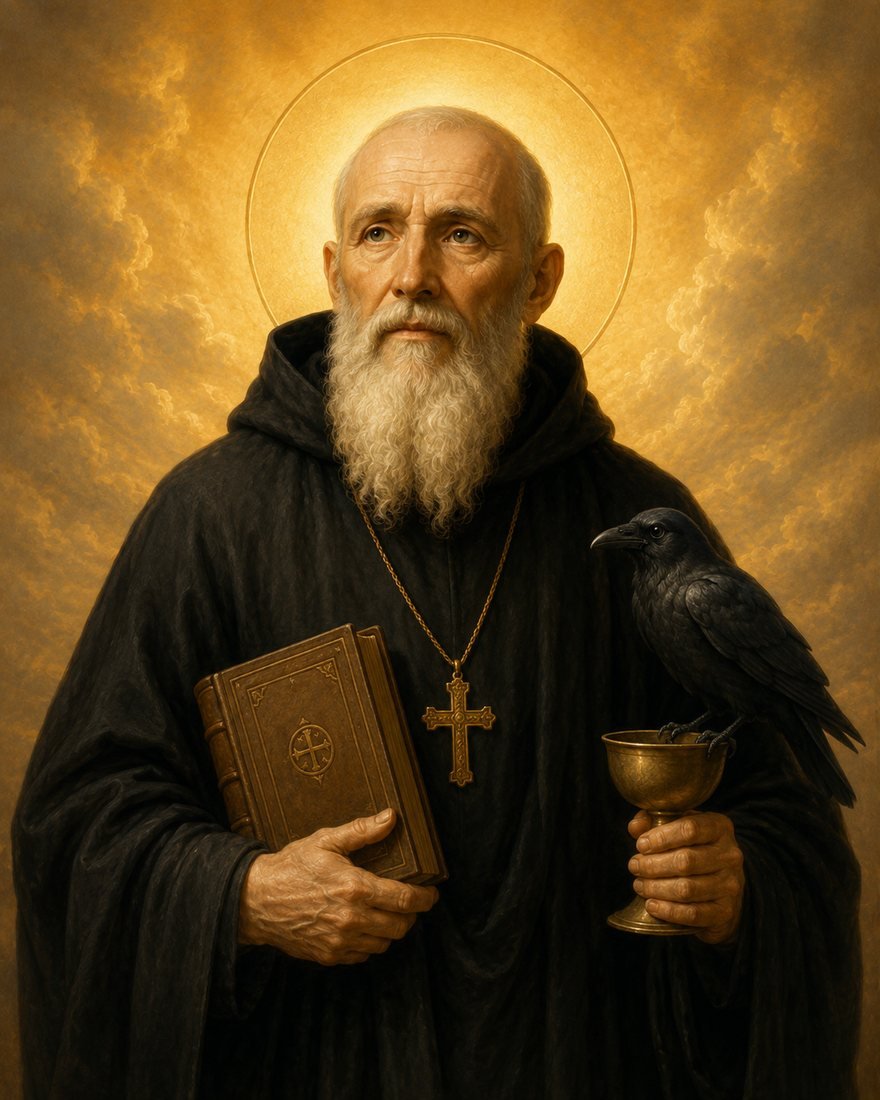
The popup uses the devotional portrait shown on the Saints-directory card. It is sacred art and is not presented as a verified likeness from life.
St. Benedict of Nursia
Life and Witness
Benedict was born around 480 as the western Roman world was passing through upheaval. St. Gregory the Great says the young Benedict was sent to Rome for study but became disillusioned by the moral atmosphere around him. He withdrew first to solitude near Subiaco, not because he hated people, but because he wanted a heart centered on God.
Others gradually sought him out. Through experience Benedict learned that communities need prayer, patience, accountability, mercy, and wise structure. At Monte Cassino he shaped the form of life expressed in the Rule of St. Benedict. The Rule is demanding but humane: it pays attention to worship and obedience, but also to sleep, food, work, illness, guests, the elderly, the young, and difficult personalities.
His charity appears especially in the Rule’s treatment of vulnerable people. The sick are to be cared for as Christ; guests are to be received as Christ; the abbot must correct without crushing. Benedict’s peace was therefore disciplined peace—formed through listening, humility, forgiveness, common prayer, and ordinary service.
Benedictine communities later became centers of prayer, hospitality, learning, agriculture, and culture across Europe. Pope Benedict XVI called him a fundamental point of reference for European civilization. His enduring gift is a spirituality in which holiness grows patiently through fidelity to God and to the people placed beside us.
What St. Benedict of Nursia Is Known For
- The Rule of St. Benedict: Prayer, work, stability, humility, hospitality, and charity shaped into a balanced common life.
- Western monasticism: His Rule became one of the most influential patterns of monastic life in the Latin West.
- Hospitality: His Rule commands that guests, especially the poor and pilgrims, be welcomed with reverence.
- Spiritual protection: Catholics have long invoked St. Benedict against temptation and evil. The St. Benedict Medal expresses prayers for God’s blessing and protection through his intercession; it is a sacramental, not a charm or magical object.
Intercession & Patronage
Why Catholics Ask St. Benedict of Nursia to Intercede
Catholics ask St. Benedict to intercede for steadiness: the grace to remain faithful when life feels fragmented, to make prayer part of ordinary work, and to build homes and communities where people are received with dignity.
References
- Pope Benedict XVI — General Audience on St. Benedict (9 April 2008)
- Magisterium — The Rule of St. Benedict
- EWTN — St. Benedict, Abbot and Founder of Western Monasticism
- Magisterium AI — Saints database research interface (used to cross-check identity, feast and patronage)
- Butler’s Lives of the Saints — searchable calendar edition
- Saint Benedict Center — Saint Benedict Medal: prayers for God’s blessing and protection
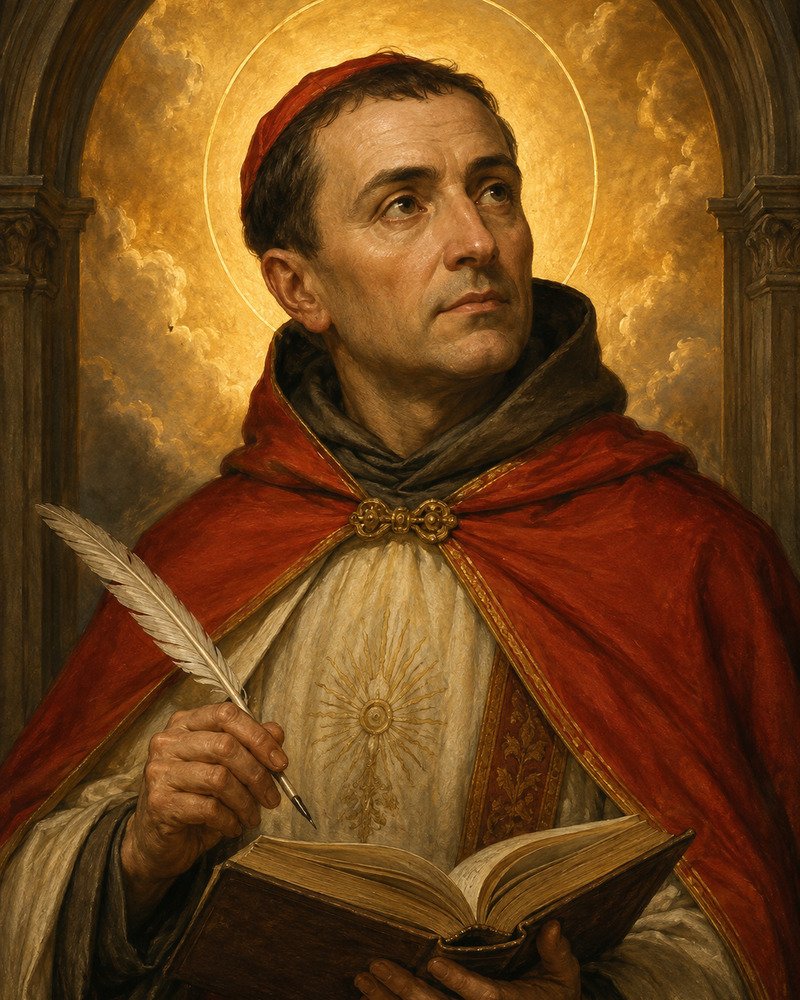
St. Bonaventure
Life and Witness
Bonaventure was born Giovanni di Fidanza, probably in 1217, and joined the Friars Minor after studies in Paris. His intellectual gifts were exceptional, but learning never became merely academic for him. He believed theology should move the whole person toward wisdom, worship, and love of God.
His writings repeatedly turn knowledge into prayer. In The Journey of the Mind into God, creation and the human soul become signs leading toward the Creator, while Christ crucified stands at the center. He wanted study to make a person humbler and more capable of wonder, not merely more argumentative.
When the Franciscan Order was strained by disagreements about poverty and the legacy of St. Francis, Bonaventure was elected Minister General. He traveled, listened, corrected, reconciled, and worked for unity. Pope Benedict XVI emphasized that he united contemplation with practical leadership.
Pope Gregory X later made him a cardinal-bishop and called him to the Second Council of Lyon, where he worked for Church unity and died in 1274. The Church remembers the “Seraphic Doctor” as a thinker whose brilliance remained warmed by prayer and affection for Christ.
What St. Bonaventure Is Known For
- The “Seraphic Doctor”: Rigorous theology united with ardent Franciscan love of God.
- Franciscan leadership: As Minister General he guided a divided order with practical wisdom.
- Contemplative theology: His study consistently ends in prayer and worship.
Intercession & Patronage
Why Catholics Ask St. Bonaventure to Intercede
Catholics ask St. Bonaventure to intercede when they need both a clear mind and a loving heart. He reminds students, teachers, and leaders that truth should make us more capable of wonder, patience, and charity.
References
- Pope Benedict XVI — General Audience on St. Bonaventure (3 March 2010)
- Pope Benedict XVI — St. Bonaventure (17 March 2010)
- EWTN — St. Bonaventure
- Magisterium AI — Saints database research interface (used to cross-check identity, feast and patronage)
- Butler’s Lives of the Saints — searchable calendar edition
The popup uses the devotional portrait shown on the Saints-directory card. It is sacred art and is not presented as a verified likeness from life.
St. Charbel Makhlouf
Life and Witness
Youssef Makhlouf was born in a Lebanese mountain village in 1828. His father died when he was young, and the family lived a simple rural life shaped by Maronite Catholic faith. Drawn to prayer and solitude, he entered the Lebanese Maronite Order and received the name Charbel.
After ordination, Charbel lived in community before receiving permission for the more hidden life of a hermit near Annaya. His days were deliberately simple: the Divine Liturgy, adoration, prayer, manual labor, fasting, and silence. He did not seek public influence. His life was an offering most people scarcely saw.
Those who knew him remembered reverence, obedience, and recollection. People came asking for prayer, and after his death on Christmas Eve 1898 devotion spread quickly, especially as many reported favors and healings through his intercession. His tomb became a major place of pilgrimage.
Pope Paul VI canonized Charbel in 1977. His witness is particularly striking in a noisy age: holiness can be fruitful when it is hidden, peaceful, and rooted in faithful worship rather than recognition.
What St. Charbel Makhlouf Is Known For
- Prayer and silence: His mature vocation was built around recollection, solitude, and prayer.
- The Eucharist: Accounts consistently emphasize his reverence for the Divine Liturgy.
- Maronite spirituality: He is one of the best-known saints of the Maronite Catholic Church.
Intercession & Patronage
Why Catholics Ask St. Charbel Makhlouf to Intercede
Catholics ask St. Charbel to intercede when suffering has made prayer difficult. His life offers a gentle lesson: love of God does not always need many words; fidelity, silence, and the Eucharist can become a hidden form of charity.

The popup uses the devotional portrait shown on the Saints-directory card. It is sacred art and is not presented as a verified likeness from life.
Sts. Anne and Joachim
Life and Witness
The canonical Gospels do not name Mary’s parents or tell their story. The names Joachim and Anne come from early Christian writings outside the New Testament, especially the Protoevangelium of James. Their detailed biographies therefore cannot be reconstructed with the certainty available for many later saints.
Ancient tradition portrays them as a married couple who endured childlessness, prayed with perseverance, and received Mary as a gift from God. Those details are pious tradition rather than canonical Scripture, but they express an enduring Christian insight: God’s saving work enters history through families and through generations that quietly transmit faith.
Pope Francis has used their feast to speak especially about grandparents and the elderly. Grandparents can hand on memory, tenderness, faith, and the sense that a person belongs to a story larger than the present moment. Joachim and Anne thus became an icon of intergenerational love.
Their feast reminds families that holiness is often prepared invisibly. Scripture tells us much about Mary’s faith, courage, and knowledge of Israel’s hope, and Christian devotion naturally gives thanks for the hidden family life in which she was formed.
What Sts. Anne and Joachim Is Known For
- Grandparents of Jesus: Tradition honors them as Mary’s parents and therefore Jesus’ maternal grandparents.
- Family faith: They symbolize the quiet transmission of prayer and belief across generations.
- Patient hope: Traditional accounts of long waiting for a child made them signs of perseverance.
Intercession & Patronage
Why Catholics Ask Sts. Anne and Joachim to Intercede
Catholics ask Sts. Anne and Joachim to intercede for families because their feast points toward the holiness of ordinary generations—grandparents who pray, parents who persevere, and children who receive a faith they may one day hand on.
References
The card and popup use an AI-generated devotional image created for this site from representative sacred-art references to Saints Martha and Mary of Bethany. It is not presented as a verified portrait from life.
Sts. Martha and Mary
Life and Witness
Martha and Mary appear in the Gospels as people whose home Jesus knew. Luke shows Martha welcoming him and becoming absorbed in serving while Mary sits at his feet listening. Jesus gently calls Martha away from anxious distraction and affirms Mary’s attention to his word. The scene has helped Christians understand that active charity and contemplative listening belong together.
John’s Gospel gives an even deeper picture of their friendship with Jesus. When Lazarus dies, Martha meets Jesus in grief and speaks honestly, yet her sorrow does not extinguish faith. She confesses Jesus as the Christ and hears him declare, “I am the resurrection and the life.” Mary comes weeping, and Jesus himself weeps with the family.
Later, Martha serves at a supper while Mary anoints Jesus’ feet with costly perfume. The sisters reveal different expressions of love: attentive service and extravagant devotion. Neither is a stereotype. Martha becomes one of the Gospel’s strongest confessors of faith; Mary’s listening and anointing show love without calculation.
In 2021 Pope Francis directed that the General Roman Calendar celebrate Martha, Mary, and Lazarus together on July 29, emphasizing the family spirit and friendship Jesus experienced in their home.
What Sts. Martha and Mary Is Known For
- Hospitality: Their home at Bethany repeatedly welcomes Jesus as a friend.
- Service and contemplation: Martha and Mary became classic images of active and contemplative discipleship.
- Faith in grief: John 11 shows sorrow, honest questioning, tears, and hope in resurrection together.
Intercession & Patronage
Why Catholics Ask Sts. Martha and Mary to Intercede
Catholics ask Martha and Mary to intercede for homes and hearts that need to welcome Jesus more completely. Together they show that Christian peace is not choosing between work and prayer, but allowing both to flow from friendship with Christ.
The popup uses the devotional portrait shown on the Saints-directory card. It is sacred art and is not presented as a verified likeness from life.
St. Ignatius of Loyola
Life and Witness
Íñigo López de Loyola grew up dreaming of courtly honor and military achievement. In 1521 a cannonball shattered his leg while he defended Pamplona. During recovery he wanted romances and tales of chivalry, but the books available were a life of Christ and lives of saints. He began noticing that fantasies of worldly glory excited him briefly and left him empty, while thoughts of following Christ left a deeper peace.
That observation became the seed of his teaching on discernment. At Manresa he passed through prayer, scruples, purification, and spiritual insight. The notes growing from these experiences became the Spiritual Exercises, a disciplined school of prayer helping a person become free enough to choose what leads more fully to God.
His conversion redirected rather than erased his energy. He studied as an adult, gathered companions in Paris including Francis Xavier and Peter Faber, and with them offered himself for mission wherever the Church had need. The Society of Jesus was approved in 1540.
As superior in Rome, much of Ignatius’s charity took the form of letters, governance, schools, care for the poor, and patient attention to individual souls. “Finding God in all things” meant that prayer should make a person more available to love God concretely in the mission actually given.
What St. Ignatius of Loyola Is Known For
- The Spiritual Exercises: A structured retreat and method of prayer for encountering Christ, discerning interior movements, and making freer choices.
- Discernment of spirits: Ignatius learned to notice what leads toward lasting faith, hope, love, and freedom.
- The Society of Jesus: He founded the Jesuits with companions committed to mission, education, and service.
Intercession & Patronage
Why Catholics Ask St. Ignatius of Loyola to Intercede
Catholics ask St. Ignatius to intercede when they need clarity without panic. His life shows that God can redirect strong ambitions and teach a person to notice what produces lasting faith, hope, and love—and then to act generously.
References
- Magisterium — St. Ignatius, Spiritual Exercises: Contemplation to Attain Love
- Magisterium — Pope Francis homily on St. Ignatius (31 July 2013)
- EWTN — St. Ignatius of Loyola and the Society of Jesus
- Magisterium AI — Saints database research interface (used to cross-check identity, feast and patronage)
- Butler’s Lives of the Saints — searchable calendar edition
The popup uses the devotional portrait shown on the Saints-directory card. It is sacred art and is not presented as a verified likeness from life.
St. Alphonsus Liguori
Life and Witness
Alphonsus was born into a noble Neapolitan family and became a gifted lawyer while still young. A humiliating courtroom defeat helped redirect his life. He left the legal profession, resisted family expectations, and moved toward priesthood, convinced that his abilities should serve people whose spiritual needs were neglected.
As a priest in Naples he preached plainly, heard confessions, and formed evening chapels where working people could pray and learn the faith. He was especially moved by poor rural communities with little pastoral care. That concern led him to found the Redemptorists in 1732.
His moral theology grew from the confessional and compassion for wounded consciences. Alphonsus rejected both laxity and a harsh rigorism that could make God seem inaccessible. Pope Benedict XVI emphasized his balanced pastoral approach: moral teaching should call people to conversion while helping them trust Christ’s mercy.
Later, as bishop, he worked for reform, priestly formation, preaching, and care of the poor. His final years included illness and painful conflict within his congregation. He endured these without abandoning his conviction that holiness rests on loving God’s will and trusting divine mercy.
What St. Alphonsus Liguori Is Known For
- Moral theology of mercy: He united serious moral teaching with pastoral compassion.
- The Redemptorists: He founded the congregation to evangelize the poor and spiritually abandoned.
- Accessible prayer: His devotional writings helped ordinary Christians pray with confidence.
Intercession & Patronage
Why Catholics Ask St. Alphonsus Liguori to Intercede
Catholics ask St. Alphonsus to intercede when conscience needs both truth and mercy. His life insists that compassion is not the lowering of the Gospel; it is the patient work of helping a person believe conversion is possible because Christ’s grace is real.
References
- Pope Benedict XVI — General Audience on St. Alphonsus (30 March 2011)
- Pope Benedict XVI — St. Alphonsus and prayer (1 August 2012)
- EWTN — St. Alphonsus Liguori
- Magisterium AI — Saints database research interface (used to cross-check identity, feast and patronage)
- Butler’s Lives of the Saints — searchable calendar edition
The popup uses the devotional portrait shown on the Saints-directory card. It is sacred art and is not presented as a verified likeness from life.
St. John Vianney
Life and Witness
John Vianney was born into a farming family during the upheaval surrounding the French Revolution. His education was irregular and Latin studies were difficult. He wanted intensely to become a priest, but the path was neither easy nor flattering. With patient help from teachers who recognized his character, he was ordained in 1815.
He was sent to Ars, a small village with little prestige. Instead of waiting for a more important assignment, Vianney gave himself to the people actually entrusted to him. He visited families, taught children, cared for the poor, restored the church, prayed for parishioners, and preached directly.
As word spread, people traveled great distances to confess to him. He spent exhausting hours listening to ordinary human shame, grief, confusion, and longing. He could be demanding about sin, but his severity toward himself was joined to extraordinary patience with penitents.
His charity included founding the Providence, a home and school for vulnerable girls. He repeatedly longed for a more hidden life, yet returned because his people needed him. That tension reveals his love: he desired solitude, but accepted the costly presence demanded by pastoral care.
What St. John Vianney Is Known For
- Patron of parish priests: His entire mature life was poured into one local parish.
- Confession and mercy: Thousands sought him because he listened and helped penitents encounter forgiveness.
- Eucharistic prayer: His pastoral work was sustained by long prayer before the Blessed Sacrament.
Intercession & Patronage
Why Catholics Ask St. John Vianney to Intercede
Catholics ask St. John Vianney to intercede for priests and for anyone tempted to think weakness makes a person useless to God. His life shows how ordinary fidelity, patient listening, and prayer can transform a place that seems small.
The popup uses the devotional portrait shown on the Saints-directory card. It is sacred art and is not presented as a verified likeness from life.
St. Lawrence
Life and Witness
Lawrence served as one of the deacons of the Church of Rome under Pope Sixtus II. In the early Church a deacon’s work included practical responsibility for community goods and care for people in need. During Emperor Valerian’s persecution, Sixtus was executed in August 258; Lawrence followed him in martyrdom only days later.
The historical core is firm: Lawrence was a Roman deacon and martyr whose veneration became important very early. Later tradition tells that Roman authorities demanded the Church’s treasures and Lawrence presented the poor, widows, and suffering as its true treasure. Even when recognized as a later literary tradition, the story expresses something authentic about the diaconal vocation he represented.
The famous account of execution on a gridiron is also later than the earliest evidence. The details of his death are less certain than the fact of martyrdom. What remained strong in Christian memory was his courage and intimate association with service to the poor.
Lawrence became one of Rome’s most beloved martyrs and is named in the Roman Canon. His witness unites altar and charity: worship of Christ cannot be separated from reverence for Christ in people who are hungry, sick, displaced, or forgotten.
What St. Lawrence Is Known For
- Roman deacon and martyr: His ancient veneration is rooted in service under Pope Sixtus II and martyrdom in 258.
- The poor as the Church’s treasure: A famous tradition presents the poor and vulnerable as the Church’s true riches.
- Courage under persecution: He became an enduring model of steadfastness under threat.
Intercession & Patronage
Why Catholics Ask St. Lawrence to Intercede
Catholics ask St. Lawrence to intercede for courage that remains charitable. His feast asks Christians to measure the Church’s riches by the dignity of the poor rather than by possessions.
The card and popup use an AI-generated devotional portrait created for this site from representative sacred-art references to St. Jane Frances de Chantal. It is not presented as a verified portrait from life.
St. Jane Frances de Chantal
Life and Witness
Jane Frances married Baron Christophe de Rabutin-Chantal and became a devoted wife, mother, and capable manager of a large household. Her charity was practical: early biographies describe concern for poor neighbors and sick people on the family estates. Her spirituality began amid marriage, children, finances, hospitality, and ordinary responsibility.
In 1601 her husband died after an accidental hunting wound. Jane Frances was devastated. The man responsible became a painful reminder of the loss, yet over time she chose forgiveness, even becoming godmother to one of his children. Forgiveness did not erase grief; it revealed a charity willing to act before the heart felt completely healed.
She met St. Francis de Sales in 1604 and found in him a wise spiritual guide. Their friendship became one of the great spiritual partnerships of the period. Francis helped her understand holiness through gentleness, trust, fidelity, and the duties of one’s state in life.
After ensuring care for her children, Jane Frances helped Francis found the Visitation Order in 1610, a community marked by humility, gentleness, and charity. She eventually guided many houses through expansion, bereavement, illness, and leadership burdens.
What St. Jane Frances de Chantal Is Known For
- Widowhood transformed into service: She endured sudden bereavement and gradually transformed grief into deeper charity.
- Forgiveness: Her treatment of the man responsible for her husband’s death is one of the most moving features of her life.
- The Visitation Order: With Francis de Sales she founded a community marked by humility and gentleness.
Intercession & Patronage
Why Catholics Ask St. Jane Frances de Chantal to Intercede
Catholics ask St. Jane Frances de Chantal to intercede when love has been wounded by grief or resentment. She shows that forgiveness can be chosen patiently and that gentleness can be a demanding form of courage.
The popup uses the devotional portrait shown on the Saints-directory card. It is sacred art and is not presented as a verified likeness from life.
St. Helena of Constantinople
Life and Witness
Helena came from relatively humble origins, although her exact birthplace is uncertain. She became the mother of Constantine, the future Roman emperor, and eventually received the imperial title Augusta. Her life crossed an extraordinary transition as Christianity moved from persecution to legal toleration and public visibility.
Ancient sources, especially Eusebius of Caesarea, remember Helena in old age as a devout Christian who traveled to the Holy Land, honored places associated with Christ’s life, and used imperial resources generously. Eusebius praises her gifts to churches and to the poor.
Her pilgrimage around 326 became associated with important building projects at sacred sites in Jerusalem and Bethlehem. Later tradition also connected her with the discovery of the True Cross. That story became enormously influential, but its detailed form appears in sources later than Eusebius and should be presented as later tradition.
Helena’s witness is larger than the famous Cross story. She represents an older woman whose faith became publicly fruitful and a benefactor who used position and resources to honor Christ and assist people in need.
What St. Helena of Constantinople Is Known For
- Pilgrimage to the Holy Land: Her journey is one of the most famous royal Christian pilgrimages of late antiquity.
- Church building: Her patronage supported churches associated with the places of Christ’s life.
- Generosity to the poor: Eusebius specifically praises her charitable gifts.
Intercession & Patronage
Why Catholics Ask St. Helena of Constantinople to Intercede
Catholics ask St. Helena to intercede for the grace to use whatever influence, resources, age, or experience they possess in service of God and neighbor. Her life is especially hopeful for people whose most fruitful work comes later than expected.
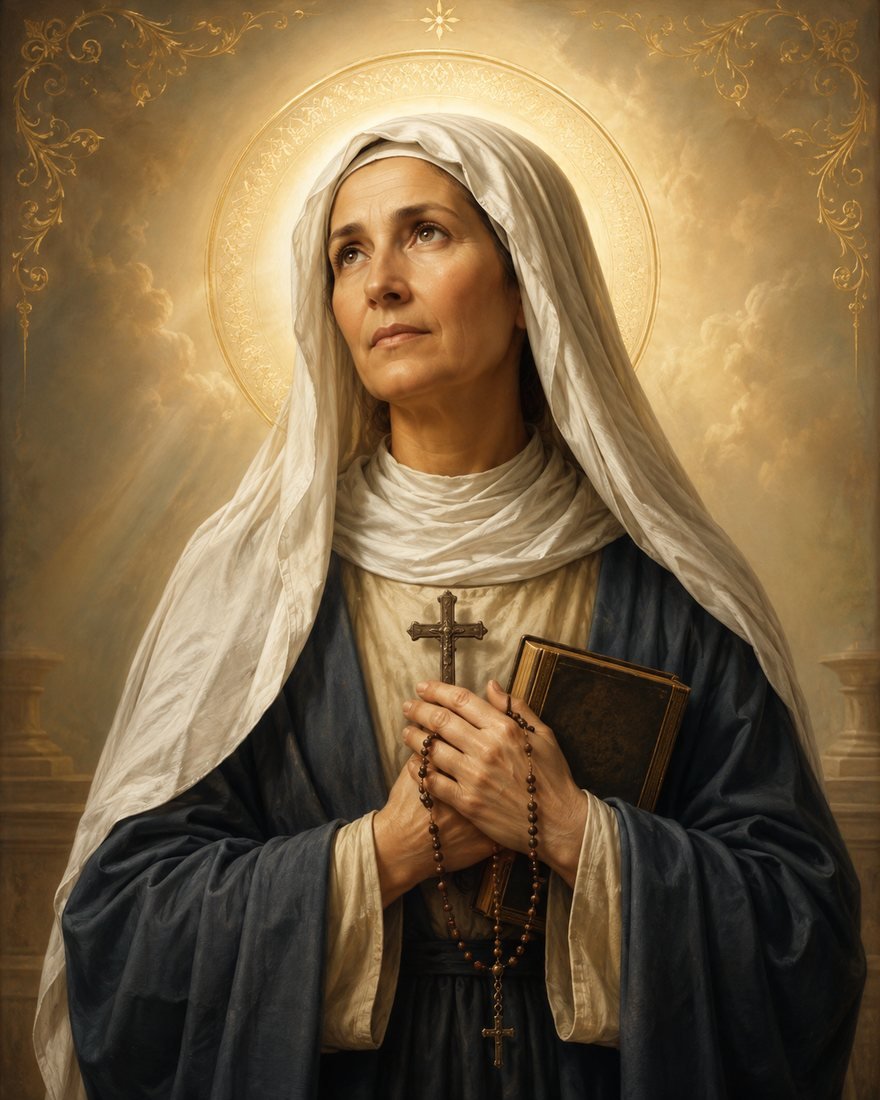
The popup uses the devotional portrait shown on the Saints-directory card. It is sacred art and is not presented as a verified likeness from life.
St. Monica
Life and Witness
Monica was raised in a Christian household and married Patricius, a man who was not initially Christian and whose temper and infidelity caused real suffering. Augustine’s Confessions portrays her as patient but not passive. Her steady Christian life helped create conditions in which Patricius was baptized before his death.
Her relationship with Augustine was even more complicated. He was brilliant, ambitious, morally restless, and for years attached to beliefs Monica considered false. She prayed, wept, sought wise counsel, and refused to give up hope. Yet her love matured as she learned that she could not control the timing of his conversion.
Augustine’s conversion in Milan brought her immense joy. At Ostia, while preparing to return to Africa, mother and son shared an extraordinary conversation about eternal life. Soon afterward Monica became ill and died, asking only to be remembered at the altar of the Lord.
Her peace came after decades of uncertainty. Monica’s charity was tenacious but not possessive: she loved her family enough to pray, speak, wait, forgive, and finally entrust them to God.
What St. Monica Is Known For
- Persistent prayer for a child: Her long prayer for Augustine made her the classic patron of parents worried about children.
- Marriage marked by difficulty: Her life included a challenging husband and family tensions.
- Hope without control: Her story shows persistence that ultimately surrenders the outcome to God.
Intercession & Patronage
Why Catholics Ask St. Monica to Intercede
Catholics ask St. Monica to intercede when love requires waiting. Her story gives parents permission to grieve and pray without pretending they can force another person’s conversion.
References
- Pope Benedict XVI — Angelus on St. Monica (27 August 2006)
- Pope Benedict XVI — Monica and Augustine (30 August 2009)
- St. Augustine — Confessions
- Magisterium AI — Saints database research interface (used to cross-check identity, feast and patronage)
- Butler’s Lives of the Saints — searchable calendar edition
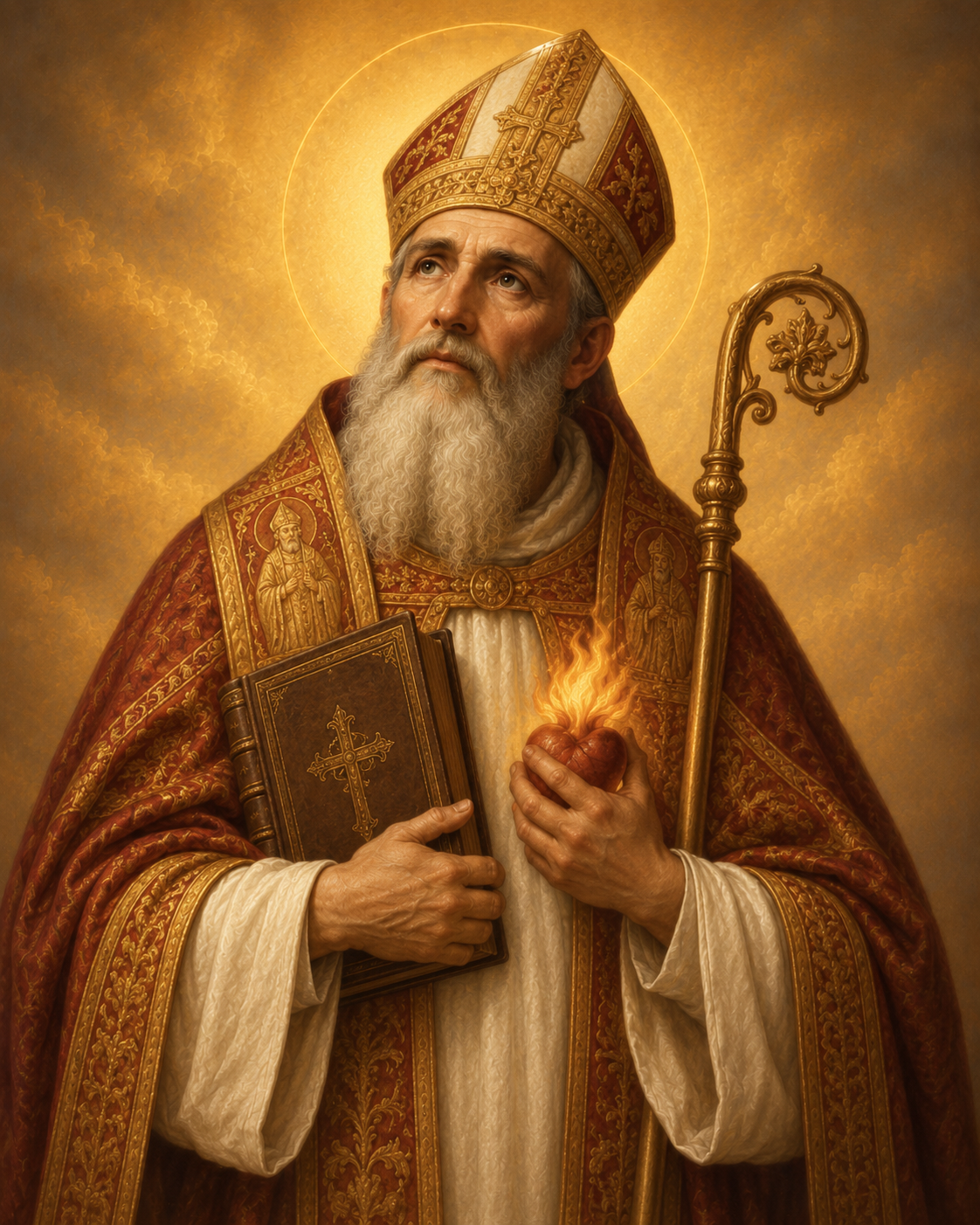
The card and popup use an AI-generated devotional portrait created for this site from representative sacred-art references to St. Augustine. It is not presented as a verified portrait from life.
St. Augustine
Life and Witness
Augustine was born in Roman North Africa to Patricius and St. Monica. Exceptionally intelligent and ambitious, he became a teacher of rhetoric and spent years searching for truth outside the full communion of the Catholic Church. His search passed through Manichaeism, philosophical study, career ambition, and a complicated personal life, while Monica continued to pray for his conversion.
After moving through Rome to Milan, Augustine began listening to St. Ambrose. Ambrose’s preaching helped him see that Scripture possessed an intellectual and spiritual depth he had previously missed. Augustine also encountered philosophical ideas that removed some of his objections to Christianity. In 386, after a long interior struggle, his conversion reached a decisive point; St. Ambrose baptized him at the Easter Vigil in 387.
Augustine returned to North Africa intending a life of prayer and study, but the Church called him into pastoral ministry. He was ordained a priest in Hippo in 391 and bishop in 395. He preached constantly, cared for the poor, formed clergy and religious communities, and defended Catholic teaching amid major controversies involving Manichaeism, Donatism, and Pelagianism.
His writings include the Confessions, The City of God, On the Trinity, biblical commentaries, sermons, and hundreds of letters and theological works. Benedict XVI called him the greatest Father of the Latin Church and emphasized the extraordinary reach of his influence. Augustine died in 430 while Hippo was under siege, spending his final days in prayer and repentance.
What St. Augustine Is Known For
- The Confessions: His spiritual autobiography traces a restless search for truth, sin, memory, conversion, grace, and the discovery that the human heart ultimately rests in God.
- The City of God: Written in the aftermath of Rome’s sack, this monumental work distinguishes the ultimate hope of God’s city from the rise and fall of earthly political orders.
- Grace and conversion: Augustine’s life and theology continually return to the initiative of God’s grace and the lifelong conversion of the human will.
- Father of the Latin Church: His preaching and vast body of writings exerted extraordinary influence on Catholic theology, spirituality, biblical interpretation, and Western culture.
Intercession & Patronage
Why Catholics Ask St. Augustine to Intercede
Catholics ask St. Augustine to intercede for conversion that reaches both mind and heart. He is especially meaningful for people who love God yet still struggle with habits, doubts, ambition, or divided desires. His life shows that grace does not erase a serious search for truth; it can purify and complete it.
References
- Pope Benedict XVI — General Audience: St. Augustine of Hippo (1), life and conversion (9 January 2008)
- Pope Benedict XVI — St. Augustine of Hippo (2), final years and pastoral witness (16 January 2008)
- Pope Benedict XVI — St. Augustine of Hippo (4), writings (20 February 2008)
- Pope Benedict XVI — St. Augustine of Hippo (5), conversion (27 February 2008)
- St. Augustine — Confessions, New Advent translation
- Wikimedia Commons — St. Augustine by Philippe de Champaigne, c. 1645–1650; public-domain reproduction
The popup uses the devotional portrait shown on the Saints-directory card. It is sacred art and is not presented as a verified likeness from life.
St. Teresa of Calcutta
Life and Witness
Anjezë Gonxhe Bojaxhiu was born in Skopje into an Albanian Catholic family. Her father died when she was young, and her mother’s faith and generosity deeply influenced her. At eighteen she joined the Sisters of Loreto and went to India, where she became Sister Teresa and taught in a girls’ school in Calcutta.
In 1946, traveling by train to a retreat, she experienced what she later called a “call within a call”: a conviction that Jesus was asking her to leave the security of the convent school and serve him among the poorest of the poor. After Church permission and brief nursing training, she entered the slums wearing a simple white sari with blue border.
Her charity was personal and concrete. She cared for people dying on streets, opened homes for children and the sick, and founded the Missionaries of Charity. The work spread internationally, yet she continually redirected attention toward the dignity of the person immediately in front of her.
After her death, letters revealed long periods of interior darkness and little felt spiritual consolation. Her public joy was therefore not dependent on constant emotional comfort. She continued prayer and service through hidden dryness. Canonized by Pope Francis in 2016, she remains a demanding witness that peace begins by refusing to treat any person as disposable.
What St. Teresa of Calcutta Is Known For
- The poorest of the poor: Her congregation made direct service to abandoned, dying, sick, and homeless people its mission.
- The Missionaries of Charity: She founded the congregation in 1950.
- Faith during interior darkness: Her letters reveal decades of fidelity with little felt consolation.
Intercession & Patronage
Why Catholics Ask St. Teresa of Calcutta to Intercede
Catholics ask St. Teresa of Calcutta to intercede for eyes that notice the person everyone else overlooks. Her life teaches that love is often concrete, repetitive, tiring, and hidden.
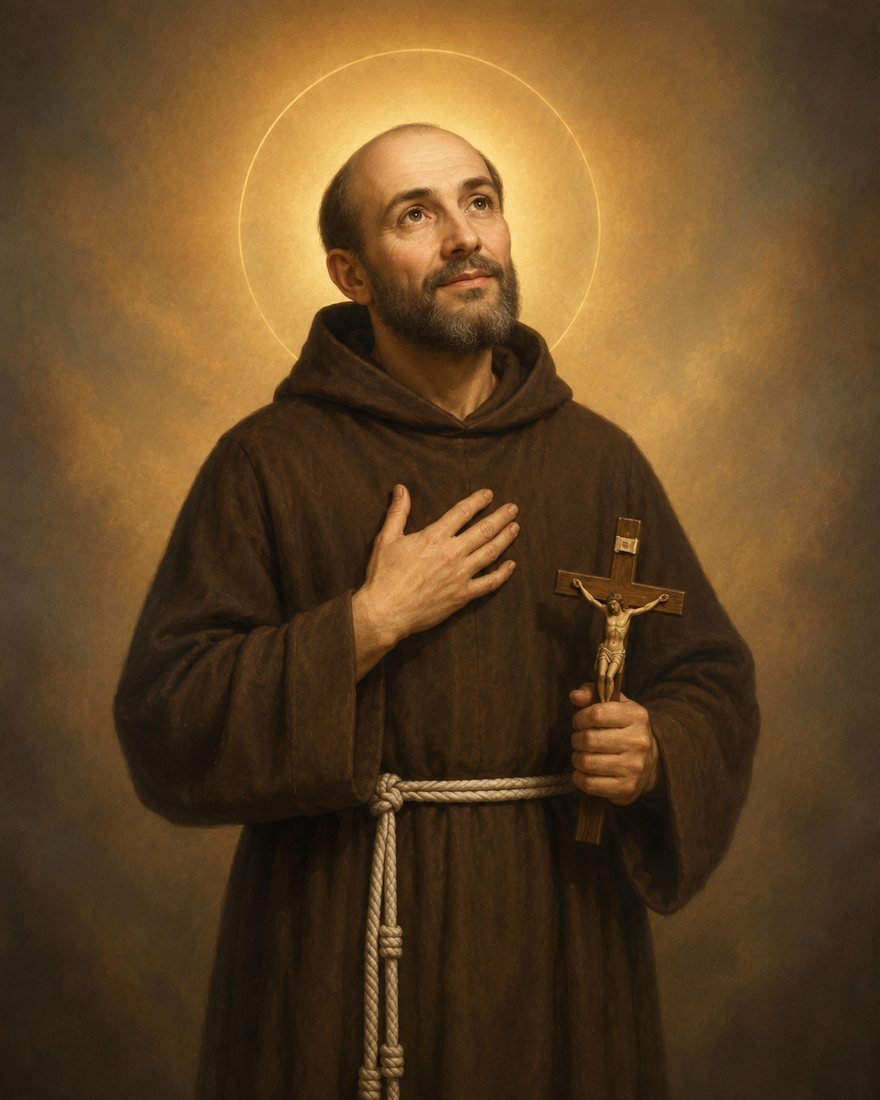
The popup uses the devotional portrait shown on the Saints-directory card. It is sacred art and is not presented as a verified likeness from life.
St. Joseph of Cupertino
Life and Witness
Joseph was born in 1603 at Copertino in southern Italy into a poor family. From childhood he was deeply drawn to prayer, but he struggled with formal learning and with many ordinary tasks. Others often considered him slow or incapable, and his path into religious life was difficult. After setbacks, he was eventually received among the Conventual Franciscans, first serving in simple work and caring for animals.
Study remained extraordinarily difficult for him, yet he persevered. He was ordained a priest in 1628. St. John Paul II later presented Joseph above all as a teacher of prayer whose day centered on Holy Mass and long hours of adoration before the tabernacle. The Pope also specifically noted that students venerate him as their patron.
Joseph became famous for intense ecstasies during prayer. Contemporary testimony and the later canonization process recorded many extraordinary incidents in which he was said to rise from the ground while absorbed in prayer. These experiences drew crowds and scrutiny. Church authorities investigated him, and at various times he was restricted from public ministry or moved from one friary to another.
Rather than seeking attention, Joseph accepted these restrictions with obedience and humility. His spiritual life was rooted less in extraordinary phenomena than in prayer, the Eucharist, devotion to Christ, and a Franciscan simplicity that trusted God despite personal limitations. He died at Osimo on September 18, 1663, and was canonized by Pope Clement XIII in 1767.
What St. Joseph of Cupertino Is Known For
- Patron of students: His severe difficulty with study and perseverance toward ordination made him a beloved intercessor for students, especially those anxious about examinations.
- The “Flying Saint”: He became popularly known by this title because of the many reported levitations connected with his ecstasies in prayer.
- Teacher of prayer: St. John Paul II emphasized Joseph’s life of Mass, Eucharistic adoration, and intimate union with the Holy Spirit.
- Humility and obedience: He accepted investigation, restrictions, and repeated transfers without turning extraordinary experiences into a source of self-importance.
Intercession & Patronage
Why Catholics Ask St. Joseph of Cupertino to Intercede
Catholics often ask St. Joseph of Cupertino to intercede before examinations, interviews, and difficult studies because he personally knew the humiliation and anxiety of struggling to learn what seemed easy to others.
He is also invoked by travelers and those who work in aviation because of his traditional association with flight. More deeply, his life points beyond the extraordinary: he teaches that weakness does not prevent holiness and that persistent prayer, humility, and trust in God can bear fruit even when a person feels inadequate.
The popup uses the devotional portrait shown on the Saints-directory card. It is sacred art and is not presented as a verified likeness from life.
St. Matthew the Apostle
Life and Witness
The Gospel describes Matthew sitting at a customs post when Jesus says, “Follow me.” Matthew rises and follows. Tax collectors were widely despised because their work was tied to the occupying system and could be associated with exploitation. Jesus does not wait for Matthew to acquire a respectable reputation before calling him.
A meal follows in which Jesus eats with tax collectors and sinners. When critics object, Jesus says the sick need a physician and tells them to learn the meaning of mercy. Matthew’s vocation is therefore inseparable from the Gospel’s insistence that grace can enter compromised lives and redirect them.
Christian tradition identifies Matthew with the evangelist whose Gospel stands first in the New Testament. The Gospel itself does not sign the author’s name, and modern scholarship discusses its literary history. The Church nevertheless preserves the ancient liturgical identification of Matthew as Apostle and Evangelist.
Later traditions about his missions and martyrdom vary. His clearest biblical portrait remains beautifully simple: Jesus sees a man at a tax booth, calls him, and makes an apostle out of someone others had learned to distrust.
What St. Matthew the Apostle Is Known For
- The tax collector who followed Jesus: His call is a vivid Gospel image of mercy transforming a socially compromised life.
- The Gospel according to Matthew: Church tradition associates him with the First Gospel.
- Mercy toward sinners: His call is linked immediately to Jesus eating with people considered morally suspect.
Intercession & Patronage
Why Catholics Ask St. Matthew the Apostle to Intercede
Catholics ask St. Matthew to intercede when a person feels trapped by a past identity. The grace of discipleship does not deny the past, but it refuses to let the past have the final word.
The popup uses the devotional portrait shown on the Saints-directory card. It is sacred art and is not presented as a verified likeness from life.
St. Pio of Pietrelcina (Padre Pio)
Life and Witness
Francesco Forgione was born to a farming family and entered the Capuchins as a young man, taking the name Pio. His health was fragile for much of his early religious life. Ordained in 1910, he eventually settled at San Giovanni Rotondo, where he spent most of the rest of his life.
Padre Pio became renowned for intense prayer, reverent celebration of Mass, and enormous amounts of time hearing confessions. People came with hidden sins, grief, and questions. He could be direct, but his aim was conversion rather than humiliation.
In 1918 he developed wounds identified with the stigmata of Christ. They brought devotion, curiosity, controversy, medical examination, and periods of restriction by Church authorities. Pio accepted investigation and limitations while continuing religious life, repeatedly directing attention toward Christ rather than extraordinary phenomena.
His compassion also became institutional. He inspired Casa Sollievo della Sofferenza, a modern hospital intended to unite excellent medicine with reverence for the sick. This shows that his spirituality of suffering did not romanticize pain; it moved him toward practical relief of suffering.
What St. Pio of Pietrelcina (Padre Pio) Is Known For
- The Eucharist and Mass: His priesthood was visibly centered on reverent Eucharistic worship.
- Confession: He became one of the twentieth century’s best-known confessors.
- Casa Sollievo della Sofferenza: The hospital he inspired expresses compassion through skilled care.
- The stigmata: St. John Paul II explicitly described Padre Pio’s body as marked by the stigmata, connecting his suffering with a particular participation in the Passion of Christ.
Intercession & Patronage
Why Catholics Ask St. Pio of Pietrelcina (Padre Pio) to Intercede
Catholics ask Padre Pio to intercede when suffering feels isolating or when someone needs courage to return to confession. His witness says prayer should deepen compassion, and compassion should look for practical ways to relieve pain.
References
- Vatican — Official biography of St. Pio
- St. John Paul II — Canonization homily for Padre Pio
- Magisterium AI — Saints database research interface (used to cross-check identity, feast and patronage)
- Butler’s Lives of the Saints — searchable calendar edition
- St. John Paul II — Beatification homily: Padre Pio’s body “marked by the stigmata” (2 May 1999)
This is devotional sacred art representing the archangel symbolically. Angels are spiritual creatures; the image is not a physical portrait.
St. Gabriel the Archangel
Life and Witness
St. Gabriel is not a human saint with an ordinary biography. Catholic teaching understands angels as personal spiritual creatures created by God. Their life is not measured by human birth and death, so the most reliable way to speak about St. Gabriel begins with Scripture and the Church’s teaching rather than an invented earthly chronology.
Gabriel appears in Daniel as interpreter of visions. In Luke he announces John the Baptist’s birth to Zechariah and then is sent to Mary at Nazareth to announce Jesus, the Son of the Most High. His most famous mission is a message whose center is not the messenger but Christ.
The Church’s devotion to the holy angels is always directed toward God. Angels do not compete with Christ. They are servants and messengers whose identity points beyond themselves to the divine will.
Traditional patronages developed by reflecting on the particular mission Scripture gives this archangel. Some modern occupational patronages are later applications of that biblical mission and are identified as such.
What St. Gabriel the Archangel Is Known For
- A named archangel in Scripture: St. Gabriel is one of the angels explicitly named in the canonical Bible.
- Service to God: Catholic devotion emphasizes the angels as creatures whose dignity comes from carrying out God’s will.
- A biblical mission: God’s messenger in Daniel and Luke, especially at the Annunciation
Intercession & Patronage
Why Catholics Ask St. Gabriel the Archangel to Intercede
Catholics ask St. Gabriel to intercede when communication matters—especially when a message must be truthful, clear, and centered on God rather than the ego of the messenger.

This is devotional sacred art representing the archangel symbolically. Angels are spiritual creatures; the image is not a physical portrait.
St. Michael the Archangel
Life and Witness
St. Michael is not a human saint with an ordinary biography. Catholic teaching understands angels as personal spiritual creatures created by God. Their life is not measured by human birth and death, so the most reliable way to speak about St. Michael begins with Scripture and the Church’s teaching rather than an invented earthly chronology.
In Daniel, Michael appears as a great prince who defends God’s people. Jude calls him “the archangel.” Revelation 12 portrays Michael and his angels fighting the dragon, making him the Church’s great biblical symbol of God-given protection against evil.
The Church’s devotion to the holy angels is always directed toward God. Angels do not compete with Christ. They are servants and messengers whose identity points beyond themselves to the divine will.
Traditional patronages developed by reflecting on the particular mission Scripture gives this archangel. Some modern occupational patronages are later applications of that biblical mission and are identified as such.
What St. Michael the Archangel Is Known For
- A named archangel in Scripture: St. Michael is one of the angels explicitly named in the canonical Bible.
- Service to God: Catholic devotion emphasizes the angels as creatures whose dignity comes from carrying out God’s will.
- A biblical mission: Protection in spiritual battle and defense of God’s people
Intercession & Patronage
Why Catholics Ask St. Michael the Archangel to Intercede
Catholics ask St. Michael to intercede not because they imagine two equal cosmic powers fighting, but because Scripture presents him as a servant of the one sovereign God. His strength is reassuring precisely because it is obedient: evil does not have the final word.
This is devotional sacred art representing the archangel symbolically. Angels are spiritual creatures; the image is not a physical portrait.
St. Raphael the Archangel
Life and Witness
St. Raphael is not a human saint with an ordinary biography. Catholic teaching understands angels as personal spiritual creatures created by God. Their life is not measured by human birth and death, so the most reliable way to speak about St. Raphael begins with Scripture and the Church’s teaching rather than an invented earthly chronology.
Raphael is the angelic companion in Tobit. He travels with Tobias, guides him safely, helps bring healing to Tobit’s blindness, and assists the marriage of Tobias and Sarah. He later reveals that he presented their prayers before God; his name means “God heals.”
The Church’s devotion to the holy angels is always directed toward God. Angels do not compete with Christ. They are servants and messengers whose identity points beyond themselves to the divine will.
Traditional patronages developed by reflecting on the particular mission Scripture gives this archangel. Some modern occupational patronages are later applications of that biblical mission and are identified as such.
What St. Raphael the Archangel Is Known For
- A named archangel in Scripture: St. Raphael is one of the angels explicitly named in the canonical Bible.
- Service to God: Catholic devotion emphasizes the angels as creatures whose dignity comes from carrying out God’s will.
- A biblical mission: Healing, safe travel, guidance, marriage, and providential care
Intercession & Patronage
Why Catholics Ask St. Raphael the Archangel to Intercede
Catholics ask St. Raphael to intercede for healing and safe journeys because Tobit presents God’s providence working through companionship. His presence says guidance can arrive quietly, sometimes before we recognize the help.
The popup uses the devotional portrait shown on the Saints-directory card. It is sacred art and is not presented as a verified likeness from life.
St. Thérèse of Lisieux (The Little Flower)
Life and Witness
Thérèse Martin was the youngest surviving daughter of Sts. Louis and Zélie Martin. Her childhood held deep affection and deep loss: her mother died when Thérèse was four, and later family changes intensified her sensitivity. She did not become holy by pretending those traits did not exist; she gradually learned to turn sensitivity outward into compassion.
At fifteen she entered the Carmelite monastery at Lisieux. Her life there was externally ordinary—prayer, community duties, hidden sacrifices, and eventually serious illness. She came to understand that sanctity was not reserved for spectacular achievements. Her “little way” meant receiving everything from God with confidence and turning small acts into occasions for love.
This simplicity was demanding. Thérèse chose patience with sisters who irritated her, service without recognition, and trust during spiritual dryness. Near death from tuberculosis she endured a severe trial of faith in which heaven felt obscured, yet continued to believe and love without emotional comfort.
Story of a Soul made her interior life known worldwide. Pius XI named her patroness of the missions though she never left Carmel, because she offered prayer and suffering for missionaries. St. John Paul II declared her a Doctor of the Church in 1997. Her peace was not confidence in being strong, but confidence in God’s mercy.
What St. Thérèse of Lisieux (The Little Flower) Is Known For
- The “little way”: Confidence, humility, and ordinary acts done with great love rather than spectacular accomplishments.
- Spiritual childhood: She approached God with trusting dependence on grace.
- Missionary prayer: She offered hidden prayer and suffering for missionary work.
Intercession & Patronage
Why Catholics Ask St. Thérèse of Lisieux (The Little Flower) to Intercede
Catholics ask St. Thérèse to intercede when holiness seems impossibly large. She teaches that love can be practiced in the next small act: a restrained word, an unnoticed kindness, a task accepted without applause, or trust offered when certainty feels absent.
References
- Pope Benedict XVI — St. Thérèse of Lisieux (6 April 2011)
- Pope Francis — St. Thérèse and missionary zeal (7 June 2023)
- Magisterium — C’est la confiance
- Magisterium — Story of a Soul
- Magisterium AI — Saints database research interface (used to cross-check identity, feast and patronage)
- Butler’s Lives of the Saints — searchable calendar edition
The popup uses the devotional portrait shown on the Saints-directory card. It is sacred art and is not presented as a verified likeness from life.
St. Francis of Assisi
Life and Witness
Francis was born to a prosperous merchant family and spent his youth enjoying status, fine clothes, adventure, and dreams of knighthood. War, captivity, illness, and disappointment unsettled those ambitions. His conversion unfolded gradually through prayer, the crucifix at San Damiano, and encounters with people he had once feared—especially lepers.
Francis later wrote that what had seemed bitter in his encounter with lepers became sweetness. That movement from avoidance to fraternity is at the heart of his charity. Poverty was not simply owning fewer things; it was becoming available to Christ and refusing to let possessions determine who deserved love.
Others joined him and the Friars Minor emerged as a brotherhood of Gospel prayer, poverty, preaching, and peace. His love of creation came from worship. The Canticle of the Creatures praises God through sun, moon, water, fire, and earth. Creation became family because all came from the same Creator.
Near the end of life Francis received the stigmata and endured serious illness. His peace was not softness; it was the fruit of conversion, reconciliation, poverty, and a radical decision to recognize Christ in both creation and the excluded person.
What St. Francis of Assisi Is Known For
- Evangelical poverty: He chose radical simplicity for freedom to love God and neighbor.
- Fraternity with the marginalized: His embrace of lepers marks conversion from fear to compassionate solidarity.
- Care for creation: His Canticle inspired his patronage of ecology.
Intercession & Patronage
Why Catholics Ask St. Francis of Assisi to Intercede
Catholics ask St. Francis to intercede for peace because he learned peace by letting Christ change what he feared and valued. His tenderness toward creation and the poor came from gratitude for a world received as gift rather than possessed as property.
References
- Pope Benedict XVI — St. Francis of Assisi (27 January 2010)
- Magisterium — Franciscan Rule
- Magisterium — Pope Francis at Assisi (4 October 2013)
- Magisterium AI — Saints database research interface (used to cross-check identity, feast and patronage)
- Butler’s Lives of the Saints — searchable calendar edition
The popup uses the devotional portrait shown on the Saints-directory card. It is sacred art and is not presented as a verified likeness from life.
St. Faustina Kowalska
Life and Witness
Helena Kowalska was born into a poor farming family and had only a few years of formal education. As a young woman she worked as a domestic servant. She felt called to religious life but faced family resistance and practical obstacles; her vocation began with work, persistence, and trust rather than privilege.
She entered the Sisters of Our Lady of Mercy and became Sister Maria Faustina. Her assigned work was ordinary—cooking, gardening, porter duties. Within that hidden life she reported mystical encounters with Jesus centered on divine mercy, trust, repentance, and prayer for sinners. At the direction of confessors she recorded them in the Diary.
“Jesus, I trust in You” summarizes her spirituality, but trust was not denial of suffering. Faustina endured illness, misunderstanding, and ordinary community limitations. Her writings repeatedly connect receiving mercy with becoming merciful toward other people.
She died of tuberculosis in 1938. St. John Paul II canonized her in 2000 and established Divine Mercy Sunday for the universal Church. The approved devotion is not fascination with private revelation for its own sake; it directs Christians back to the Gospel of mercy, conversion, forgiveness, and works of love.
What St. Faustina Kowalska Is Known For
- Divine Mercy: Her Diary became the principal modern source for this devotion.
- “Jesus, I trust in You”: The phrase summarizes confident surrender to Christ’s mercy.
- Mercy toward others: Her writings insist that devotion must become concrete merciful action.
Intercession & Patronage
Why Catholics Ask St. Faustina Kowalska to Intercede
Catholics ask St. Faustina to intercede when shame makes trust difficult. Her message is not that sin is unimportant; it is that Christ’s mercy is greater than the sinner’s fear, and forgiven people are called to become merciful.
References
- Vatican — Dicastery documents including the 2020 decree adding St. Faustina to the General Roman Calendar
- Magisterium — Directory on Popular Piety, Divine Mercy
- Magisterium AI — Saints database research interface (used to cross-check identity, feast and patronage)
- Butler’s Lives of the Saints — searchable calendar edition
The popup uses the devotional portrait shown on the Saints-directory card. It is sacred art and is not presented as a verified likeness from life.
St. Carlo Acutis
Life and Witness
Carlo Acutis was born in London to Italian parents and grew up in Milan. He developed a strong attraction to prayer and the Eucharist from childhood. After First Communion he attended Mass frequently, spent time in adoration, and went regularly to confession. His faith existed alongside ordinary interests: friends, school, pets, soccer, video games, and computers.
Technically gifted, Carlo used web design to help parishes and Catholic organizations. His best-known project catalogued Eucharistic miracles. The importance is not that technology made him holy, but that he deliberately used something he enjoyed to share what he loved. He also defended classmates who were bullied and quietly helped poor or homeless people.
Accounts from those who knew him describe a teenager learning moderation—for example, setting limits on games because he did not want entertainment to control him. His holiness therefore offers young people something recognizable: grace working within normal life rather than a personality emptied of ordinary interests.
In October 2006 he developed acute leukemia and died at fifteen. Pope Leo XIV canonized Carlo with Pier Giorgio Frassati on September 7, 2025. His message is ancient in a modern setting: friendship with Jesus, the sacraments, care for people, and freedom from whatever threatens to become an idol.
What St. Carlo Acutis Is Known For
- A saint of the digital age: He used web skills for evangelization while practicing restraint toward technology.
- Eucharistic devotion: Mass and adoration were the spiritual center of his short life.
- Ordinary teenage holiness: His recognizable interests make him an accessible example for young people.
Intercession & Patronage
Why Catholics Ask St. Carlo Acutis to Intercede
Catholics ask St. Carlo to intercede for young people trying to become holy without escaping ordinary life. His witness asks whether our gifts, hobbies, and devices help us love God and people more freely—or have begun to possess us.
References
- Vatican — Canonization of Carlo Acutis and Pier Giorgio Frassati
- Pope Leo XIV — Canonization homily (7 September 2025)
- Vatican — Formula of Canonization
- Magisterium AI — Saints database research interface (used to cross-check identity, feast and patronage)
- Butler’s Lives of the Saints — searchable calendar edition
The popup uses the devotional portrait shown on the Saints-directory card. It is sacred art and is not presented as a verified likeness from life.
St. Teresa of Ávila
Life and Witness
Teresa de Cepeda y Ahumada was intelligent, affectionate, strong-willed, and socially gifted. She entered the Carmelite monastery of the Incarnation, but religious life did not immediately solve every interior struggle. Serious illness and years of distraction taught her that prayer matures slowly.
Her deeper conversion centered on mental prayer understood as friendship with Christ. The more deeply she prayed, the more practical she became. She believed Carmelite life needed a simpler and more recollected form centered on poverty, community, silence, and prayer, and began founding reformed monasteries across Spain.
The work required travel, negotiation, money, conflict management, and extraordinary resilience. Teresa could be humorous about discomfort and weakness. Her Interior Castle describes growth in prayer through the image of a many-roomed castle, but she repeatedly insists that authentic prayer must produce humility and love of neighbor.
She worked with St. John of the Cross and endured serious opposition. In 1970 St. Paul VI declared her one of the first two women Doctors of the Church. Her life shows that contemplation and action are not rivals: deep friendship with God can make a person more courageous and realistic.
What St. Teresa of Ávila Is Known For
- Mental prayer as friendship: Teresa describes prayer as intimate friendship with the One who loves us.
- The Interior Castle: Her masterpiece maps spiritual growth through the image of an interior castle.
- Carmelite reform: She founded reformed convents that became the Discalced Carmelite tradition.
Intercession & Patronage
Why Catholics Ask St. Teresa of Ávila to Intercede
Catholics ask St. Teresa to intercede for prayer that becomes real friendship rather than performance. She reassures people who think distraction disqualifies them from contemplation: her own path matured slowly, and its test was always greater love.
The popup uses the devotional portrait shown on the Saints-directory card. It is sacred art and is not presented as a verified likeness from life.
St. Gerard Majella
Life and Witness
Gerard was born into a poor family and was apprenticed as a tailor after his father died. He longed for religious life but was initially rejected because of fragile health. Eventually he joined the Redemptorists and performed ordinary work—tailoring, sacristy duties, gardening, and service to communities—with prayer and generosity.
A painful episode shaped his reputation for patience. A young woman falsely accused him of sexual misconduct. When St. Alphonsus Liguori questioned him, Gerard largely remained silent rather than retaliating. She later withdrew the accusation. Redemptorist memory sees in this a man who endured humiliation without surrendering charity.
His patronage of expectant mothers developed through traditions about women who sought his prayers and especially a story involving a handkerchief later connected with safe childbirth. He died of tuberculosis at twenty-nine.
Gerard’s life is gentle but demanding: hidden work, bodily weakness, a wounded reputation, and confidence that a person can remain charitable without controlling how others see him.
What St. Gerard Majella Is Known For
- Patron of expectant mothers: His most famous devotion grew from traditions of prayer for women and childbirth.
- Humility under false accusation: He refused retaliation when seriously accused.
- Hidden lay-brother holiness: Ordinary service rather than rank became his field of sanctity.
Intercession & Patronage
Why Catholics Ask St. Gerard Majella to Intercede
Catholics ask St. Gerard to intercede for mothers and families because generations connected his gentle prayer with pregnancy and childbirth. They also turn to him when reputation is wounded, because he knew the helplessness of false accusation and chose patience over revenge.
The popup uses the devotional portrait shown on the Saints-directory card. It is sacred art and is not presented as a verified likeness from life.
St. Luke the Evangelist
Life and Witness
Luke is named in New Testament letters as a companion of St. Paul, including the phrase “the beloved physician” in Colossians. Ancient Christian tradition identifies this Luke with the author of the Gospel according to Luke and Acts of the Apostles.
Luke’s Gospel has a distinctive tenderness. It preserves the Annunciation, Visitation, Magnificat, Nativity scenes, the Good Samaritan, the Prodigal Son, and many encounters in which Jesus draws near to the poor, women, sinners, foreigners, and people pushed to the margins. Mercy is part of the architecture of Luke’s Gospel.
Acts continues the story through the Holy Spirit’s work in the Church. Prayer, courage, generosity toward the poor, table fellowship, and missionary expansion appear repeatedly. Luke’s writing joins careful narration with compassion and mission.
Later traditions about his travels, death, and artistic activity vary. A beloved tradition calls him a painter of Marian icons, explaining his patronage of artists, but this is not established by first-century evidence. His strongest legacy remains the inspired Gospel and Acts received by the Church.
What St. Luke the Evangelist Is Known For
- The Gospel of mercy: Luke preserves many of the New Testament’s most beloved parables of compassion.
- Acts of the Apostles: His second volume narrates Pentecost and the early Church’s expansion.
- The beloved physician: Colossians supplies the basis of his patronage of medical professionals.
Intercession & Patronage
Why Catholics Ask St. Luke the Evangelist to Intercede
Catholics ask St. Luke to intercede for healers, writers, and people trying to tell truth with compassion. His Gospel shows that careful attention to a person’s story can itself become an act of charity.
The card and popup use an AI-generated devotional portrait created for this site from representative sacred-art references to St. Jude Thaddeus. It is not presented as a verified portrait from life.
St. Jude Thaddeus
Life and Witness
The New Testament lists Jude among the Twelve, using names such as Thaddeus or Jude of James to distinguish him from Judas Iscariot. In John’s Gospel, a Judas who is not the Iscariot asks Jesus why he will reveal himself to the disciples and not the world; Jesus answers with love, obedience, and God’s indwelling presence.
Ancient traditions associate Jude with missionary preaching beyond Palestine, sometimes with the apostle Simon. Exact routes and circumstances of death are difficult to establish because later accounts vary. The Church honors him as apostle and martyr without requiring certainty about every later detail.
The short Letter of Jude is traditionally connected with him, though questions of identity and authorship remain. Its urgent message calls Christians to fidelity amid confusion and ends with praise of God who can keep believers from falling.
Jude’s extraordinary modern popularity as patron of desperate or impossible causes developed much later. A common explanation links it to confusion with Judas Iscariot, but this is difficult to document as the single origin. What is certain is that modern Catholic devotion became very strong and gave many people a sign of hope in apparently hopeless circumstances.
What St. Jude Thaddeus Is Known For
- One of the Twelve: His primary dignity comes from being chosen and sent by Christ.
- Patron of difficult causes: This modern devotion is among Catholicism’s most widespread patronages.
- Perseverance in faith: The Letter of Jude strongly urges fidelity amid confusion.
Intercession & Patronage
Why Catholics Ask St. Jude Thaddeus to Intercede
Catholics ask St. Jude to intercede when a situation feels impossible because apostolic faith refuses to equate difficulty with abandonment by God. Healthy devotion strengthens perseverance, wise action, and trust rather than magical expectations.
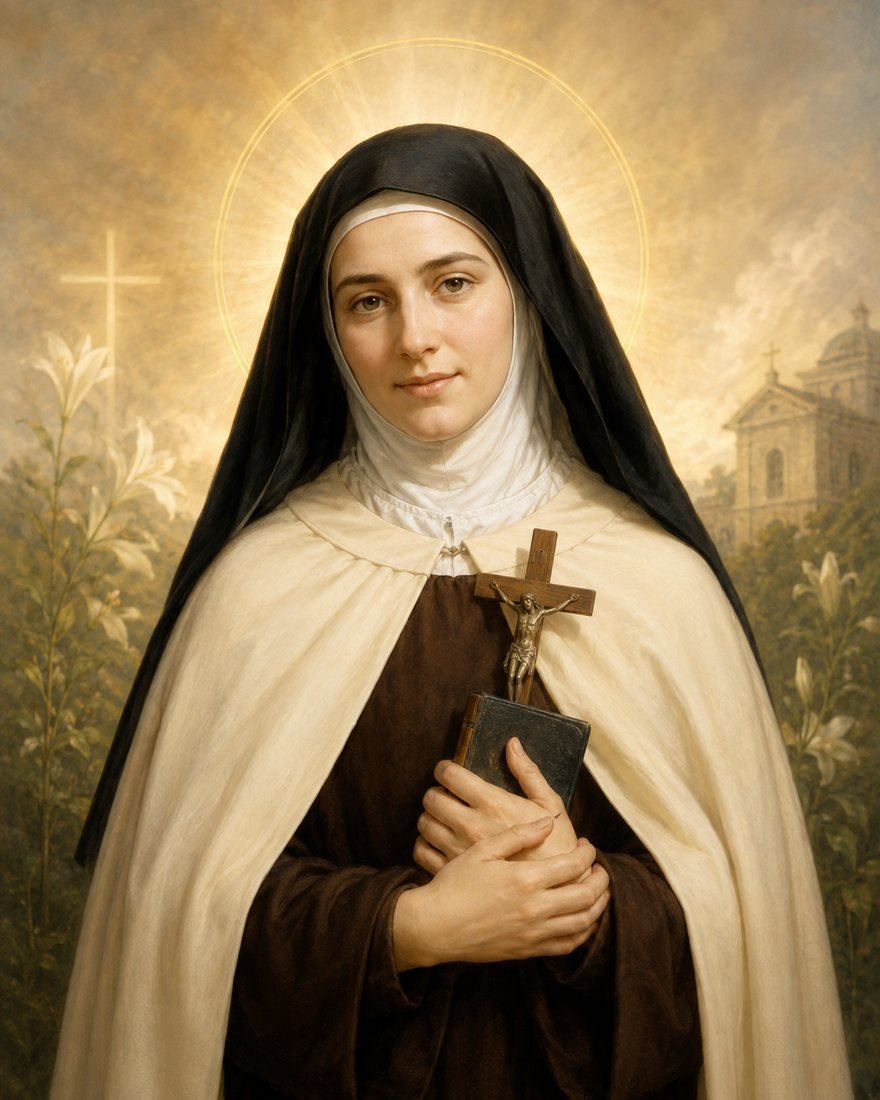
The popup uses the devotional portrait shown on the Saints-directory card. It is sacred art and is not presented as a verified likeness from life.
St. Elizabeth of the Trinity
Life and Witness
Élisabeth Catez was born into a military family and lost her father while still a child. She was musically gifted and became an accomplished pianist, but she also had a forceful temperament. Family memories describe a child capable of intense anger. Her spiritual growth did not erase that strength; grace gradually taught her to turn it toward self-mastery, attentiveness, and love.
As a young woman she was lively, affectionate, and engaged with family and friends. She felt drawn to the Carmelite life but waited until her mother consented. Entering the Carmel of Dijon in 1901, she received the name Elizabeth of the Trinity. Her central spiritual insight was simple and profound: through baptism the Triune God dwells within the Christian soul. Prayer meant learning to live peacefully in that presence.
Elizabeth did not understand recollection as withdrawal from people. Her surviving letters are full of concern for relatives and friends, and she tried to help them discover the same interior freedom she was learning. Her famous Prayer to the Trinity asks God to make her soul his dwelling and place of rest.
Her final years were marked by Addison’s disease, then a painful and usually fatal illness. Physical decline narrowed her outward life but deepened her conviction that suffering could be offered in love. She died at twenty-six in 1906. Pope Francis canonized her in 2016. Her witness is especially gentle for people with busy or troubled minds: peace does not require an empty life; it can grow from remembering that God is already near.
What St. Elizabeth of the Trinity Is Known For
- The indwelling Trinity: Her spirituality centers on living consciously in the presence of Father, Son, and Holy Spirit within the soul.
- Prayerful interior peace: She taught recollection as loving attention to God rather than escape from daily responsibilities.
- Transformation of temperament: Her life shows a strong personality gradually disciplined by grace, charity, and prayer.
Intercession & Patronage
Why Catholics Ask St. Elizabeth of the Trinity to Intercede
Catholics ask St. Elizabeth of the Trinity to intercede when the interior life feels noisy or unsettled. Her own strong temperament did not disappear; it became more peaceful as she learned to live from God’s presence. She offers hope that holiness can transform intensity into attentive love.
References
- Vatican — Canonization of Elizabeth of the Trinity (16 October 2016)
- Vatican — Formula of Canonization (16 October 2016)
- St. John Paul II — Address citing Elizabeth of the Trinity’s spirituality
- Magisterium AI — Saints database research interface (used to cross-check identity, feast and patronage)
- Butler’s Lives of the Saints — searchable calendar edition
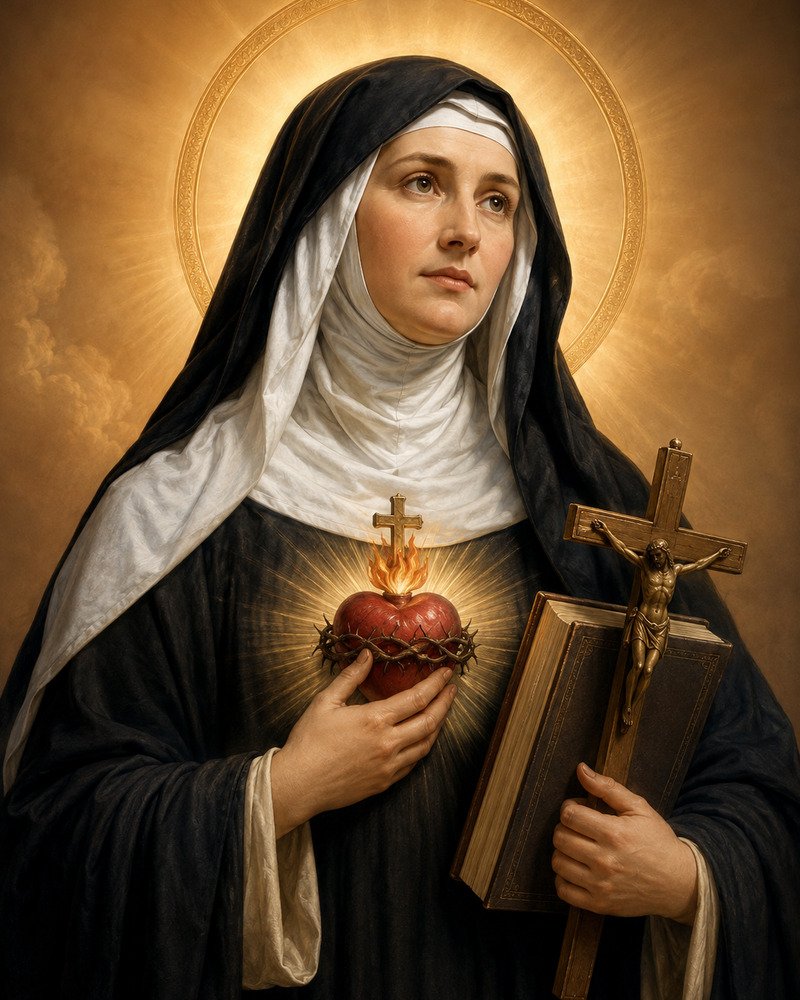
The popup uses the devotional portrait shown on the Saints-directory card. It is sacred art and is not presented as a verified likeness from life.
St. Gertrude the Great
Life and Witness
Gertrude entered the monastery school at Helfta at about five years of age. We do not know with certainty who her parents were or why she was placed there. What we do know is that she received an unusually strong education and became intellectually gifted, mastering the liberal arts and Latin literature.
At about twenty-five she experienced a profound spiritual turning point. Learning remained important, but Scripture, liturgy, and theology became the center of her attention. Her writings describe an increasingly personal love of Christ, especially his Sacred Heart, and a prayer life that was both contemplative and outward-looking.
Pope Benedict XVI described Gertrude as profoundly humble and zealous for the salvation of her neighbor, united to God in contemplation while ready to help people in need. That combination matters. Her mysticism was not spiritual self-absorption; intimacy with Christ widened her concern for others and for the whole Church.
Gertrude’s Herald of Divine Love and Spiritual Exercises helped transmit a warm, biblical spirituality centered on Christ’s love, the Eucharist, the liturgy, and confidence in divine mercy. She died around the beginning of the fourteenth century. The exact year and day remain uncertain.
Later popular devotion attached many prayers and promises to her name, especially prayers for the dead. Her authentic legacy is richer than any single formula: a learned woman whose study became worship, whose contemplation became charity, and whose confidence in the Heart of Christ helped generations pray with trust.
What St. Gertrude the Great Is Known For
- Mysticism centered on Christ: Her writings unite Scripture, liturgy, Eucharistic devotion, and loving intimacy with Jesus.
- Early devotion to the Sacred Heart: Her visions and writings are important in the history of medieval devotion to Christ’s Heart.
- Learning transformed into prayer: Her exceptional education became a means of deeper biblical and theological contemplation.
Intercession & Patronage
Why Catholics Ask St. Gertrude the Great to Intercede
Catholics ask St. Gertrude to intercede for a heart that knows God intimately without becoming closed in on itself. Her life suggests that true contemplation makes a person more available to the needs of others, not less.
References
- Pope Benedict XVI — General Audience on St. Gertrude the Great (6 October 2010)
- Vatican — Verbi Sponsa, citing Elizabeth and the Helfta tradition of contemplative praise
- Magisterium AI — Saints database research interface (used to cross-check identity, feast and patronage)
- Butler’s Lives of the Saints — searchable calendar edition
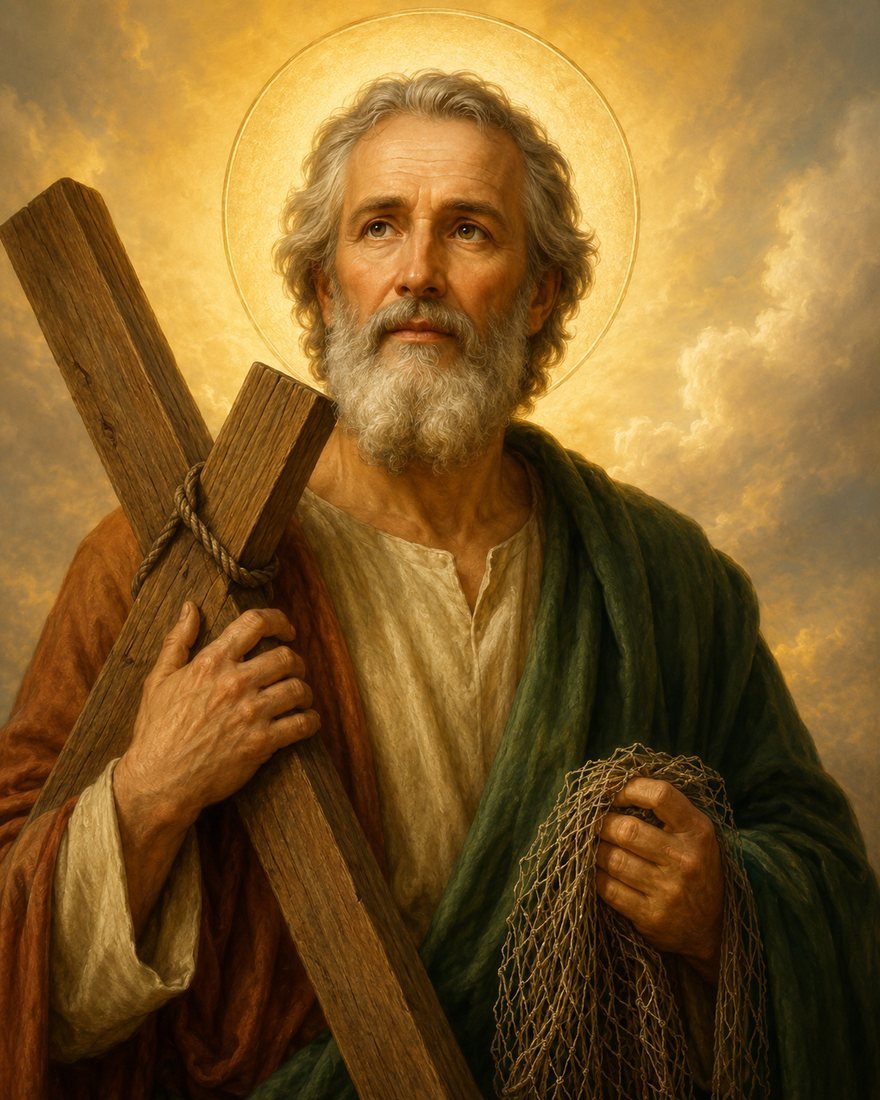
The popup uses the devotional portrait shown on the Saints-directory card. It is sacred art and is not presented as a verified likeness from life.
St. Andrew the Apostle
Life and Witness
Andrew was a fisherman from Bethsaida and the brother of Simon Peter. John’s Gospel first presents him as a disciple of John the Baptist who hears the Baptist identify Jesus and then follows him. Andrew’s first instinct is to seek out his brother and bring him to Jesus. For this reason Eastern Christian tradition calls him the “First-Called.”
That quiet habit of bringing people and possibilities to Christ appears again. Before the multiplication of the loaves, Andrew notices a boy with five barley loaves and two fish. The amount seems absurdly small for the crowd, yet Andrew brings it to Jesus. Later, when Greeks say they want to see Jesus, Philip approaches Andrew and together they bring the request to the Lord.
Andrew’s Gospel portrait is therefore remarkably relational. He is not remembered for dominating conversations but for noticing, introducing, and opening a way toward Christ. Pope Benedict XVI highlighted both his closeness to Jesus and his role as a bridge in the apostolic community.
Ancient traditions say Andrew preached beyond the regions named in Scripture and eventually suffered martyrdom at Patras. The familiar X-shaped “St. Andrew’s cross” belongs to later tradition rather than the earliest accounts. The Church nevertheless venerates him from antiquity as apostle and martyr.
His life offers an attainable form of missionary charity: notice the person beside you, bring what little you have to Christ, and help someone else find the way to him.
What St. Andrew the Apostle Is Known For
- The “First-Called” Apostle: John’s Gospel presents Andrew among the first disciples to follow Jesus.
- Bringing people to Christ: He brings Simon Peter to Jesus and helps bring the Greeks’ request to him.
- Apostolic bridge-building: His figure has special importance in relations between the Churches of Rome and Constantinople.
Intercession & Patronage
Why Catholics Ask St. Andrew the Apostle to Intercede
Catholics ask St. Andrew to intercede for the courage to introduce rather than impress—to bring people, needs, and small gifts to Jesus and trust what Christ can do with them.
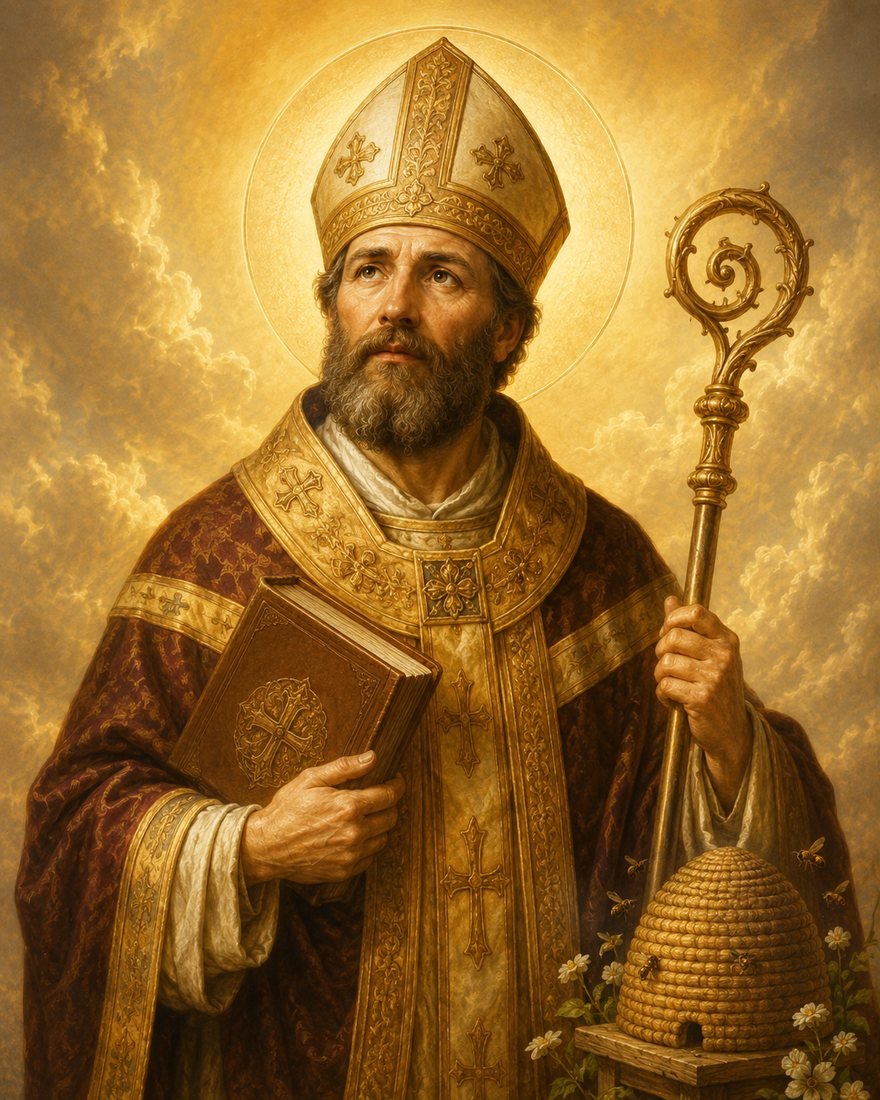
The popup uses the devotional portrait shown on the Saints-directory card. It is sacred art and is not presented as a verified likeness from life.
St. Ambrose
Life and Witness
Ambrose was trained for public administration rather than the priesthood. He became governor of the region around Milan and was respected for his ability to keep order. In 374, when Milan was divided over the choice of a new bishop, Ambrose went to the church to prevent violence. The crowd unexpectedly acclaimed him bishop—even though he was still a catechumen and had not yet been baptized.
He resisted at first, then accepted. Within a remarkably short period he was baptized, ordained, and consecrated bishop. Knowing how much he still had to learn, Ambrose became an intense student of Scripture and theology. His preaching grew from that study and eventually helped St. Augustine move beyond objections that had kept him from Christian faith.
Ambrose’s pastoral life joined courage with practical mercy. He defended the Church’s freedom when imperial power pressed for control, but he also used Church resources to ransom captives and insisted that wealth exists for the good of the poor. His authority was not meant to make him untouchable; it made him responsible for people who lacked power.
He also helped shape Western Christian worship through hymns and preaching. When conflict threatened his congregation, singing became a way for ordinary Christians to pray together and remain peaceful. Benedict XVI described Ambrose as a catechist whose life and teaching formed one coherent witness.
He died in Milan during Holy Week in 397. The man who had entered church as a governor trying to calm a dispute became one of the great bishops and Doctors of the Western Church.
What St. Ambrose Is Known For
- Bishop and Doctor of the Church: His preaching and theology profoundly shaped Western Christianity.
- Influence on St. Augustine: Ambrose’s biblical preaching helped Augustine move toward conversion.
- Courage before political power: He defended the Church’s spiritual freedom while calling rulers themselves to moral accountability.
- Care for the poor and captives: He treated Church wealth as a resource for mercy, including ransom of prisoners.
Intercession & Patronage
Why Catholics Ask St. Ambrose to Intercede
Catholics ask St. Ambrose to intercede for leaders who must speak truth without losing charity. His life shows that firmness and mercy can belong together: he confronted power, educated patiently, and treated the Church’s possessions as belonging in a special way to people in need.
References
- Pope Benedict XVI — General Audience on St. Ambrose (24 October 2007)
- Pope Leo XIV — Jubilee Audience reflecting on St. Ambrose (27 September 2025)
- Catholic Encyclopedia — St. Ambrose
- Magisterium AI — Saints database research interface (used to cross-check identity, feast and patronage)
- Butler’s Lives of the Saints — searchable calendar edition
The popup uses the devotional portrait shown on the Saints-directory card. It is sacred art and is not presented as a verified likeness from life.
St. Lucy
Life and Witness
Lucy was a young Christian woman of Syracuse in Sicily who died during the great persecution under Emperor Diocletian, about the year 304. Her antiquity is secure: devotion to her arose early, her name entered ancient liturgical tradition, and she is one of the women named in the Roman Canon of the Mass.
The detailed Acts of Lucy’s martyrdom were written later and contain hagiographical elements. They portray a young woman determined to consecrate herself to Christ and to use her wealth for the poor. When a rejected suitor denounces her as Christian, she refuses to abandon her faith despite threats and violence. Whether every detail can be established historically, the tradition consistently remembers courage joined with generosity.
Her name, Lucia, is closely related to the Latin word for light, lux. That association became spiritually powerful: Lucy is celebrated during the darkness of December in the Northern Hemisphere as a witness that Christ’s light is not extinguished by persecution.
She became especially associated with eyesight. Later stories say her eyes were removed or miraculously restored, but even Butler notes that the surviving Acts he used do not contain that detail. The patronage is also naturally reinforced by the meaning of her name. Thus the familiar image of Lucy holding eyes on a dish should be understood as devotional symbolism shaped by later tradition.
Lucy’s enduring witness is not gruesome suffering for its own sake. It is the peace of a young Christian who would rather lose security than surrender the truth she loved, and whose memory became a light for people facing darkness.
What St. Lucy Is Known For
- Virgin martyr of Syracuse: Her martyrdom during the Diocletian persecution is the historical center of her longstanding veneration.
- A saint of light: Her name’s association with “light” shaped centuries of Christian symbolism and winter customs.
- Ancient liturgical veneration: Her name is included in the Roman Canon, demonstrating the antiquity of her veneration.
Intercession & Patronage
Why Catholics Ask St. Lucy to Intercede
Catholics ask St. Lucy to intercede for sight—both physical sight and the interior clarity needed when fear or suffering makes the way forward difficult. Her ancient memory says that darkness does not get the final word.
The card and popup use an AI-generated devotional portrait created for this site from representative sacred-art references to St. John the Evangelist. It is not presented as a verified portrait from life.
St. John the Evangelist
Life and Witness
John, son of Zebedee, was a Galilean fisherman and the brother of James when Jesus called them from their nets. The Gospels place John within the small group present at several decisive moments: the raising of Jairus’s daughter, the Transfiguration, and Jesus’ agony in Gethsemane. His early zeal could be fierce—Jesus called James and John “sons of thunder”—and Luke records their impulse to call down fire on an inhospitable village. The mature Christian tradition remembers that intensity transformed into a theology of love.
The Fourth Gospel never names its “disciple whom Jesus loved.” Ancient Church tradition identifies that beloved disciple with John the Apostle and associates John with the Gospel, the three Johannine letters, and Revelation, while modern scholarship examines the literary history and exact authorship of those works in greater detail. The site therefore honors the Church’s traditional identification without pretending every scholarly question is closed.
At the Cross, the beloved disciple remains near Jesus with Mary and receives her into his care. Whether read historically and spiritually, the scene has made John a powerful image of faithful presence when love cannot remove another person’s suffering. The Johannine writings return again and again to love that is concrete: God first loves us, and that love must become love of one another.
Ancient tradition connects John’s later ministry with Ephesus and says that, unlike most of the Twelve, he lived to old age. Pope Benedict XVI emphasized how John’s witness joins contemplation of Christ with the practical command to love.
John’s story therefore moves from youthful intensity to steadfast communion. His Gospel soars in theology, yet its deepest test is simple: remain with Christ, receive the people he entrusts to you, and love in truth.
What St. John the Evangelist Is Known For
- Apostle and Evangelist: The Church traditionally associates him with the Fourth Gospel and Johannine writings.
- The disciple of love: Johannine spirituality makes God’s love and mutual charity central.
- Presence at the Cross: Tradition identifies John with the beloved disciple entrusted with Mary.
- Contemplative theology: The eagle became his symbol because his Gospel is seen as soaring toward the mystery of Christ’s divinity.
Intercession & Patronage
Why Catholics Ask St. John the Evangelist to Intercede
Catholics ask St. John to intercede for a love strong enough to remain. His Gospel does not reduce charity to emotion: love abides at the Cross, receives responsibility for another person, tells the truth, and learns to see every gift as beginning in God’s prior love.
References
- Pope Benedict XVI — John, son of Zebedee (5 July 2006)
- Pope Benedict XVI — John the theologian (9 August 2006)
- Pope Benedict XVI — John the Seer of Patmos (23 August 2006)
- USCCB Bible — Gospel according to John
- Magisterium AI — Saints database research interface (used to cross-check identity, feast and patronage)
- Butler’s Lives of the Saints — searchable calendar edition
The popup uses the devotional portrait shown on the Saints-directory card. It is sacred art and is not presented as a verified likeness from life.
Mother Angelica
Life and Witness
Rita Antoinette Rizzo grew up in Canton, Ohio, in circumstances that were often painful. Her parents separated when she was young, money was scarce, and family life could be unstable. Those experiences gave her an unusually direct way of speaking about fear, suffering, loneliness, and trust in God.
After a period of deeper conversion as a young woman, Rita entered religious life in 1944 and became Sister Mary Angelica of the Annunciation, later known as Mother Angelica. Poor health accompanied much of her life. She endured serious problems with her knees, back, and other illnesses, yet also proved remarkably practical: she organized construction projects, raised money, wrote booklets, recorded talks, and built communities.
In Alabama she founded Our Lady of the Angels Monastery. Her desire to teach ordinary Catholics gradually moved from printed materials and tapes into television. After visiting a television station, she became convinced that Catholic media could reach people directly in their homes. EWTN began broadcasting in 1981 from a garage with limited resources and grew into an international Catholic media network.
Mother Angelica’s appeal was not polished perfection. She could be funny, blunt, impatient, affectionate, and intensely confident in divine providence. People who felt intimidated by religious language often heard her speak about God as someone personally present in real problems. Her combination of contemplation and entrepreneurial boldness was unusual: a cloistered nun became one of the most recognizable Catholic communicators of her generation.
A major stroke in 2001 greatly reduced her ability to speak and appear publicly. The woman whose vocation had become identified with broadcasting then spent many years in relative silence. She died on Easter Sunday in 2016. Her final period gives a different meaning to her legacy: Christian fruitfulness is not measured only by visible productivity.
Mother Angelica is included in this site’s collection because of her importance to contemporary Catholic life. She has not been canonized or beatified, and this popup intentionally does not call her a saint or assign her formal patronage.
What Mother Angelica Is Known For
- Founding EWTN: She founded a Catholic television network in 1981 that developed into a worldwide multimedia apostolate.
- Trust in divine providence: Her teaching repeatedly encouraged practical action joined to confidence in God.
- Direct spiritual teaching: Her humor and plain speech made Catholic prayer and doctrine accessible to many ordinary viewers.
- Contemplation joined to media: Her life combined cloistered Eucharistic prayer with unusually ambitious communications work.
Legacy & Areas of Inspiration
A Note on Prayer and Canonical Status
Mother Angelica has no Church-approved public veneration as a saint or formal saintly patronage. Catholics may certainly thank God for her life, study her teaching, and pray for her soul. Any private prayer concerning a possible future cause should respect the Church’s discernment and should not treat her as already beatified or canonized.
The popup uses the devotional portrait shown on the Saints-directory card. It is sacred art and is not presented as a verified likeness from life.
Venerable Fulton J. Sheen
Life and Witness
Fulton John Sheen grew up in Illinois and was ordained a priest in 1919. A gifted student, he pursued advanced study in philosophy and theology, including work at the Catholic University of Leuven. His academic ability could have kept him in a small intellectual world, but his vocation increasingly turned toward communicating the faith to ordinary people.
For decades Sheen taught, preached, wrote, and used the newest mass media available to him. His radio program The Catholic Hour and later television program Life Is Worth Living brought theology, moral reflection, humor, and encouragement into millions of homes. Standing before a blackboard with no elaborate production, he spoke as though the individual viewer mattered.
His public success was supported by a hidden discipline. Sheen repeatedly emphasized a daily Holy Hour before the Blessed Sacrament and practiced it for decades. Prayer, he believed, kept preaching from becoming performance. He also served as national director of the Society for the Propagation of the Faith, linking his public voice to concrete support for the Church’s worldwide missionary work.
Sheen became an auxiliary bishop of New York and later Bishop of Rochester, eventually receiving the personal title of archbishop. His long public life included conflicts, mistakes, demanding responsibilities, and enormous visibility, yet the persistent thread was his conviction that people are made for God and that no life is meaningless.
He died in 1979 before the Blessed Sacrament in his New York apartment chapel. The Church has declared him Venerable, recognizing his heroic virtues. As of September 1, 2026, he has not yet been beatified: Pope Leo XIV has publicly announced that his beatification is scheduled for September 24, 2026, in St. Louis, Missouri.
What Venerable Fulton J. Sheen Is Known For
- Radio and television evangelization: He became one of the twentieth century’s best-known Catholic communicators.
- The daily Holy Hour: Eucharistic prayer was the hidden spiritual discipline behind his public ministry.
- Missionary support: He led the Society for the Propagation of the Faith in the United States and promoted the Church’s global mission.
- Clear teaching with humor: He used wit, analogy, and ordinary language to make difficult ideas accessible.
Private Devotion & Areas of Association
How Catholics May Pray with Fulton Sheen’s Cause in Mind
Because Fulton Sheen is Venerable rather than yet Blessed or Saint, Catholics may privately ask God for favors through his intercession and pray for the progress of his cause. Public liturgical veneration proper to a beatified or canonized person should await the Church’s judgment. His life especially invites prayer for faithful preaching, Eucharistic devotion, missionaries, and wise use of media.
References
- Pope Leo XIV — Address to the Pontifical Mission Societies announcing Sheen’s scheduled beatification (1 June 2026)
- Vatican Press Office — Decree recognizing Sheen’s miracle (6 July 2019)
- Fulton Sheen Cause — Biographical overview
- Magisterium AI — Saints database research interface (used to cross-check identity, feast and patronage)
- Butler’s Lives of the Saints — searchable calendar edition