Mother of Christ
Blessed Virgin Mary
Explore Marian apparitions, devotions, titles, and shrines — with source-based history and Church status.
Marian Apparitions and Devotions
A source-based collection of Marian apparitions, devotions, titles, and shrines. Open each entry for its history, Church standing, and references.
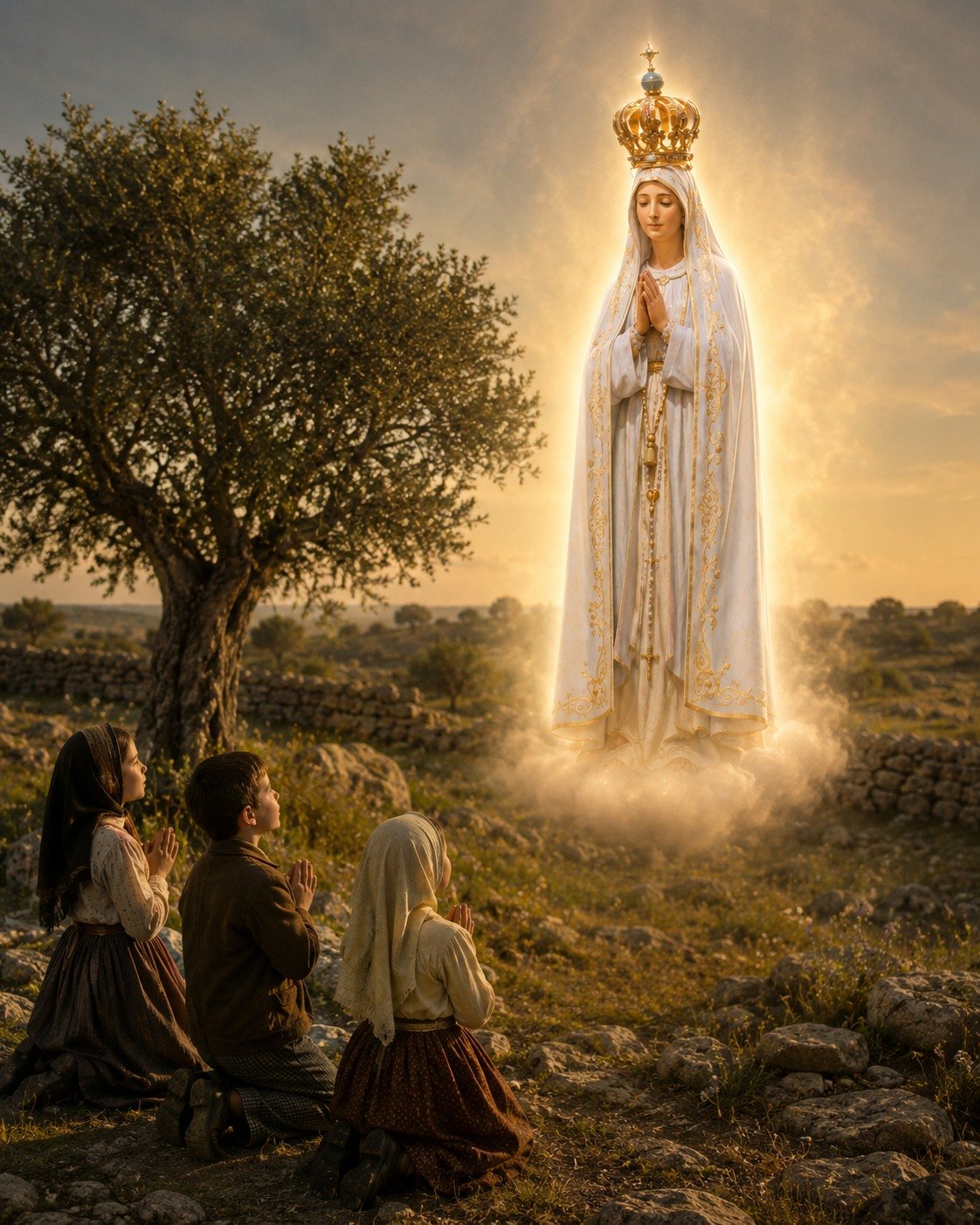
Why this image fits
This generated devotional scene places the recognizable crowned Fátima image with the three shepherd children in the rural Cova da Iria setting. It is source-grounded devotional artwork, not a historical photograph.
- Credit
- Existing To God Be Glory devotional artwork.
- License
- Original generated artwork for To God Be Glory
Verification sources
Our Lady of Fatima
The apparitions at Fátima took place during the First World War, in a period marked by violence, political instability, and deep social upheaval. Three shepherd children—Lúcia dos Santos and her cousins Francisco and Jacinta Marto—reported a series of apparitions of the Blessed Virgin Mary beginning on 13 May 1917 at the Cova da Iria near Fátima. The children said that Mary asked them to return on the thirteenth day of each month for six months.
The central message of Fátima was not a new doctrine, but an urgent summons back to the Gospel: prayer, penance, conversion, reparation for sin, and confidence in God. The Rosary occupied a prominent place in the apparitions. The children also reported a vision of hell, a request for devotion to the Immaculate Heart of Mary, and warnings concerning war, persecution, and Russia. Catholic theology understands these elements as private revelation: they do not add to the deposit of faith and must always be interpreted in light of Christ and the Gospel.
The final apparition, on 13 October 1917, drew a very large crowd. Many present reported the extraordinary solar phenomenon later known as the “Miracle of the Sun.” The Church’s discernment of Fátima unfolded over time. In 1930 the Bishop of Leiria declared the visions worthy of belief and permitted official devotion to Our Lady of Fátima.
Francisco and Jacinta died young during the influenza pandemic. Pope St. John Paul II beatified them in 2000, and Pope Francis canonized them in Fátima in 2017. Lúcia entered religious life and lived until 2005. Her memoirs became central historical sources for the events and messages she said were entrusted to the children.
Fátima became especially significant in the twentieth century through papal pilgrimages and consecrations, and through the publication in 2000 of the third part of the “secret” by the Congregation for the Doctrine of the Faith. Cardinal Joseph Ratzinger’s theological commentary emphasized that authentic private revelation leads people more deeply into the Gospel rather than creating a new plan of salvation. The enduring spiritual core of Fátima is therefore the call to conversion, prayer for sinners, penance, the Rosary, and trust in the mercy of God.
Church Standing
Formal diocesan recognition under the Church’s earlier procedures. On 13 October 1930, Bishop José Alves Correia da Silva of Leiria declared the 1917 visions worthy of belief and officially permitted public devotion to Our Lady of Fátima. The Holy See has repeatedly received and promoted the spiritual message of Fátima.
References
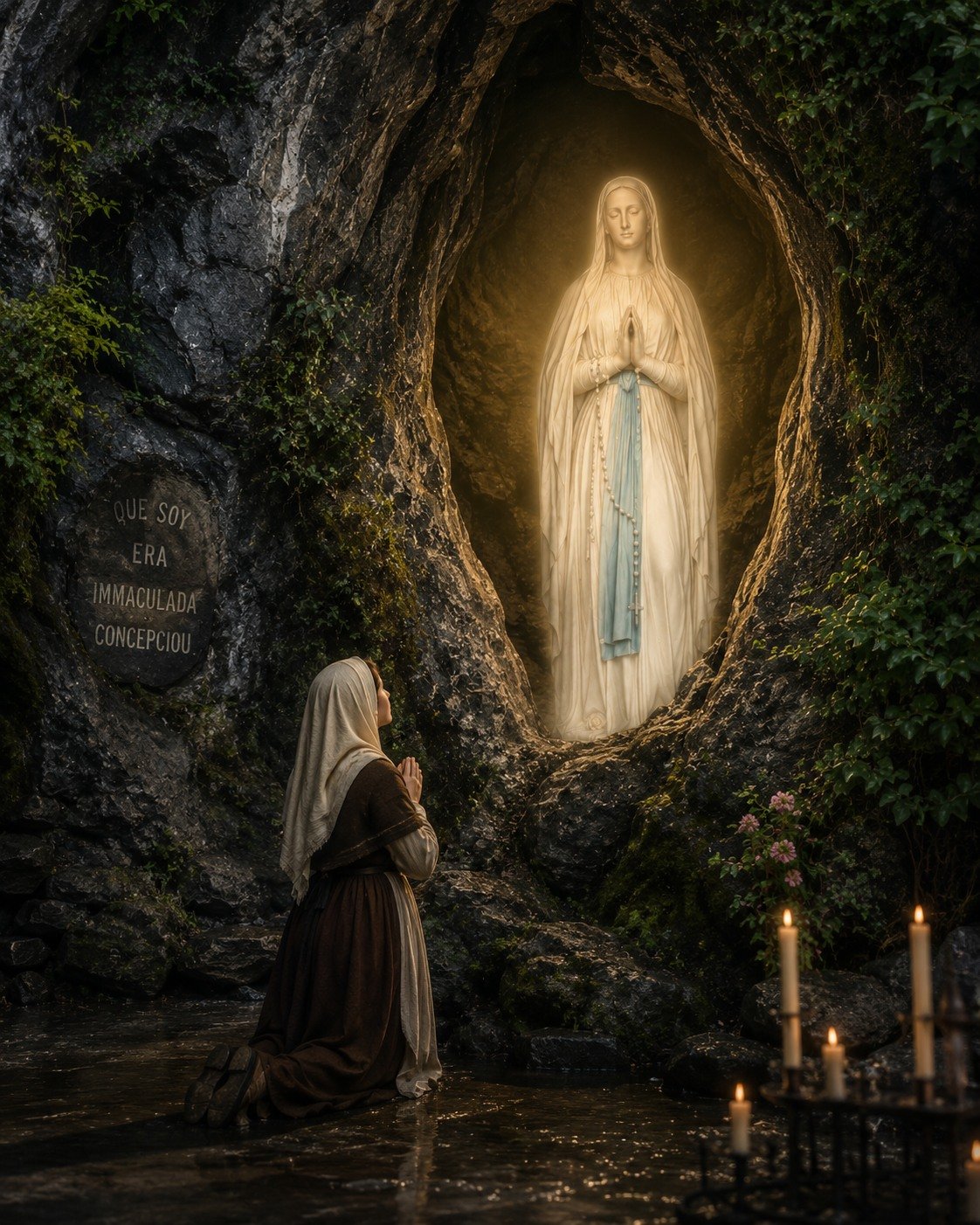
Why this image fits
This generated devotional scene follows the established Lourdes identity: the Grotto of Massabielle, Mary in white with a blue sash and rosary, and St. Bernadette in prayer. It is source-grounded devotional artwork, not a historical photograph.
- Credit
- Existing To God Be Glory devotional artwork.
- License
- Original generated artwork for To God Be Glory
Verification sources
Our Lady of Lourdes
On 11 February 1858, fourteen-year-old Bernadette Soubirous, the daughter of an impoverished miller’s family in Lourdes, France, went with companions to gather firewood near the Grotto of Massabielle. There she reported seeing a beautiful young woman dressed in white, with a blue sash and a rosary. Over the next five months Bernadette reported eighteen apparitions, ending on 16 July 1858.
The apparitions unfolded gradually. The Lady asked for prayer and penance for sinners and instructed Bernadette to drink from and wash in a spring. Bernadette dug in the ground, and water began to flow from a place that became the famous Lourdes spring. The apparition also asked that a chapel be built and that people come there in procession.
One of the most important moments occurred on 25 March 1858. After Bernadette repeatedly asked the Lady her name, she reported the answer: “I am the Immaculate Conception.” The phrase was striking because Pope Pius IX had solemnly defined the dogma of the Immaculate Conception only four years earlier, in 1854, and Bernadette herself had little theological education.
Bernadette underwent repeated questioning by civil officials, clergy, and skeptics. Her testimony remained substantially consistent. In January 1862, after an ecclesiastical investigation, Bishop Bertrand-Sévère Laurence of Tarbes formally judged the apparitions worthy of belief and authorized devotion connected with them. Lourdes quickly became one of the world’s great pilgrimage centers.
The shrine became especially associated with the sick, both because of the spring and because of the Church’s careful investigation of claimed healings. The Church does not teach that Lourdes water has magical power; rather, the shrine places healing within prayer, the sacraments, and trust in Christ. Bernadette later entered the Sisters of Charity of Nevers. She died in 1879 and was canonized by Pope Pius XI in 1933.
Pope Pius XII’s 1957 encyclical Le Pèlerinage de Lourdes reviewed the history of the apparitions and emphasized their Christ-centered character. Later popes likewise presented Lourdes as a school of prayer, conversion, Eucharistic devotion, and compassionate care for the sick. The enduring message remains simple: prayer, penance, conversion, humility, and confidence in God through the maternal intercession of Mary.
Church Standing
Formal ecclesiastical recognition. After investigation, Bishop Bertrand-Sévère Laurence of Tarbes declared on 18 January 1862 that the Immaculate Virgin had truly appeared to Bernadette Soubirous and authorized the devotion. Lourdes remains one of the Church’s major international Marian shrines.
References
- Bernadette Soubirous (1844–1879) — Dicastery for the Causes of Saints
- Butler’s Lives of the Saints — Alban Butler
- Torchlight Procession at Lourdes, 13 September 2008 — Pope Benedict XVI
- Catholic Encyclopedia: Notre-Dame de Lourdes — Encyclopedia Press
- Le Pèlerinage de Lourdes — Pope Pius XII
- Magisterium AI source-backed research page
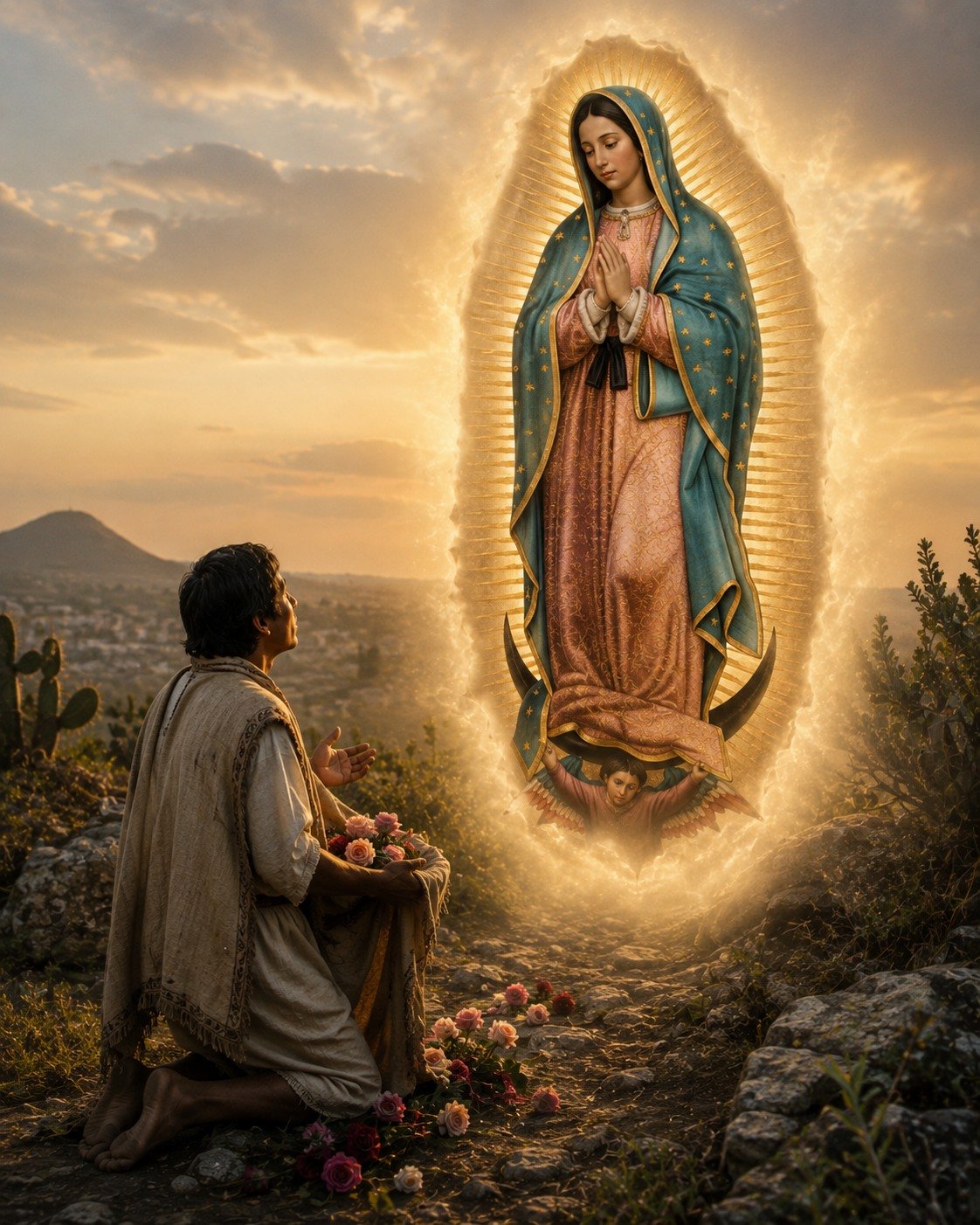
Why this image fits
This generated devotional scene keeps the defining features of the sacred Guadalupe image while placing St. Juan Diego and the roses in the Tepeyac setting. It is a devotional interpretation grounded in the tilma and traditional account.
- Credit
- Generated by OpenAI for To God Be Glory; source-grounded devotional interpretation.
- License
- Original generated artwork for To God Be Glory
Verification sources
Our Lady of Guadalupe
The Guadalupan event is traditionally dated to 9–12 December 1531, only a decade after the Spanish conquest of the Aztec capital. Juan Diego Cuauhtlatoatzin, an Indigenous Christian convert, was walking near Tepeyac Hill when he reported encountering the Blessed Virgin Mary. According to the traditional account preserved in the Nican Mopohua, she asked that a church be built at Tepeyac so that she might show her maternal love and compassion to the people.
Juan Diego carried the request to Bishop Juan de Zumárraga, who asked for a sign. After further encounters, Mary instructed Juan Diego to gather flowers growing on the hill despite the winter season. He collected them in his tilma. When he opened the cloak before the bishop, the flowers fell and the image now venerated as Our Lady of Guadalupe appeared on the fabric.
The apparition story is inseparable from the evangelization of Mexico. Mary’s appearance and the image on the tilma were received in a cultural setting where Indigenous peoples were undergoing immense political and social disruption. Popes have repeatedly presented Guadalupe as an outstanding example of evangelization that enters a culture without destroying its legitimate identity. St. John Paul II called Juan Diego a model of holiness and highlighted his humility, faith, charity, and evangelical poverty.
A chapel was soon erected at Tepeyac to house the tilma, and Juan Diego lived nearby for years, caring for the shrine and speaking with pilgrims. The devotion grew rapidly. Over the centuries larger churches were built, culminating in the modern Basilica of Our Lady of Guadalupe, where the tilma remains on display.
The Church’s recognition of Guadalupe developed through enduring public devotion, liturgical celebration, papal acts, and the canonization of Juan Diego in 2002. Pope Pius XII referred to the long history of the shrine and the canonical crowning of the image. Later popes repeatedly visited or honored Guadalupe, presenting Mary there as Mother of the Americas and a sign of unity and evangelization.
Theologically, Guadalupe does not add a new revelation to the Gospel. Its enduring significance lies in Mary’s maternal presence directing people toward Christ, the dignity of Indigenous peoples, the inculturation of the Gospel, care for the poor and marginalized, and confidence in God during fear and upheaval.
Church Standing
Deeply established in the life of the Catholic Church through centuries of public devotion, the Basilica and shrine at Tepeyac, the liturgical Feast of Our Lady of Guadalupe, papal teaching, and the canonization of St. Juan Diego. Popes repeatedly speak of Mary’s appearance to Juan Diego and present Guadalupe as a decisive event in the evangelization of the Americas. Its ecclesial reception developed historically rather than through the same kind of modern diocesan apparition decree seen at Lourdes or Fátima.
References
- Juan Diego Cuauhtlatoatzin (1474–1548) — Dicastery for the Causes of Saints
- Catholic Encyclopedia: Shrine of Guadalupe — Encyclopedia Press
- Beatification at the Shrine of Saint Mary of Guadalupe, 6 May 1990 — Pope John Paul II
- Radio Message for the Canonical Crowning Anniversary, 12 October 1945 — Pope Pius XII
- Mass at the Basilica of Our Lady of Guadalupe, 13 February 2016 — Pope Francis
- Inauguration of the Virgin of Guadalupe Chapel in the Vatican Crypt, 12 May 1992 — Pope John Paul II
- Pastoral Visit to Mexico, 24 January 1999 — Pope John Paul II
- Magisterium AI source-backed research page
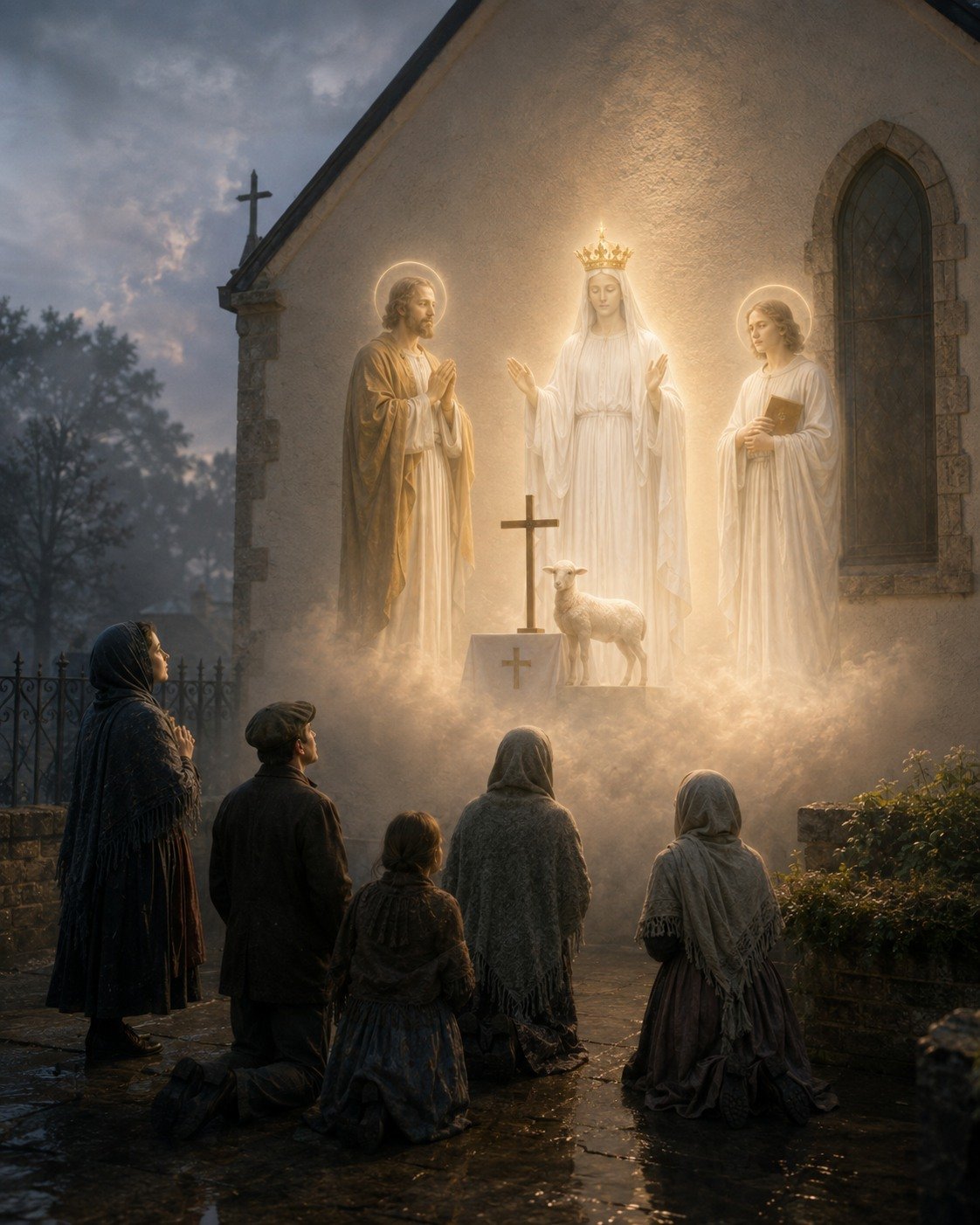
Why this image fits
This generated devotional scene follows the witnesses’ description of Mary, St. Joseph, St. John, the Lamb and the cross at the gable of the parish church. It is source-grounded devotional artwork, not a historical photograph.
- Credit
- Generated by OpenAI for To God Be Glory; source-grounded devotional interpretation.
- License
- Original generated artwork for To God Be Glory
Verification sources
Our Lady of Knock
On the evening of 21 August 1879, in the village of Knock in County Mayo, Ireland, witnesses reported an extraordinary silent apparition at the south gable of the parish church. The scene included the Blessed Virgin Mary, St. Joseph, St. John the Evangelist, and, to the left of the figures, an altar bearing a lamb with a cross behind it. The apparition occurred during heavy rain, yet witnesses said the figures and the ground immediately around them remained luminous and unaffected.
The witnesses were men, women, and children of different ages. They described Mary as standing in prayer, with her hands and eyes raised toward heaven. St. Joseph stood respectfully inclined toward her. St. John appeared dressed as a bishop and seemed to be preaching, with a book in his hand. The altar, Lamb, and cross gave the apparition a distinct Eucharistic and apocalyptic character unlike the spoken messages associated with places such as Lourdes or Fátima.
Because the apparition was entirely silent, Knock has no verbal “message” to interpret. Its significance has instead been drawn from the imagery itself: Mary in prayer, Joseph beside her, John the Evangelist with the Gospel, and Christ symbolized as the Lamb upon the altar. This has helped shape Knock as both a Marian and strongly Eucharistic shrine.
An ecclesiastical commission was established shortly after the event in 1879 and judged the testimony of the principal witnesses to be trustworthy and satisfactory. A second commission in 1936 examined surviving witnesses and additional evidence. Pilgrimage to Knock grew steadily, especially among the Irish people and the sick.
In 1979, the centenary year of the apparition, Pope St. John Paul II came to Knock as a pilgrim. He explicitly referred to 21 August 1879 as a “day of grace” and described Knock as a place where pilgrims renew their faith in the salvation that comes through Jesus Christ. His visit greatly strengthened the shrine’s international standing.
In 2021 the shrine was formally recognized as an International Eucharistic and Marian Shrine. The combination of Mary and the Lamb remains central to Knock’s spiritual identity. The apparition’s enduring invitation is contemplative rather than verbal: prayer, Eucharistic faith, confidence in Christ, and trust in Mary’s maternal presence within the life of the Church.
Church Standing
Ecclesiastically investigated and positively received. The 1879 commission judged the witnesses’ testimony, taken as a whole, trustworthy and satisfactory; a second commission examined the surviving witnesses in 1936. Knock has since been strongly received by the Church through pilgrimage and papal visits, and in 2021 Pope Francis elevated it to the status of an International Eucharistic and Marian Shrine. This is a different form of ecclesial reception from an old-style decree explicitly declaring supernatural character.
References
- Visit to the Shrine of Knock, 30 September 1979 — Pope John Paul II
- To the Irish Bishops, 30 September 1979 — Pope John Paul II / Magisterium source library
- To people working at the Shrine of Knock, 30 September 1979 — Pope John Paul II
- Knock Shrine — official history and pilgrim guide
- Your Time at Knock Shrine — official shrine booklet
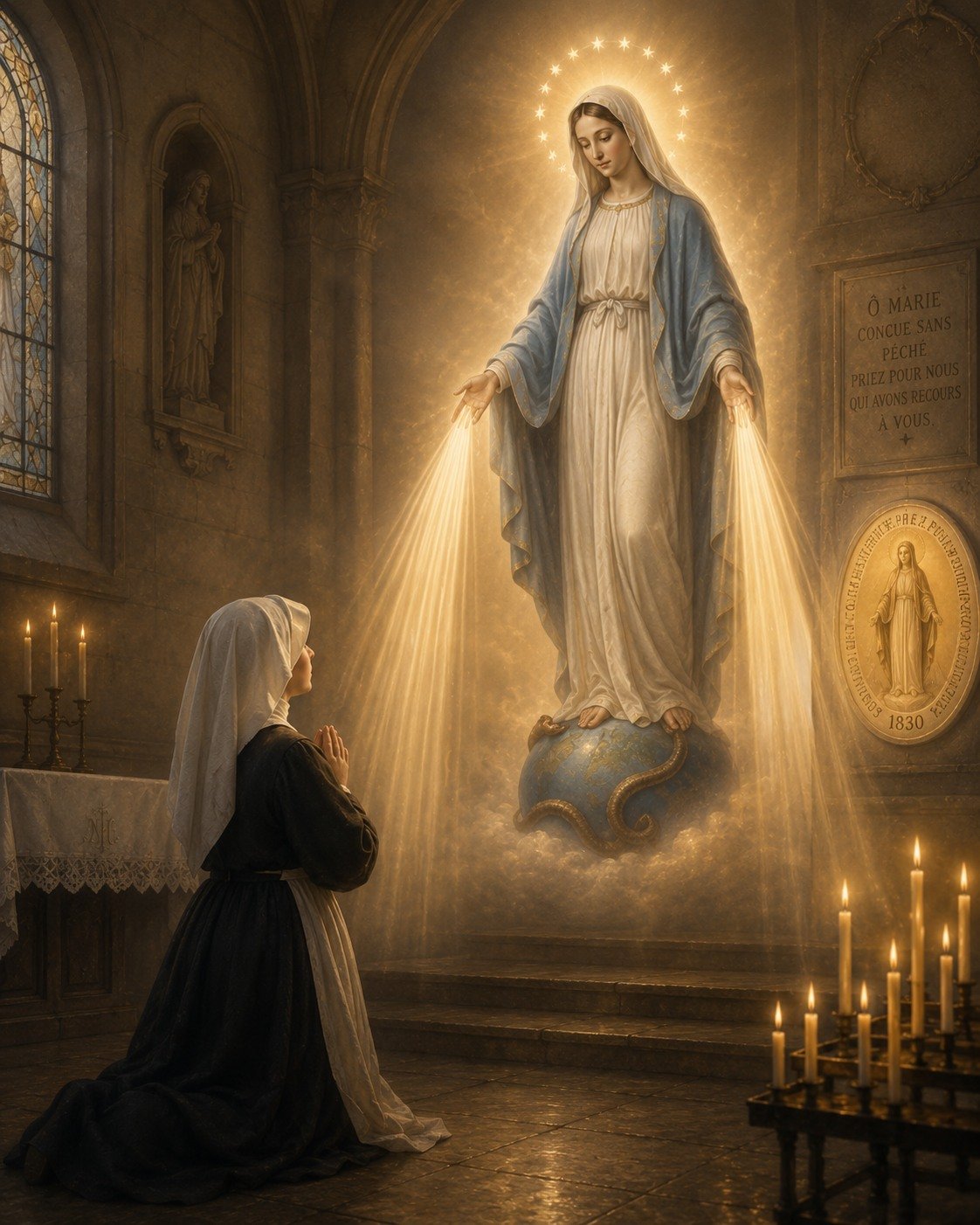
Why this image fits
This generated chapel scene follows the 1830 Rue du Bac vision: Mary with open hands and rays symbolizing graces, with St. Catherine Labouré in prayer. It is source-grounded devotional artwork, not a historical photograph.
- Credit
- Generated by OpenAI for To God Be Glory; source-grounded devotional interpretation.
- License
- Original generated artwork for To God Be Glory
Verification sources
Our Lady of the Miraculous Medal (Rue du Bac)
In 1830, Catherine Labouré was a young novice with the Daughters of Charity at their motherhouse on Rue du Bac in Paris. She later testified that on the night of 18–19 July she was awakened and led to the chapel, where she saw the Blessed Virgin Mary and spoke with her at length. Catherine described this first encounter as deeply personal and maternal.
On 27 November 1830 Catherine reported a second major vision. Mary appeared standing on a globe, with rays of light streaming from jeweled rings on her hands. This iconic image is closely associated in Catholic devotional art with Our Lady of Grace and with the front of the Miraculous Medal. Around her appeared the invocation, “O Mary, conceived without sin, pray for us who have recourse to thee.” Catherine then saw the reverse design that would become associated with the medal: the letter M beneath a cross, with the Sacred Heart of Jesus and the Immaculate Heart of Mary below.
With the help of her confessor, Father Jean-Marie Aladel, the medal was eventually struck and distributed beginning in 1832. Reports of conversions and favors spread rapidly, and the medal came to be called the “Miraculous Medal.” Catherine remained largely hidden during her lifetime; her identity as the visionary was not widely known until shortly before her death. She was canonized in 1947.
The devotion received strong ecclesial acceptance through the approval and spread of the medal, the growth of pilgrimage to the chapel, and the canonization of Catherine Labouré. The apparition is remembered especially for trust in Mary’s intercession, confidence in grace, and the call to turn to Christ through the Immaculate Mother of God.
Church Standing
An established and widely promoted Marian devotion rooted in the 1830 experiences of St. Catherine Labouré at Rue du Bac. The Vatican Directory on Popular Piety explicitly says that the Miraculous Medal has its origin in the apparitions of the Virgin Mary to Catherine, and popes have prayed at and honored the Rue du Bac chapel. The devotion’s Church standing is clear even though it is not normally presented through the same type of formal apparition decree used in some other cases.
References
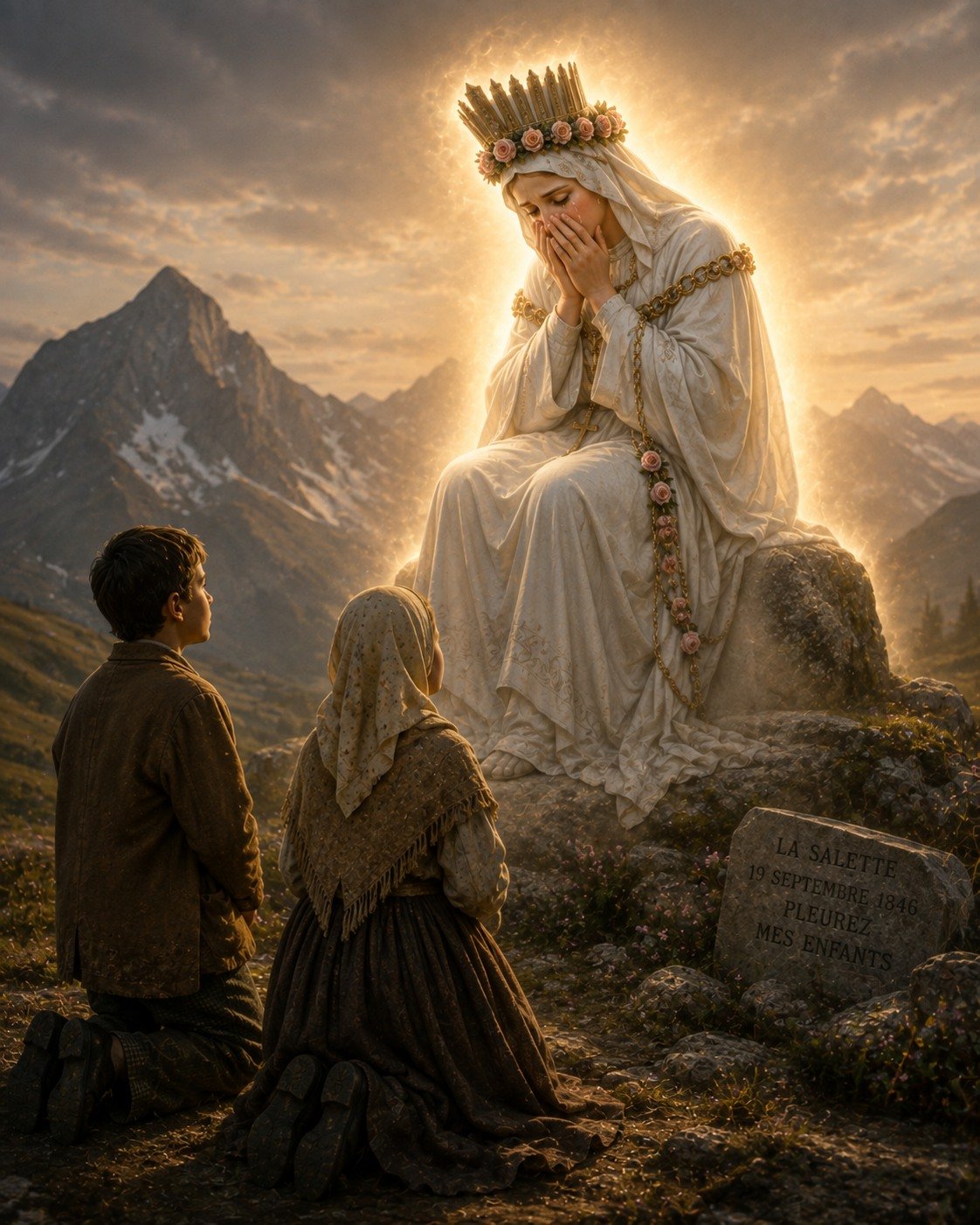
Why this image fits
This generated Alpine scene follows the established La Salette tradition of the weeping Virgin and the two young shepherds, Mélanie Calvat and Maximin Giraud. It is source-grounded devotional artwork.
- Credit
- Generated by OpenAI for To God Be Glory; source-grounded devotional interpretation.
- License
- Original generated artwork for To God Be Glory
Verification sources
Our Lady of La Salette
On 19 September 1846, two young shepherds, Mélanie Calvat and Maximin Giraud, were tending cattle near the village of La Salette in the French Alps. They reported seeing a brilliant light and, within it, a beautiful woman seated with her face in her hands, weeping. She then stood and spoke to them.
The message centered on conversion, prayer, fidelity to Sunday worship, reverence for the name of God, and repentance from sin. The children said Mary lamented the religious indifference of many Christians and warned of hardships if people did not return to God. The apparition ended with Mary ascending and disappearing into light.
The Bishop of Grenoble, Philibert de Bruillard, appointed commissions to investigate the event, the visionaries, and the spiritual fruits. On 19 September 1851 he formally declared that the apparition bore the characteristics of truth and that the faithful were justified in believing it. A sanctuary was subsequently built at the site and entrusted to missionaries who became known as the Missionaries of Our Lady of La Salette.
La Salette has remained a major place of reconciliation and penance. Its enduring spiritual emphasis is not curiosity about predictions, but the Gospel call to conversion, prayer, sacramental life, and renewed fidelity to God.
Church Standing
Formal diocesan recognition under the Church’s earlier procedures. After investigation, Bishop Philibert de Bruillard of Grenoble declared on 19 September 1851 that the apparition bore the characteristics of truth and that the faithful had good grounds to believe it. His successor confirmed that judgment after a further inquiry in 1855.
References
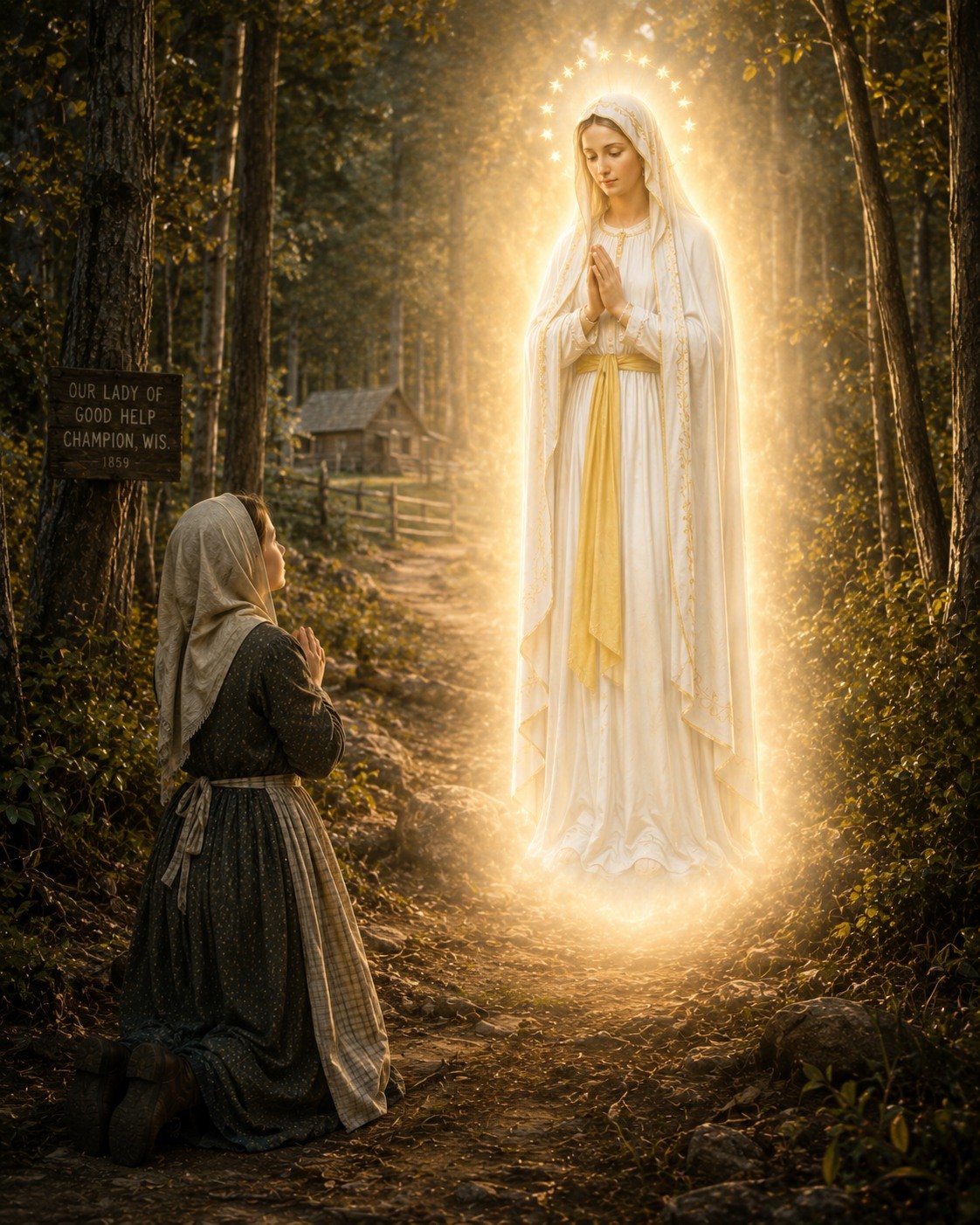
Why this image fits
This generated woodland scene follows the Champion tradition of Mary appearing to Adele Brise in rural Wisconsin, between trees, in a bright white garment with a gold sash. It is source-grounded devotional artwork, not a historical photograph.
- Credit
- Generated by OpenAI for To God Be Glory; source-grounded devotional interpretation.
- License
- Original generated artwork for To God Be Glory
Verification sources
Our Lady of Champion (Our Lady of Good Help)
In October 1859, Adele Brise, a Belgian immigrant living with her family in northeastern Wisconsin, reported three encounters with a radiant woman along a wooded path. On the third encounter, after seeking advice from her parish priest, Adele asked the woman who she was and what she desired. Adele understood the woman to identify herself as the Queen of Heaven and to call her to pray for the conversion of sinners.
The message entrusted to Adele was strongly missionary. She was directed to gather children, teach them what they needed to know for salvation, instruct them in the catechism, and show them how to approach the sacraments. Adele devoted the rest of her life to this work, traveling through the region to teach children and eventually forming a community of women who assisted in the mission.
A small chapel was built at the site in 1859, and pilgrimages developed there. The shrine later became associated with the 1871 Peshtigo Fire, when people gathered at the chapel and prayed while the surrounding region burned; the chapel grounds survived.
After a formal diocesan investigation, Bishop David Ricken of Green Bay issued a decree on 8 December 2010 judging the 1859 events worthy of belief. The shrine is now known as the National Shrine of Our Lady of Champion. The spiritual emphasis of the apparition is practical and evangelical: conversion, prayer, catechesis, sacramental life, and faithful service to others.
Church Standing
Formal diocesan approval under the Church’s earlier norms. On 8 December 2010, Bishop David Ricken of Green Bay declared with moral certainty that the 1859 events, apparitions, and locutions given to Adele Brise exhibited the substance of supernatural character and approved them as worthy of belief. The site was later designated a National Shrine by the U.S. bishops.
References
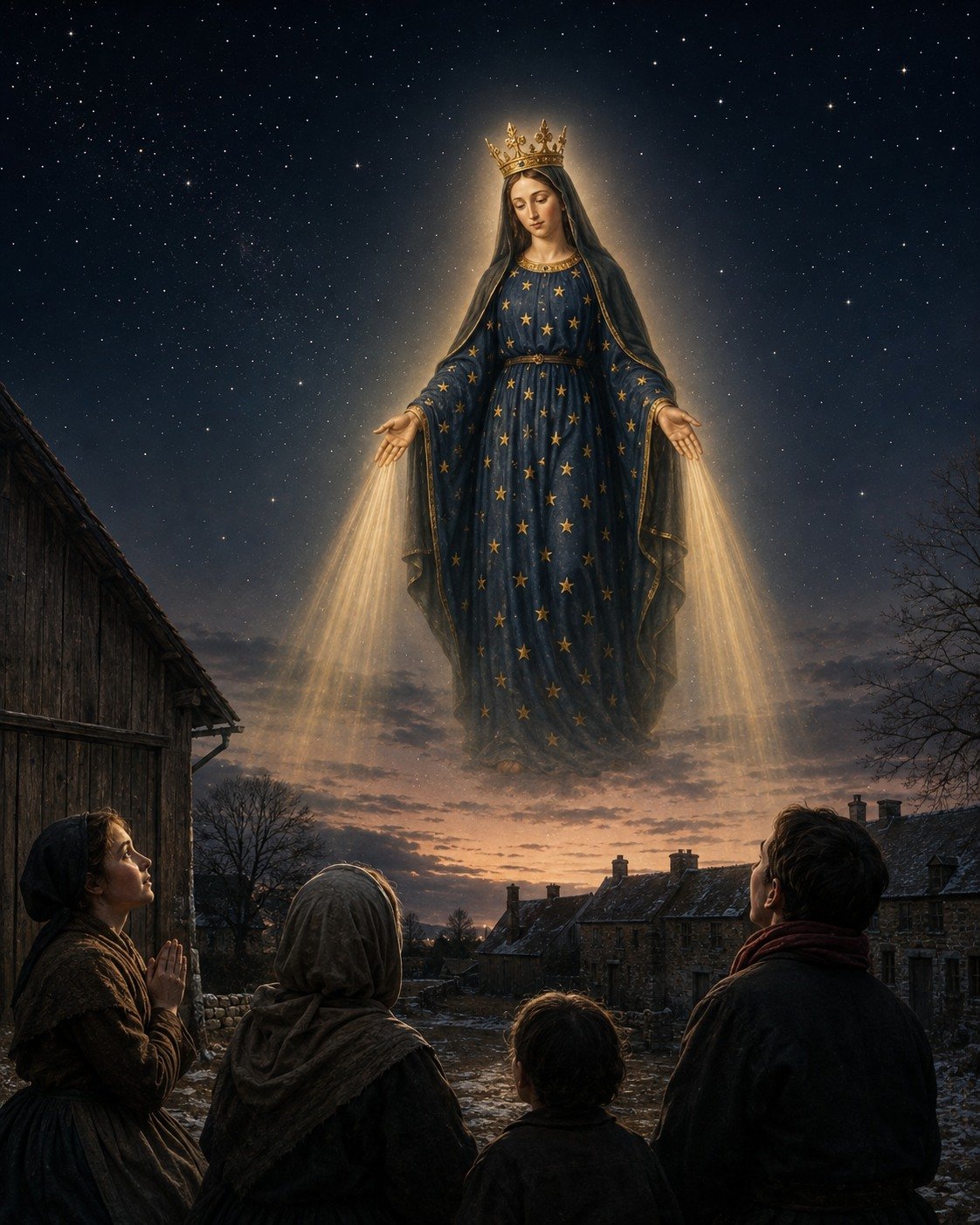
Why this image fits
This generated night scene follows the distinctive Pontmain tradition: Mary in a dark blue star-covered garment and crown appearing above the village to the children. It is source-grounded devotional artwork.
- Credit
- Generated by OpenAI for To God Be Glory; source-grounded devotional interpretation.
- License
- Original generated artwork for To God Be Glory
Verification sources
Our Lady of Pontmain (Our Lady of Hope)
On the evening of 17 January 1871, while the Franco-Prussian War was bringing fear and uncertainty to western France, several children in the village of Pontmain reported seeing a beautiful woman in the sky. The principal young witnesses included Eugène and Joseph Barbedette, Françoise Richer, and Jeanne-Marie Lebossé.
As villagers gathered and prayed, the children described the apparition changing in appearance. A written message seemed to unfold beneath Mary: “But pray, my children. God will answer you in a short time. My Son allows himself to be moved.” The apparition lasted for about three hours and ended as the community continued praying.
Following an investigation, Bishop Casimir Wicart of Laval formally recognized the apparition on 2 February 1872 and authorized devotion under the title Our Lady of Hope of Pontmain. A large basilica was eventually constructed at the site.
Pontmain remains closely associated with confidence in God during crisis. Its message is strikingly simple: persevere in prayer, do not surrender to fear, and trust that Christ hears the petitions of his people.
Church Standing
Formal diocesan recognition. On 2 February 1872, Bishop Casimir Wicart of Laval officially recognized the apparition of 17 January 1871 and authorized the devotion. The sanctuary later became a basilica and remains a place of pilgrimage centered on prayer and hope.
References
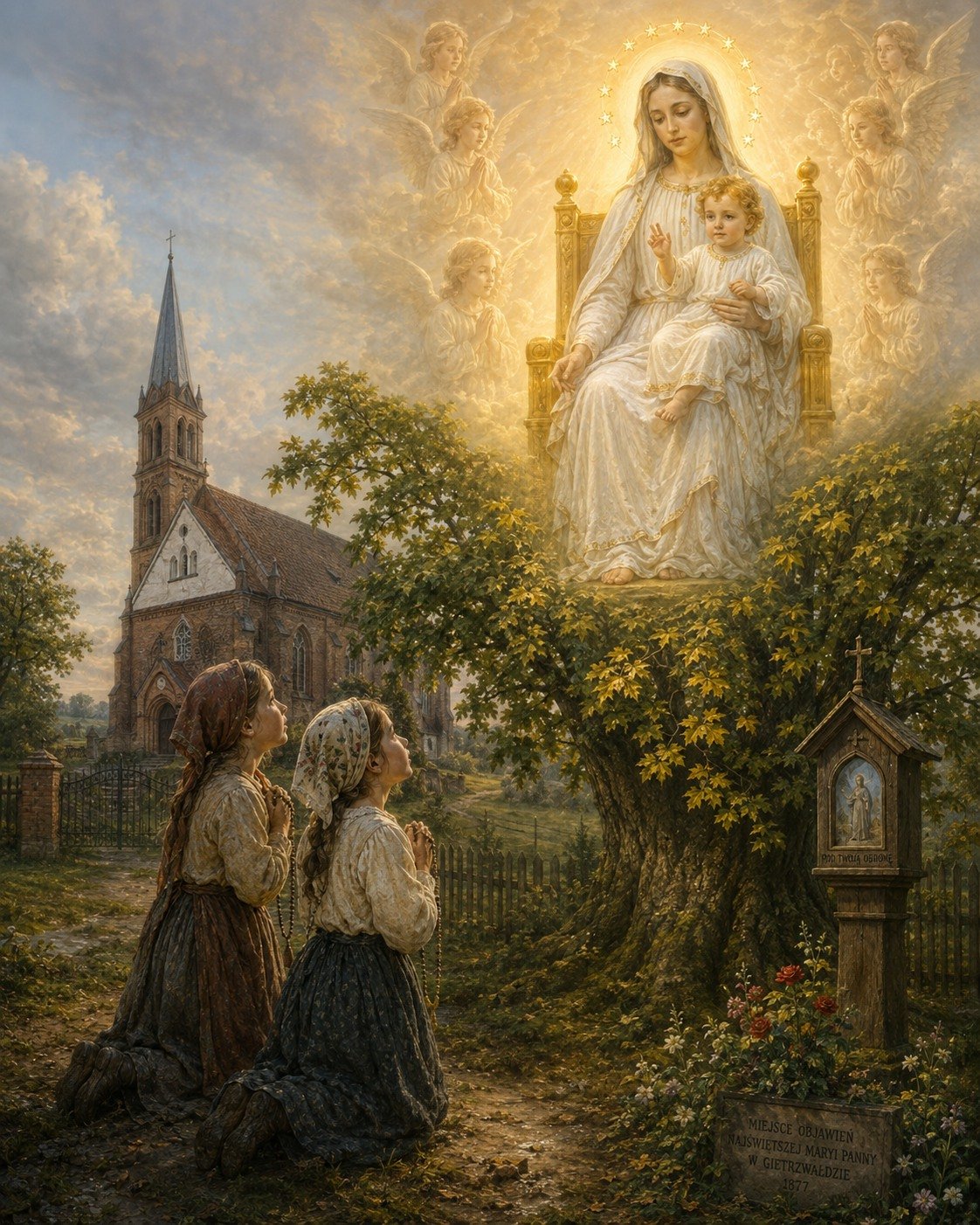
Why this image fits
This generated devotional scene places the recognized Gietrzwałd Marian tradition in its Polish village and church setting with the young visionaries. It is source-grounded devotional artwork.
- Credit
- Generated by OpenAI for To God Be Glory; source-grounded devotional interpretation.
- License
- Original generated artwork for To God Be Glory
Verification sources
Our Lady of Gietrzwałd
From 27 June to 16 September 1877, two young girls, Justyna Szafryńska and Barbara Samulowska, reported repeated apparitions of the Blessed Virgin Mary near the parish church in Gietrzwałd, then part of East Prussia. The events drew large crowds and occurred during a period when Polish Catholic identity was under strong cultural and political pressure.
The girls said that Mary spoke to them in Polish. The messages emphasized prayer, conversion, trust in God, and especially the daily recitation of the Rosary. A spring associated with the apparition site became a place of pilgrimage and prayer.
The events were investigated by Church authorities. On the centenary in 1977, Bishop Józef Drzazga of Warmia issued a decree approving devotion connected with the apparitions and acknowledging their religious credibility. Gietrzwałd is commonly described as the only Marian apparition in Poland with formal ecclesiastical recognition.
The shrine’s spirituality remains centered on prayer, family faith, fidelity to the Church, and perseverance under hardship.
Church Standing
Formal diocesan recognition. On 11 September 1977, Bishop Józef Drzazga of Warmia issued a decree recognizing the supernatural character of the 1877 events at Gietrzwałd. The shrine continues as a major Polish Marian pilgrimage center.
References
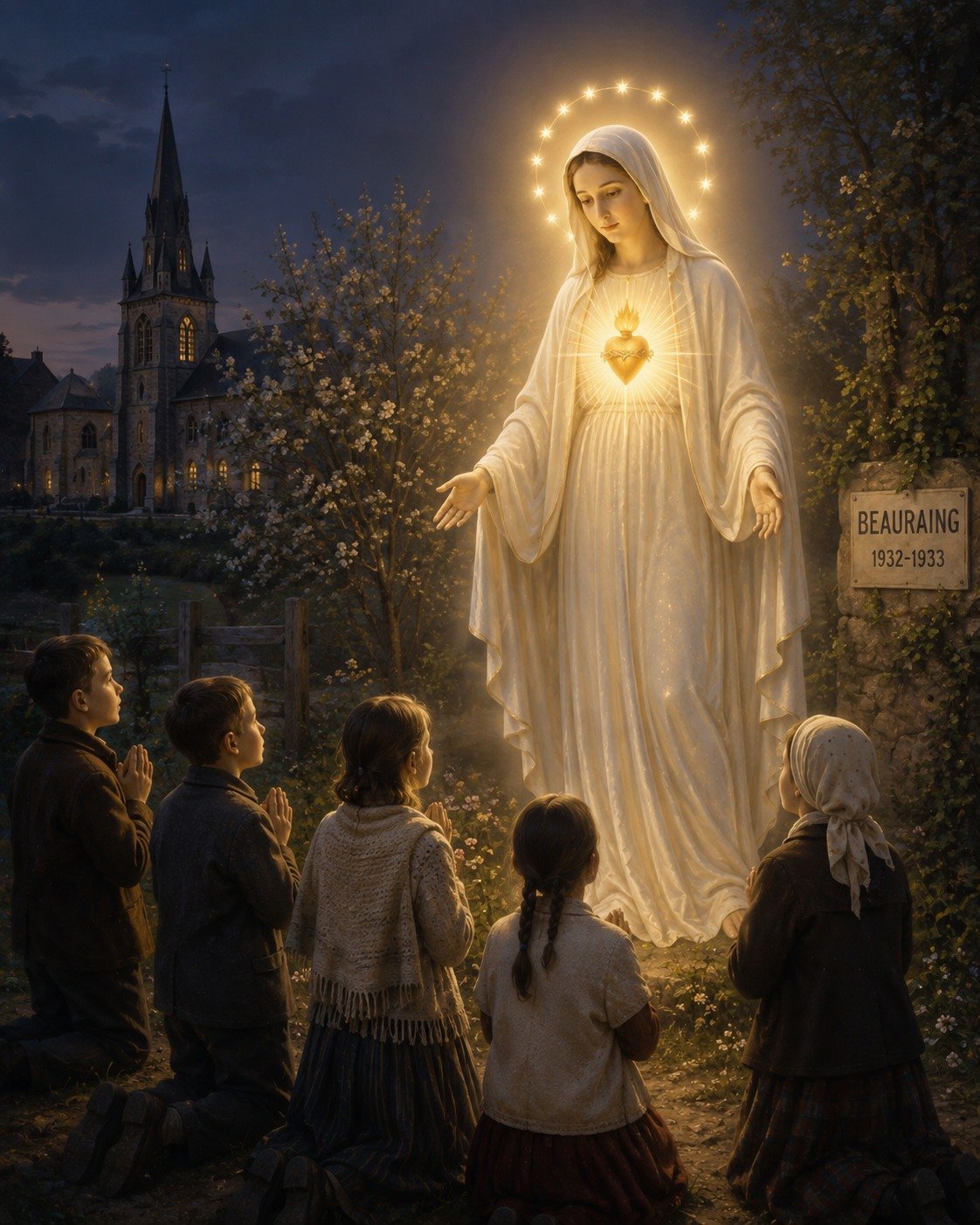
Why this image fits
This generated twilight scene follows Beauraing’s established iconography, especially Mary in white and the illuminated Golden Heart, with the five children. It is source-grounded devotional artwork.
- Credit
- Generated by OpenAI for To God Be Glory; source-grounded devotional interpretation.
- License
- Original generated artwork for To God Be Glory
Verification sources
Our Lady of Beauraing (Virgin of the Golden Heart)
Between 29 November 1932 and 3 January 1933, five children in Beauraing, Belgium, reported a series of apparitions of the Blessed Virgin Mary near a convent school. The children were Fernande, Gilberte and Albert Voisin, and Andrée and Gilberte Degeimbre.
They described Mary as dressed in white and later showing a radiant golden heart. The messages included requests for prayer, a chapel, pilgrimage, and the conversion of sinners. The title “Virgin of the Golden Heart” became closely associated with the shrine.
Church authorities investigated the reports over many years. Public devotion was authorized in 1943. On 2 July 1949, Bishop André-Marie Charue of Namur formally recognized the supernatural character of the apparitions, with the assent of the Holy See.
Beauraing developed into an international pilgrimage center. Pope St. John Paul II visited the site in 1985. The enduring message centers on prayer, conversion, love of God, and confidence in Mary’s maternal heart.
Church Standing
Formal diocesan recognition. Public devotion was authorized during the investigation, and on 2 July 1949 Bishop André-Marie Charue of Namur formally recognized the authenticity of the Beauraing events after years of theological and medical study.
References
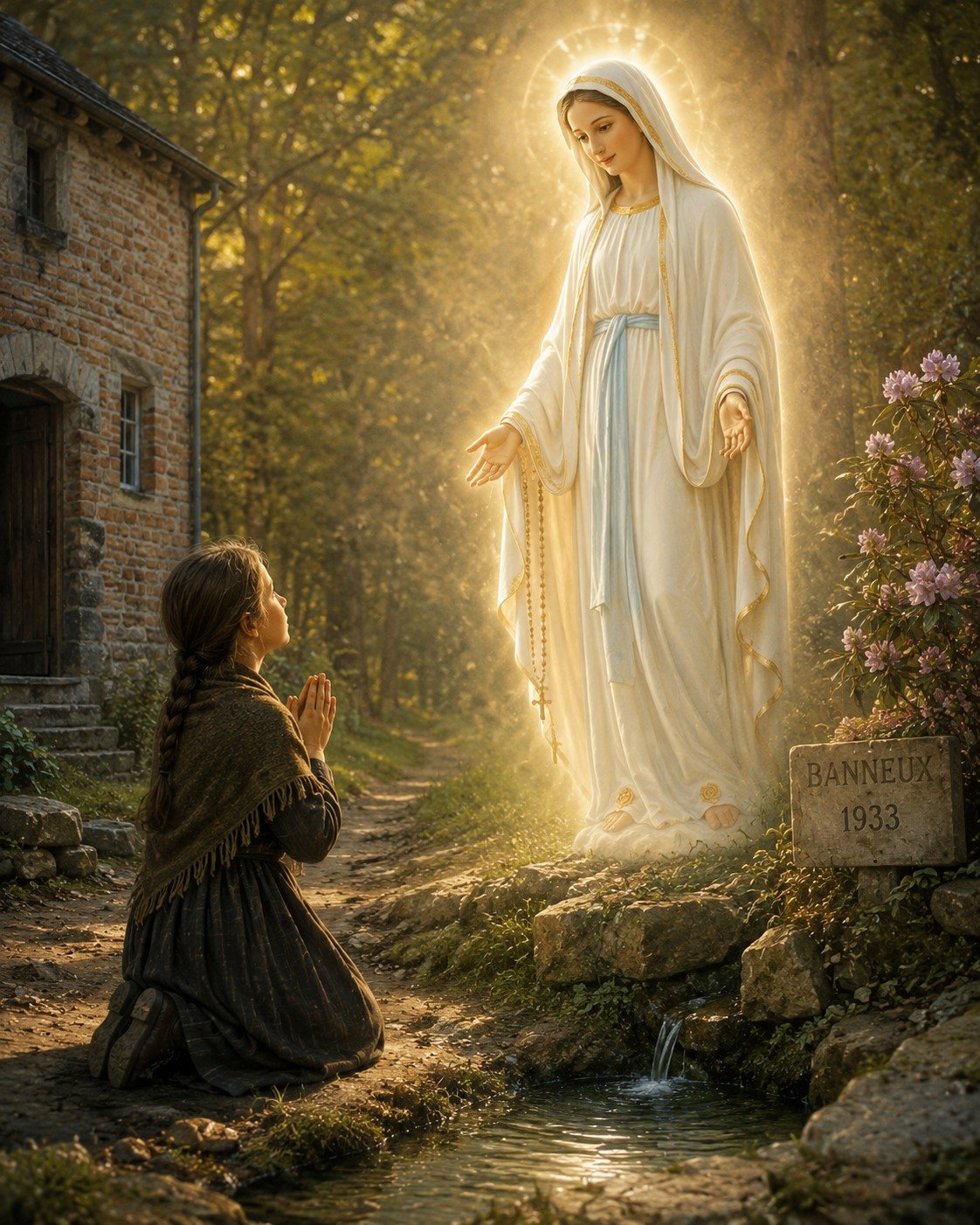
Why this image fits
This generated scene follows the Banneux tradition of Our Lady of the Poor, Mariette Beco, the white-and-blue Marian figure, rosary and spring. It is source-grounded devotional artwork.
- Credit
- Generated by OpenAI for To God Be Glory; source-grounded devotional interpretation.
- License
- Original generated artwork for To God Be Glory
Verification sources
Our Lady of Banneux (Our Lady of the Poor)
From 15 January to 2 March 1933, twelve-year-old Mariette Beco reported eight apparitions of the Blessed Virgin Mary in Banneux, a small village near Liège, Belgium. The events began outside the family home and later centered on a nearby spring.
Mariette said Mary identified herself as the “Virgin of the Poor” and told her that the spring was reserved for all nations and for the sick. The messages were brief and emphasized prayer, compassion, and trust. The simplicity of the encounters became a distinctive feature of Banneux spirituality.
After prolonged investigation, Bishop Louis-Joseph Kerkhofs of Liège definitively recognized the reality of the apparitions on 22 August 1949. Pope St. John Paul II later commemorated the fiftieth anniversary of that recognition and referred explicitly to Mary’s appearance at Banneux as a messenger of peace.
The shrine continues to receive pilgrims, especially the sick and poor. Its spiritual emphasis is solidarity with suffering people, hope in God, and Mary’s maternal concern for those in need.
Church Standing
Formal diocesan recognition. In his pastoral letter of 22 August 1949, Bishop Louis-Joseph Kerkhofs of Liège recognized without reserve the reality of the eight apparitions to Mariette Beco. The local Church has repeatedly reaffirmed that recognition, and Banneux remains an international place of prayer for the poor and the sick.
References
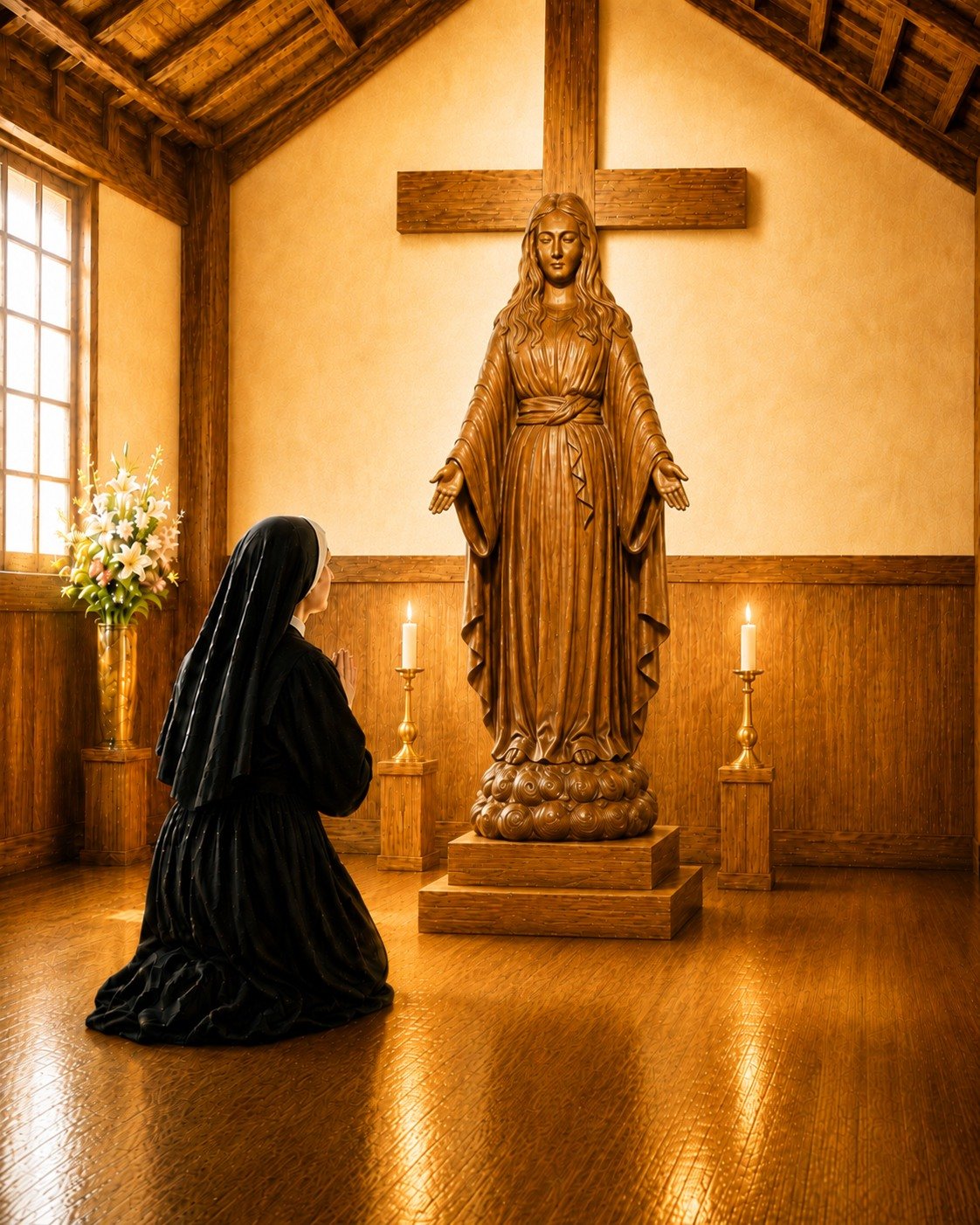
Why this image fits
This generated chapel scene is based on the actual unpainted wooden Our Lady of Akita statue carved by Saburo Wakasa in 1963. The statue is intentionally shown as carved wood while the lighting and praying sister give the scene a living devotional quality; the tears recall the reported lacrimations. It is not presented as a historical photograph.
- Credit
- Generated by OpenAI for To God Be Glory; source-grounded devotional interpretation.
- License
- Original generated artwork for To God Be Glory
Verification sources
Our Lady of Akita
In 1973, Sister Agnes Sasagawa, a member of the Handmaids of the Holy Eucharist in Akita, Japan, reported a series of interior locutions and messages associated with a wooden statue of the Blessed Virgin Mary. The reports included calls to prayer, repentance, reparation, and fidelity to God.
The statue was also associated with reports of unexplained bleeding and later repeated weeping witnessed by many people. The phenomena attracted considerable attention and were investigated by the local Church.
In 1984 Bishop John Shojiro Ito of Niigata authorized veneration connected with the events within his diocese and judged that there were no obstacles to accepting the events as worthy of belief. This was a local episcopal judgment; it should not be described as a universal Vatican declaration of supernatural authenticity.
Akita is therefore presented here with that precise status: an apparition tradition approved for devotion by the competent local bishop. Its spiritual themes echo familiar Catholic calls to prayer, penance, Eucharistic faith, and conversion.
Church Standing
Local episcopal recognition and authorization of devotion. In 1984 Bishop John Shojiro Ito of Niigata stated that he recognized the supernatural character of the series of events associated with the statue at Akita and authorized veneration throughout his diocese, while noting that a later judgment by the Holy See could still be made. The entry therefore presents Akita according to that local episcopal judgment and does not describe it as having received a later universal Vatican declaration.
References
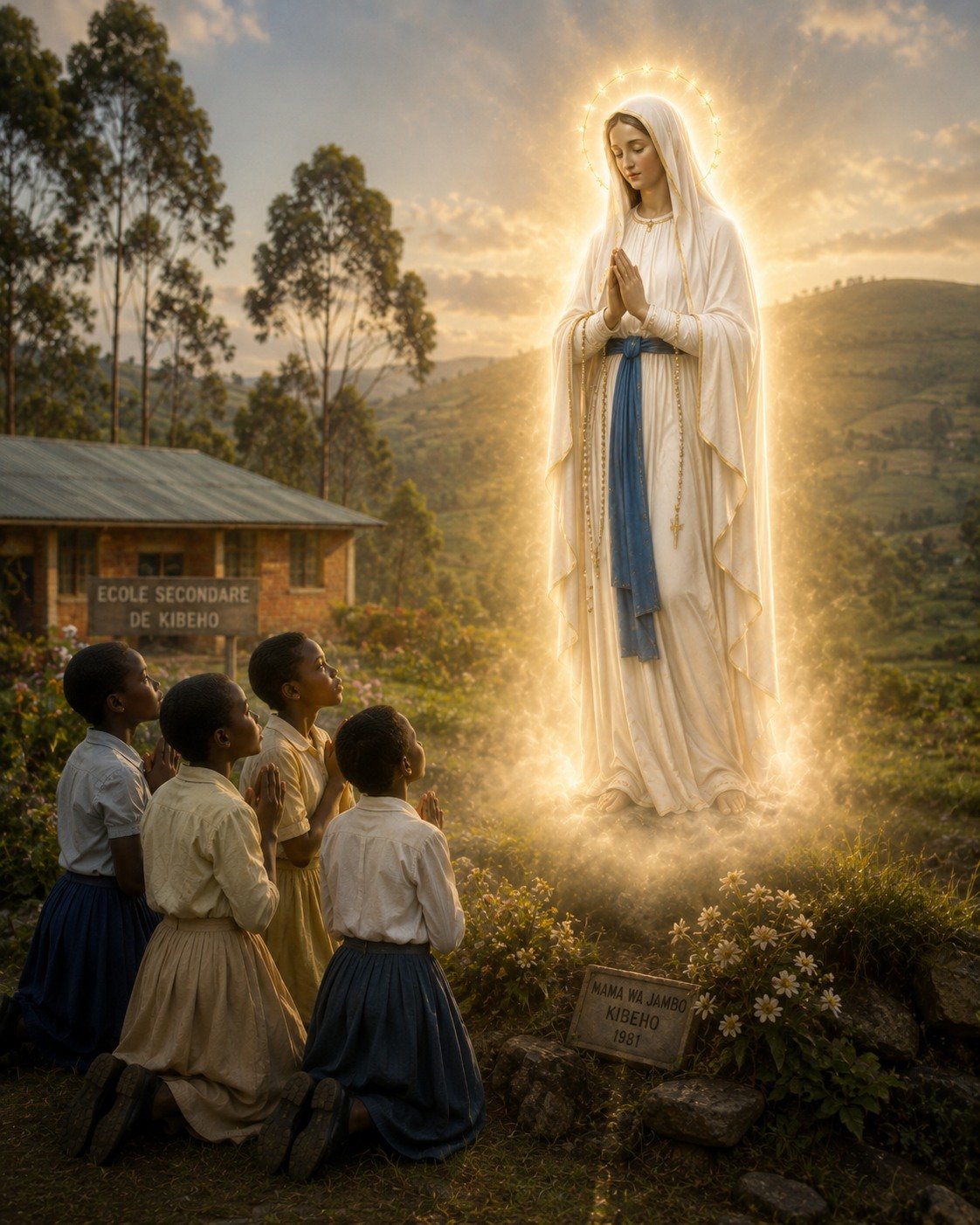
Why this image fits
This generated Rwandan scene follows the established Mother of the Word devotion and places the young visionaries in the Kibeho school and hillside setting. It is source-grounded devotional artwork.
- Credit
- Generated by OpenAI for To God Be Glory; source-grounded devotional interpretation.
- License
- Original generated artwork for To God Be Glory
Verification sources
Our Lady of Kibeho (Mother of the Word)
The reported apparitions at Kibeho began on 28 November 1981 at a girls’ school in Rwanda. Over time many people claimed visions, but the Church’s investigation focused particularly on the earliest visionaries. The principal recognized witnesses are Alphonsine Mumureke, Nathalie Mukamazimpaka, and Marie-Claire Mukangango.
The messages attributed to Mary emphasized conversion, repentance, prayer, compassion, and the seriousness of sin. The visionaries also described disturbing visions of violence and suffering. After the 1994 genocide, many interpreted these earlier warnings as especially poignant, though the Church cautions against reducing private revelation to prediction.
Medical and theological commissions studied the events for years. On 29 June 2001, Bishop Augustin Misago of Gikongoro issued a definitive judgment recognizing the apparitions to the first three visionaries. He explicitly distinguished these three from the many later claimants.
Kibeho is among the most important modern Marian apparition sites in Africa. Its enduring spiritual themes are conversion while there is still time, reconciliation, sorrow for sin, compassion, and fidelity to the Gospel.
Church Standing
Formal diocesan judgment concerning specified visionaries. On 29 June 2001, Bishop Augustin Misago of Gikongoro issued his definitive judgment recognizing the apparitions concerning Alphonsine Mumureke, Nathalie Mukamazimpaka, and Marie-Claire Mukangango. His declaration deliberately distinguished those three from the many other people who later claimed visions.
References
Why this image fits
The Miraculous Medal vision is an especially clear modern visual expression of Our Lady of Grace: rays from Mary’s hands symbolize the graces obtained for those who ask. The title itself is older than the 1830 apparition.
- Credit
- Generated by OpenAI for To God Be Glory; source-grounded devotional interpretation.
- License
- Original generated artwork for To God Be Glory
Verification sources
Our Lady of Grace
Our Lady of Grace is a broad Marian title rather than the name of one single apparition. Catholic devotion uses the title to express Mary’s maternal intercession in the life of grace while keeping Christ at the center: grace comes from God, and Mary prays for and helps the faithful to receive what God gives.
The image used on this page is closely connected with the apparitions reported by St. Catherine Labouré at the chapel on Rue du Bac in Paris in 1830. Catherine described Mary standing upon a globe with rays of light streaming from rings on her hands. She understood the rays as graces God grants in response to prayer. Around Mary appeared the invocation, “O Mary, conceived without sin, pray for us who have recourse to thee.”
Catherine’s confessor, Father Jean-Marie Aladel, eventually brought the matter to Archbishop Hyacinthe-Louis de Quélen of Paris. According to the International Miraculous Medal Association’s historical account, the archbishop saw no doctrinal obstacle to striking the medal and ecclesiastical authorization was obtained. The first medals were produced in 1832. They were initially known as the “Medal of Our Lady of Grace,” but reports of favors and conversions led to the popular name “Miraculous Medal.”
The devotion spread rapidly. Pope St. Pius X approved the Miraculous Medal Association in 1909, and its statutes were later approved again by the competent Roman congregation. The Vatican Directory on Popular Piety and the Liturgy explicitly discusses Marian medals and names the Miraculous Medal, tracing its origin to the 1830 apparitions to St. Catherine Labouré.
A 2025 doctrinal note of the Dicastery for the Doctrine of the Faith also explains how titles such as “Mother of Grace” should be understood: Mary does not possess or distribute grace independently of Christ. Rather, through her maternal intercession she helps the faithful open their hearts to the grace that comes from God through Christ in the Holy Spirit.
Church Standing
Established Marian title and Church-approved devotional tradition. The Miraculous Medal is explicitly recognized in the Vatican Directory on Popular Piety, and the international association dedicated to the medal has received pontifical approval. This entry does not treat “Our Lady of Grace” as a separate apparition from the Rue du Bac events.
References
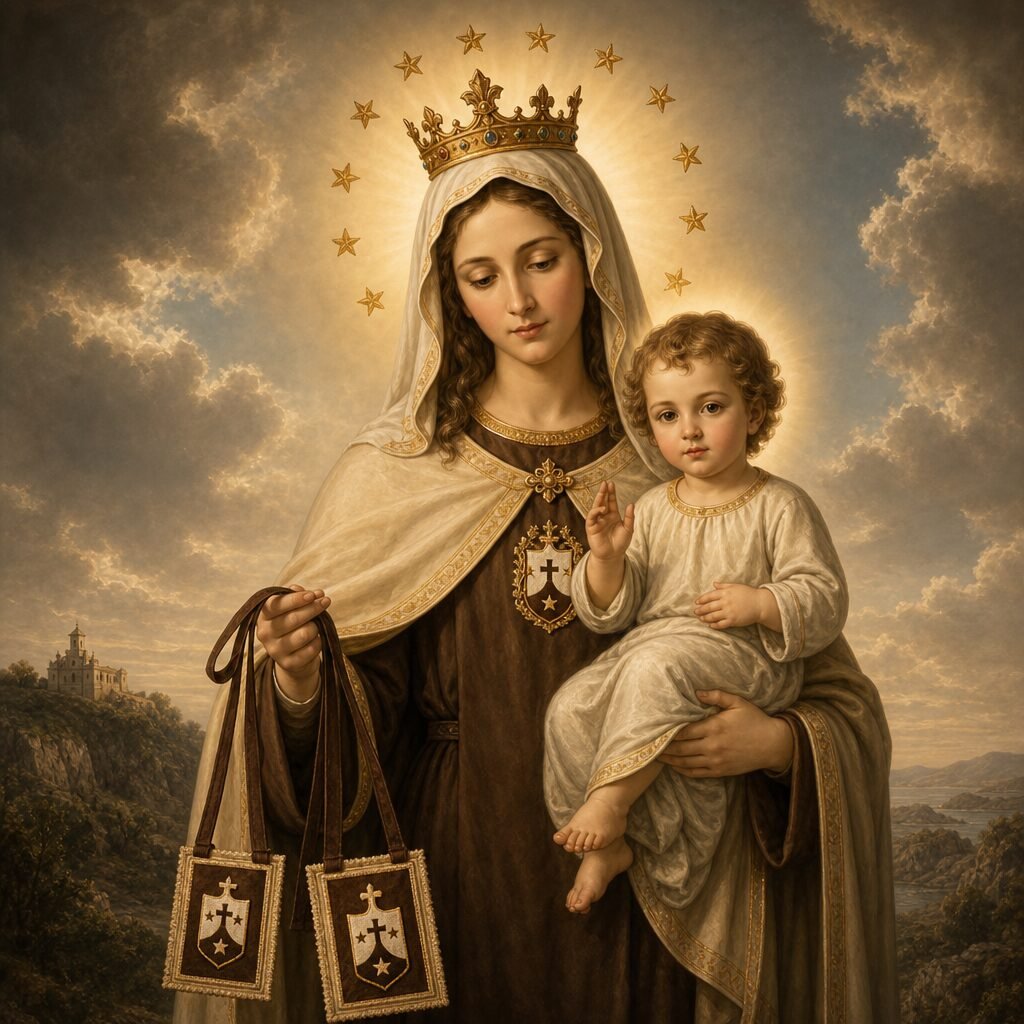
Why this image fits
The image clearly presents the traditional Mount Carmel elements the site wants to emphasize: the Carmelite brown and white, the Child Jesus, and the Brown Scapular.
- Credit
- Existing To God Be Glory devotional artwork.
- License
- Used as existing site artwork
Verification sources
Our Lady of Mount Carmel
Devotion to Our Lady of Mount Carmel grows out of the history and spirituality of the Carmelite Order. Mount Carmel in the Holy Land had long been associated with the prophet Elijah. In the early thirteenth century, a community of Latin hermits living there received a rule of life from St. Albert of Jerusalem. These hermits placed themselves under the patronage of the Blessed Virgin Mary and became known as the Brothers of the Blessed Virgin Mary of Mount Carmel.
As political conditions forced Carmelites to move from the Holy Land into Europe, devotion to Mary under the title of Mount Carmel traveled with them. She came to be honored within the Order as mother, patroness, sister, and model of contemplative discipleship.
St. Simon Stock and the Scapular tradition
According to the venerable Carmelite tradition, in the thirteenth century St. Simon Stock, an English Carmelite who served as a leader of the Order during a difficult period, prayed for Mary’s protection of the Carmelite family. The traditional account relates that the Blessed Virgin appeared to him holding the Carmelite scapular and presented it as a sign of her maternal protection and of belonging to the Carmelite family. This event became inseparably associated with the Brown Scapular devotion.
St. John Paul II spoke positively of this venerable tradition connected with St. Simon Stock while emphasizing the deeper meaning of the Scapular: a Marian way of life directed toward Christ. The Church’s liturgical observance and its encouragement of the Brown Scapular devotion are well established. The historical details of the Simon Stock apparition, however, are presented by the Church as Carmelite tradition rather than as an apparition whose supernatural character has received the same kind of formal ecclesiastical declaration found in cases such as Lourdes or Fátima.
The Brown Scapular developed from the Carmelite religious habit into a small devotional scapular worn by lay Catholics as well. Properly understood, it is not a charm or automatic guarantee of salvation. The Vatican Directory on Popular Piety and the Liturgy describes it as an external sign of a filial relationship with Mary, a reminder of the primacy of the spiritual life and prayer, and a sign connected to being clothed with Christ in Baptism.
The Church’s liturgy commemorates Our Lady of Mount Carmel on July 16. The devotion became so deeply rooted in Catholic life that St. John Paul II noted its expression in this liturgical memorial, and later popes have continued to celebrate and commend the feast.
For Catholics, the enduring point of the devotion is therefore larger than any single historical claim: Mary is honored as the Mother who leads the Carmelite family and the faithful toward prayer, contemplation, fidelity to baptism, and deeper union with Jesus Christ.
Church Standing
Long-established Marian devotion with a liturgical memorial on July 16. The Vatican Directory recognizes the Scapular of Our Lady of Mount Carmel as a widespread Marian devotion recommended by the Magisterium. St. John Paul II explicitly referred to the venerable Carmelite tradition connected with St. Simon Stock while presenting the Scapular above all as a sign of Marian discipleship directed toward Christ. The devotion and liturgical observance are established in the Church; the Simon Stock apparition account is preserved as Carmelite tradition rather than as an apparition with a formal declaration of supernatural character.
References
Why this image fits
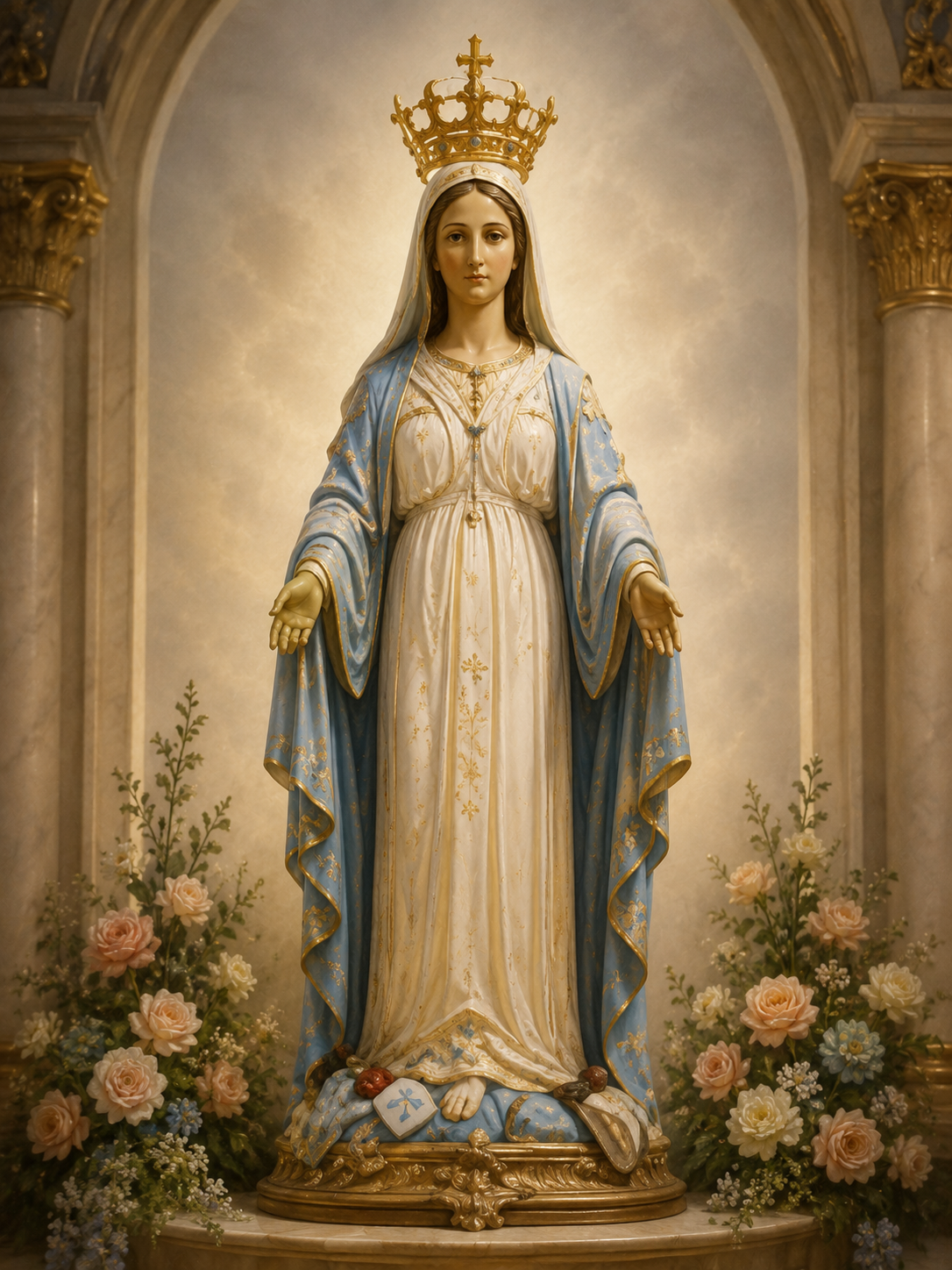
The generated image keeps the historic shrine statue recognizable while presenting a centered full-figure devotional portrait that harmonizes with the surrounding Marian cards.
- Credit
- Generated by OpenAI for To God Be Glory; source-grounded devotional interpretation.
- License
- Original generated artwork for To God Be Glory
Verification sources
Our Lady of the Cape
The devotion to Our Lady of the Cape is centered at Cap-de-la-Madeleine, now part of Trois-Rivières, Québec. Catholic life at the site reaches back to the seventeenth century. A small church was built there in the 1600s, and Father Paul Vachon established a Brotherhood of the Rosary in 1694. The stone church that is now known as the Old Shrine was opened for worship in 1720.
After many decades without a resident pastor, devotion in the parish weakened. In the nineteenth century Father Luc Desilets worked to renew prayer and especially the Rosary. When a larger church became necessary, building stone had to be transported across the St. Lawrence River. The winter of 1879 was unusually mild, but the shrine tradition recounts that after persistent prayer a narrow passage of ice formed across the river, allowing stone to be hauled over. This became known as the Rosary Bridge or ice-bridge tradition.
The old stone church was then preserved and dedicated to Our Lady, Queen of the Most Holy Rosary. On 22 June 1888, during the dedication of what became the Marian shrine, the historic statue of Mary was placed on the altar. Later that evening Father Desilets, Franciscan Father Frédéric Janssoone, and Pierre Lacroix were praying before the statue when they reported that its eyes opened and appeared alive for several minutes. The shrine remembers this event as the “Prodigy” or “Miracle of the Eyes.”
Pilgrimages increased rapidly. Father Frédéric became an important promoter of the shrine and of devotion to Our Lady of the Cape. The statue was canonically crowned in 1904, and the shrine became one of Canada’s major places of Marian pilgrimage. Pope St. John Paul II visited on 10 September 1984, praying there with tens of thousands of pilgrims.
Today the Canadian Conference of Catholic Bishops lists Our Lady of the Cape among Canada’s National Shrines. The Church’s recognition here is therefore especially clear in the life of an established national Marian shrine, its liturgical and pastoral ministry, and the long history of authorized pilgrimage. The ice bridge and the reported opening of the statue’s eyes remain part of the shrine’s devotional history; they need not be presented as a separately adjudicated Marian apparition.
Church Standing
Established Catholic Marian shrine and devotion. The Canadian Conference of Catholic Bishops lists Our Lady of the Cape among Canada’s National Shrines. The shrine has a long history of authorized pilgrimage and papal recognition, including the 1984 pilgrimage of St. John Paul II.
References
Why this image fits
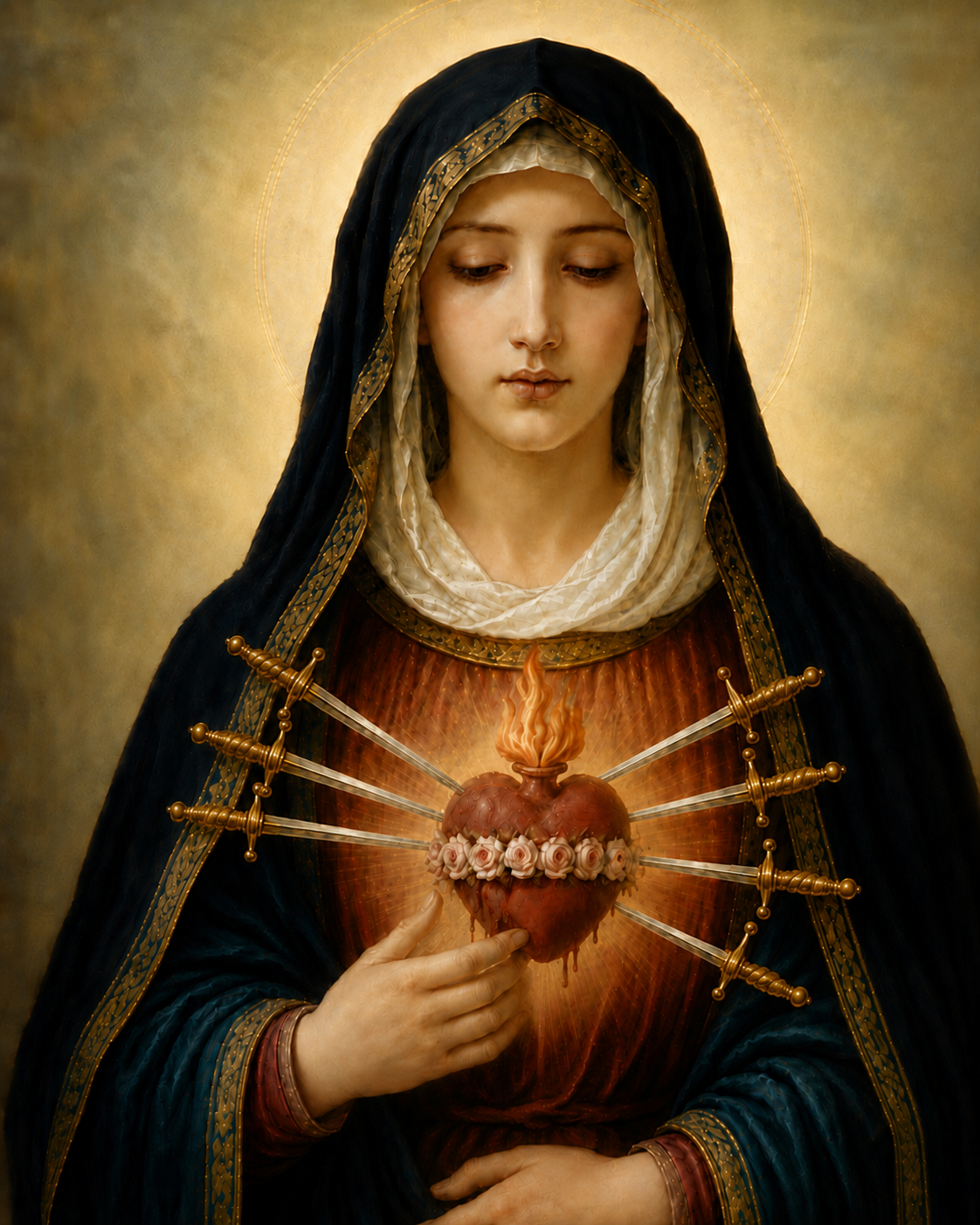
The seven individually visible swords represent the traditional Seven Sorrows of the Blessed Virgin Mary. The Vatican Directory on Popular Piety describes Mary as the woman of sorrows and notes the particular incidents of sorrow contemplated in Christian piety.
- Credit
- Generated by OpenAI for To God Be Glory; approved devotional artwork preserved without alteration.
- License
- Original generated artwork for To God Be Glory
Verification sources
Our Lady of Sorrows
Our Lady of Sorrows is one of the Church’s longstanding ways of contemplating Mary’s participation in the suffering surrounding the life, Passion, and death of Jesus. Its biblical roots are especially clear in Simeon’s prophecy that a sword would pierce Mary’s soul and in the Gospel account of Mary standing beside the Cross.
Over the centuries Catholic devotion gathered particular moments of Mary’s suffering into the traditional Seven Sorrows: the prophecy of Simeon; the flight into Egypt; the loss of the Child Jesus in Jerusalem; Mary meeting Jesus on the way to Calvary; the Crucifixion and death of Jesus; Mary receiving the body of Jesus; and the burial of her Son. The familiar image of a sorrowful Mary pierced by seven swords developed as a visual way of remembering these seven mysteries.
The Servite Order played an especially important role in spreading meditation on the Sorrows of Mary. The devotion was expressed in prayers, the Stabat Mater, the Rosary or Chaplet of the Seven Sorrows, and the Via Matris—a devotional “Way of the Mother” that parallels the Stations of the Cross by contemplating Mary’s sorrows.
The devotion also has a firm place in the Church’s liturgy. The Roman calendar observes the Memorial of Our Lady of Sorrows on September 15, the day after the Feast of the Exaltation of the Holy Cross. The Vatican Directory on Popular Piety and the Liturgy explicitly discusses devotion to the Mother of Sorrows and the Via Matris, showing that this is not merely a private or local custom.
The purpose of the devotion is not to dwell on suffering for its own sake. Mary’s sorrows are contemplated because of her steadfast fidelity to Christ. At Bethlehem, in exile, in uncertainty, and finally beneath the Cross, she remains a disciple who believes, loves, and stays with her Son. Catholics therefore ask Our Lady of Sorrows to help them remain faithful to Christ in grief, fear, illness, bereavement, and other forms of suffering.
Church Standing
Established Marian devotion and universal liturgical memorial. The Roman Church commemorates Our Lady of Sorrows on September 15, and the Vatican Directory on Popular Piety explicitly recognizes the Seven Sorrows and related devotional practices such as the Via Matris.
References
How the Church Views Marian Apparitions
Throughout the history of the Church, reported apparitions of the Blessed Virgin Mary have often called the faithful back to the heart of the Gospel: prayer, conversion, penance, trust in God, devotion to Christ, reception of the sacraments, and concern for the salvation of souls. Some have had a profound and lasting influence on Catholic life, giving rise to major shrines, pilgrimages, devotions, feast days, and renewed spiritual life throughout the world.
Because claims of supernatural events require careful discernment, the Church investigates reported apparitions cautiously. Over the centuries, Church authorities have given different kinds of judgments. Some apparitions received formal recognition of their supernatural character under earlier procedures. Others became associated with approved devotions, shrines, liturgical observances, or longstanding traditions without receiving exactly the same type of formal judgment.
When the Church judges a reported apparition favorably, its message is understood in harmony with the Gospel and the Catholic faith. Authentic Marian apparitions do not replace or alter the faith; rather, they call the faithful more deeply to Christ through prayer, conversion, penance, the sacraments, and greater fidelity to the Gospel.
In 2024, the Dicastery for the Doctrine of the Faith revised the norms for evaluating alleged supernatural phenomena. Under the present norms, the ordinary favorable judgment is a Nihil obstat. This recognizes positive spiritual and pastoral fruits and permits the associated devotion to be appreciated and, when appropriate, encouraged, without ordinarily making a declaration that the event itself has been proven to be of supernatural origin. Earlier judgments made under previous norms remain an important part of the history and Church standing of those apparitions.
For this reason, each entry on this page identifies the particular way in which the Church has received or evaluated it—whether through a formal judgment concerning an apparition, approval of a devotion, recognition of a shrine, establishment of a liturgical celebration, or another form of ecclesiastical recognition.
Scope of this page: This collection focuses specifically on Marian apparitions, Marian devotions, titles, and shrines. It does not attempt to catalogue every form of private revelation in the history of the Church.